Chinese startup Spark Space has successfully completed several consecutive funding rounds to support the development of a new launch vehicle that, according to the company, will become the largest rocket in the world to employ an electrically driven propellant feed system. The investment milestone follows a series of successful hot-fire tests of the vehicle’s propulsion system.
Founded in 2024 and headquartered in Hefei, Spark Space is currently focused on the design and assembly of its Jinhua-1 launch vehicle, also known within engineering circles as Evolution-1. The rocket will be powered by the company’s indigenous Lieyan-2 engine, which utilizes an electric-pump-fed architecture. Company leadership is targeting the vehicle’s inaugural orbital launch in 2027.

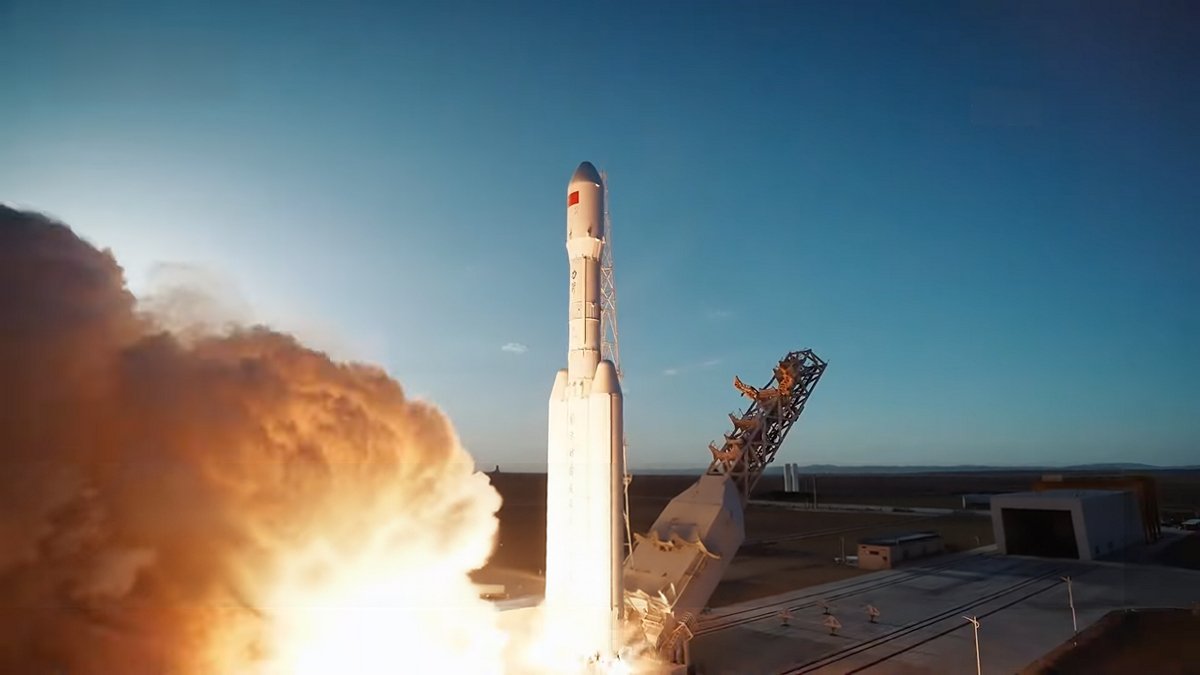
The Jinhua-1 is a two-stage expendable launch vehicle measuring 27.5 m in length with a body diameter of 2.25 m. To power the first stage, engineers plan to install nine Lieyan-2 engines, while the second stage will be equipped with a single vacuum-optimized version of the same engine. Together, these propulsion units are expected to generate a total liftoff thrust of approximately 90 tonnes.
According to company representatives, the rocket will be capable of delivering up to 1,500 kg of payload to low Earth orbit (LEO) and up to 1,000 kg to a sun-synchronous orbit (SSO). By comparison, Rocket Lab’s Electron launch vehicle can carry roughly 300 kg to low Earth orbit.
The company officially announced the completion of its Pre-A funding round on June 1, raising nearly $14.8 million. The principal investors were venture capital firm Yunze Capital and Orbital Chenguang, a company specializing in space-based computing technologies.
The effort to secure additional funding gained momentum following tangible progress in the project’s hardware development. In early March, Spark Space announced the first fully successful test firings of its Lieyan-2 rocket engine, which operates on a kerosene and liquid oxygen propellant combination. According to the company, the tests fully validated the selected engine design, confirmed ignition stability, and provided valuable data on pressure behavior and vibration characteristics during operation. Although Spark Space released a short 20-second video of the test campaign, the company chose not to disclose the exact duration of the hot-fire runs. Among the company’s next major milestones are extended engine endurance tests, comprehensive validation of the first-stage propulsion system, and the final assembly and integrated testing of the complete launch vehicle.
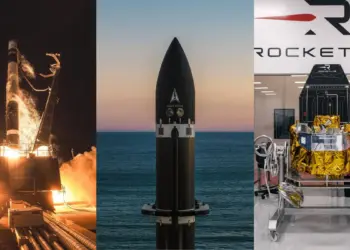
The development strategy adopted for the Evolution-1 project closely mirrors the path pioneered by Rocket Lab’s Electron launch vehicle, which remains the only rocket in the world using an electric-pump-fed propulsion system to have successfully reached orbit. However, while Electron’s Rutherford engines produce approximately 2.4 tonnes of thrust each, Spark Space claims that its Lieyan-2 engine is capable of generating up to 10 tonnes of thrust per unit. The use of electrically driven pumps offers significant advantages in terms of simplicity and weight reduction, as it eliminates the need for complex turbopumps and gas-generator systems.
At the same time, these benefits become increasingly difficult to scale. Electric-pump architectures generally deliver lower specific impulse and require heavy onboard battery packs, which can offset their structural advantages. For this reason, Rocket Lab elected to return to a more conventional gas-generator cycle when developing its new medium-class Neutron launch vehicle.
Company representatives stated that all manufacturing facilities and test infrastructure are currently located within a dedicated aerospace complex covering more than 10,000 square meters in Hefei’s high-tech industrial development zone. Construction is already underway to expand the site by an additional 20,000 square meters. According to Chinese technology outlet 36Kr, the startup’s engineering team brings substantial experience from major state-owned aerospace organizations, including the China Aerospace Science and Technology Corporation (CASC), the China Aerospace Science and Industry Corporation (CASIC), and institutions affiliated with the Chinese Academy of Sciences.
The Jinhua-1 is being positioned as a cost-effective launch vehicle capable of responding rapidly to the needs of small and medium satellite operators. At the same time, the company has set itself the ambitious goal of achieving an orbital launch as early as next year, despite operating in China’s highly competitive light-launch vehicle market. Among the solid-fueled launch systems already conducting regular commercial missions are the Ceres-1 developed by Galactic Energy, the Kinetica-1 produced by CAS Space, and the Kuaizhou-1A launch vehicle operated by Expace.
Read also:
- Air launch systems and hypersonic missiles: Ukraine outlines new developments in space mission capabilities
- Month of Silence and Uncertainty: European Space Agency Reestablishes Contact with Proba-3 Spacecraft
Source: spacenews