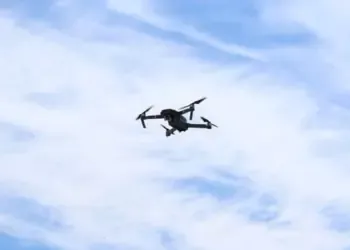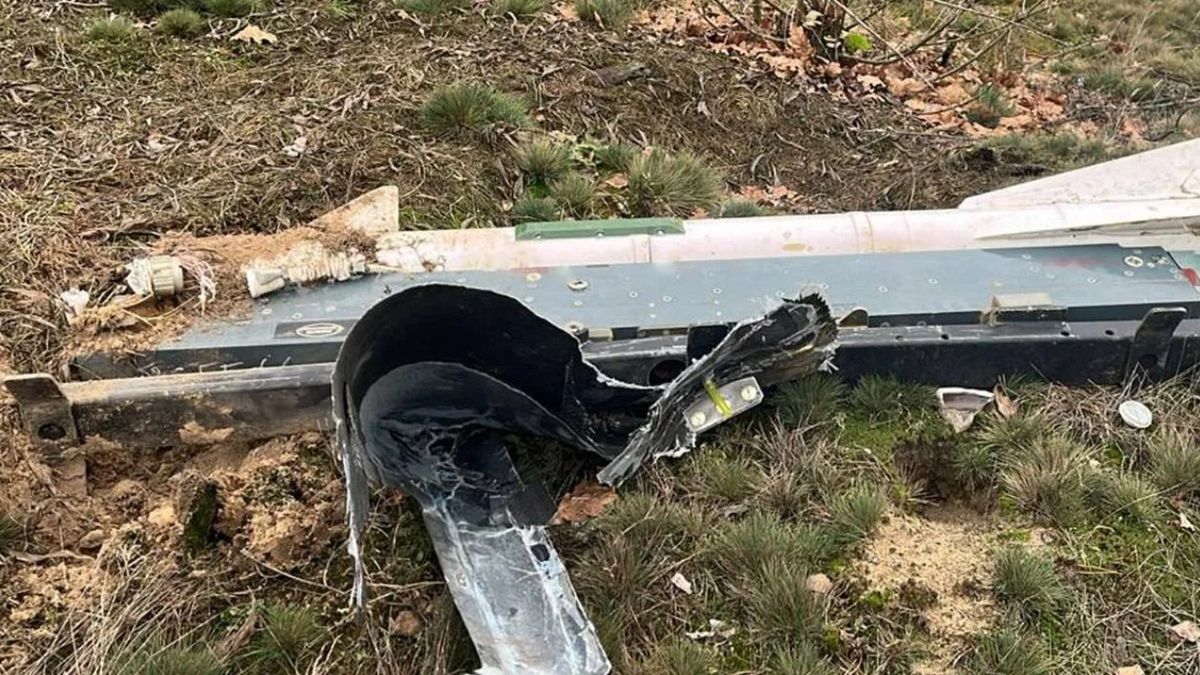
Ukraine’s Main Intelligence Directorate (HUR) of the Ministry of Defense has published a detailed description of the design, components, and industrial partners involved in the production of the Russian Geran-2 drone, “E” series, which has been equipped with an R-60 air-to-air missile. The information appears in the “Components in Weapons” section of the War&Sanctions portal.
According to the disclosure, the aggressor state has adapted the legacy Soviet R-60 air-to-air missile for use on Geran-type strike drones. The primary purpose of this modification is to counter Ukrainian helicopters and aircraft tasked with intercepting and destroying Russian unmanned aerial vehicles in flight.

The missile, together with the APU-60-1MD (P-62-1MD) aircraft launch rail, is mounted on a dedicated bracket fixed to the upper forward section of the drone’s fuselage.
The unmanned aerial vehicle is equipped with two network cameras. One is installed in the nose section, while the second is positioned behind the missile launch rail. Video transmission and control command exchange are carried out using a Chinese Xingkay Tech XK-F358 mesh modem.
The flight controller, navigation systems, and inertial units remain standard and are consistent with other Geran modifications. To maintain satellite navigation under active electronic warfare conditions, a 12-channel jam-resistant “Kometa” module is used.
The electronic subsystem also includes a British-made Raspberry Pi 4 single-board computer, a tracker, and two GSM modems intended for transmitting telemetry data during flight.
The origin of the electronic component base remains typical for Russian drones of this class. The design incorporates components manufactured in the United States, China, Switzerland, Taiwan, Japan, Germany, and the United Kingdom. A detailed list of these components, including markings and photographic documentation, has been published in the relevant section of the portal.
The likely combat employment concept involves transmitting live video from the drone’s cameras to the operator via a mesh modem. If a Ukrainian aircraft or helicopter enters the engagement zone, the operator issues a command to the missile’s control unit to initiate launch. After launch, the R-60 missile’s infrared homing seeker autonomously acquires and tracks the aerial target. An alternative scenario is also possible, in which target acquisition occurs prior to launch, with the relevant data transmitted to the operator, who then makes the decision to employ the missile.
The primary objective of this development is to introduce an additional threat to Ukrainian army and tactical aviation and to reduce the effectiveness of aerial interception of hostile drones. As a result, the Russian variant of the Iranian Shahed-136 gains an additional operational role. The experience obtained from this type of employment is likely to be shared with the Iranian side.
Read also:
- Ukrainian Security Service Drones Strike Russian Oil Platform in the Caspian Sea for the First Time
- Su-24, Radar, and Drones: Defence Intelligence Reports on “Prymary” Operations
Source: gur