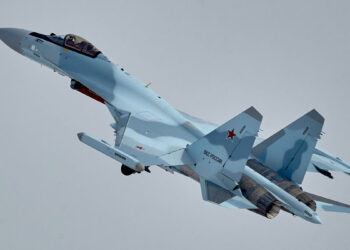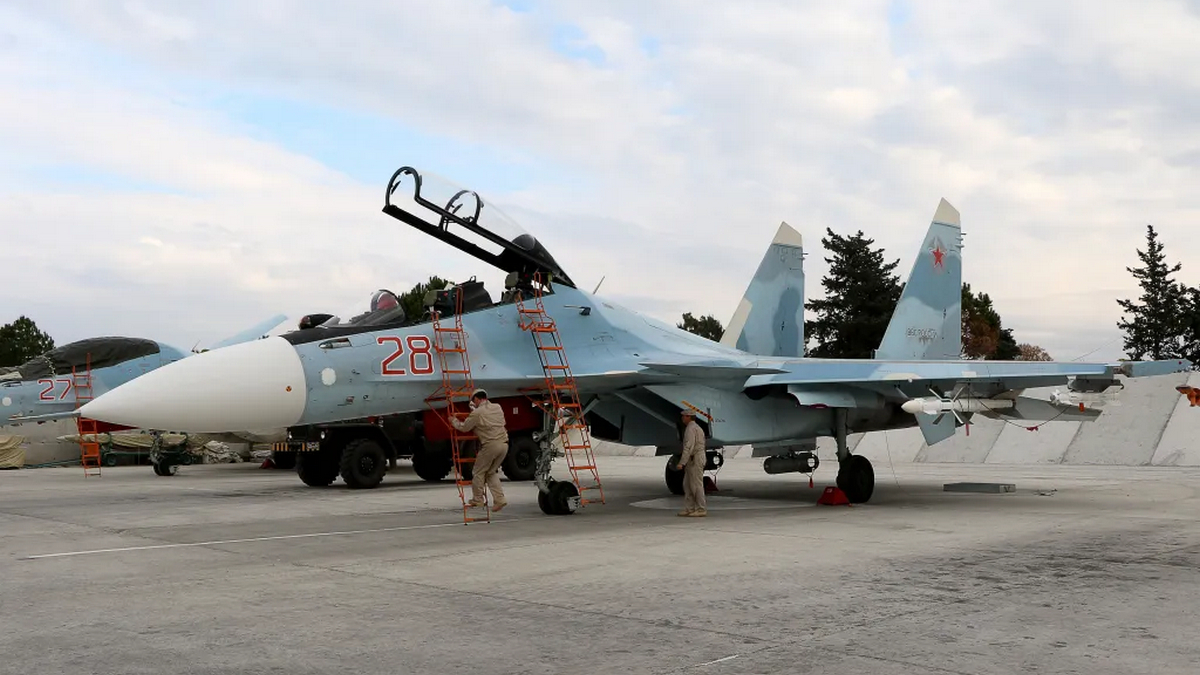
Two Russian Su-30 “Flanker” multirole fighters were damaged during a nighttime arson attack on a military airfield in Lipetsk, southwestern Russia. According to the Main Intelligence Directorate of Ukraine (HUR), the attack was carried out by a “representative of the resistance movement in Russia.” If confirmed, the incident would represent another example of strikes targeting Russian military aircraft directly on their home bases.
Initially, the Main Intelligence Directorate of Ukraine (HUR) reported that a Su-30 fighter and a Su-27 interceptor had been damaged during the night of December 20–21. The agency later clarified that both targets were actually two-seat Su-30 fighters, considered more modern and expensive platforms.
According to Ukrainian intelligence, the operation was planned over approximately two weeks, with the actual execution carried out by a member of the underground resistance movement. HUR stated that the saboteurs studied patrol routes and duty schedules before infiltrating the secured military facility, setting fire to the aircraft inside a protective hangar, and leaving the airfield without interference.

Alongside its statement, HUR released a video purportedly showing the aftermath of the attack. The footage shows the cockpit of a Su-30SM, flames near the landing gear strut, and fire spreading toward the engine air intake. One of the aircraft was armed with underwing air-to-air missiles, indicating it was in combat-ready condition. Visible tail numbers “12” and “82” further confirm that the planes were Su-30SM fighters, not training aircraft or earlier variants.
HUR estimated the combined value of the damaged Su-30SM fighters at up to $100 million, though this represents a maximum figure in the event of total write-off. Officially, the aircraft are only described as “out of service,” with the exact extent of the damage remaining unclear.
The Lipetsk airfield serves as the base for the 4th State Center for Pilot Training and Military Assessment, which plays a key role in testing new combat aircraft, training pilots, and developing tactics for the Russian Aerospace Forces. The 968th Training and Research Aviation Regiment stationed here was among the first to receive Su-34, Yak-130, Su-30SM, Su-35S, and even Su-57 aircraft for initial crew training.
Available video evidence indicates that at least one of the affected Su-30SM fighters was fully operational. Furthermore, there are grounds to believe these aircraft had been involved in countering Ukrainian long-range drones, including those potentially heading toward Moscow. The Su-30SMs with tail numbers “12” and “82” are not typically based in Lipetsk, suggesting they were performing rapid-response tasks.
This incident represents another event in a series of sabotage operations targeting Russian aviation facilities. Previous explosions have been reported at airbases in occupied Crimea, notably in Saky in 2022, as well as in the Pskov region, Siberia, and areas near Moscow. In most cases, Ukrainian authorities or affiliated sources have attributed these events to the actions of sabotage groups or underground networks.
Recent events once again indicate that Russian airbases, even those located far from the front line, remain vulnerable. At the same time, drone strikes and ground sabotage suggest that threats to the Russian Aerospace Forces extend beyond the airspace.
Read also:
- Ukrainian drones Strike a Russian “Shadow Fleet” Tanker for First Time in Neutral Waters of Mediterranean Sea
- Security Service of Ukraine Strike Belbek Airfield: Equipment Worth Hundreds of Millions Damaged, Including MiG-31 Jets
Source: TWZ