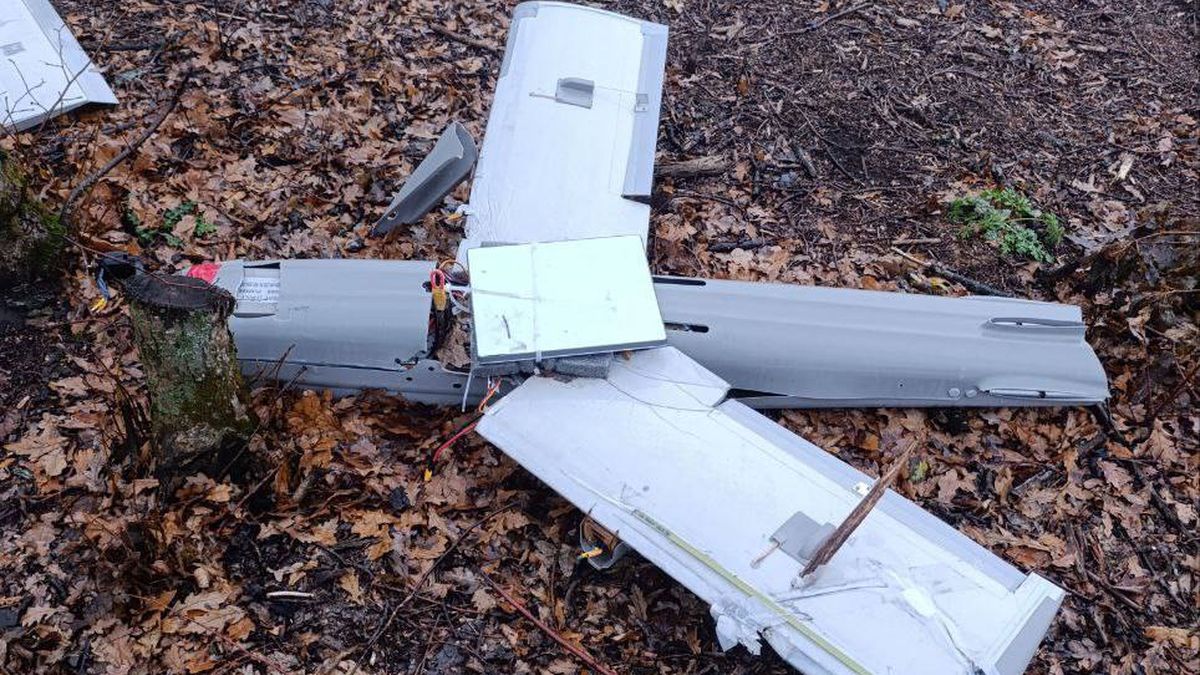
On the War&Sanctions portal, within the “Components in Weapons” section, the Main Intelligence Directorate (GUR) of Ukraine’s Ministry of Defence has published a detailed interactive schematic describing the design and electronic components of the Russian “Molniya-2R” unmanned aerial vehicle. The system is presented as a new modification of a previously known FPV drone.
Earlier, HUR reported on Russia’s use of a fixed-wing FPV drone designated “Molniya.” This strike UAV is launched using a dedicated catapult and guided to its target by an operator in FPV mode. It has a reported operational range of up to 40 km and carries a warhead weighing up to 5 kg, which is significantly smaller than that of Shahed-type loitering munitions. The system was later upgraded into the “Molniya-2” variant, which features two wing-mounted engines, a revised fuselage, increased range, and an enhanced warhead.

However, Ukrainian intelligence has recently identified another modification of this UAV, designated “Molniya-2R,” which is intended for aerial reconnaissance missions. To support this role, Russian developers significantly revised the onboard hardware, integrating a Raspberry Pi 5 single-board computer into the control system, along with a compact Chinese-made Mini PC F8. The latter is branded under the Russian name Raskat, owned by LLC “NOVY AI TI PROEKT,” and operates using a licensed Windows 11 operating system.
In addition to the forward-facing FPV camera, the UAV has been equipped with supplementary optical hardware, specifically a Chinese-made SIYI ZR10 camera featuring 10× optical zoom and a three-axis stabilization system. This configuration significantly expands the platform’s surveillance capabilities, enabling long-range observation, target identification, and the adjustment of other strike assets.
To ensure a stable communications channel and the transmission of video feeds from both cameras, telemetry data, and control commands, the “Molniya-2R” is equipped with a Starlink satellite terminal. This enables the system to be operated over extended distances.
A complete list of the components and electronic modules used in the UAV – including markings, origin, and photographic documentation – has been published in open access on the War&Sanctions portal.
As a reminder, we recently reported that Russia has adapted the Soviet-era R-60 air-to-air missile for use on Geran-type strike drones, intended to counter Ukrainian helicopters and fixed-wing aircraft. The Main Intelligence Directorate (GUR) has also published a detailed description of the design, components, and industrial cooperation involved in the production of the Russian “Geran-2” UAV of the “E” series.
Read also:
- Su-24, Radar, and Drones: Defence Intelligence Reports on “Prymary” Operations
- Ukrainian Intelligence Reveals Details of a New Modification of the Russian “Geran” Drone Equipped with an R-60 Air-to-Air Missile
Source: gur