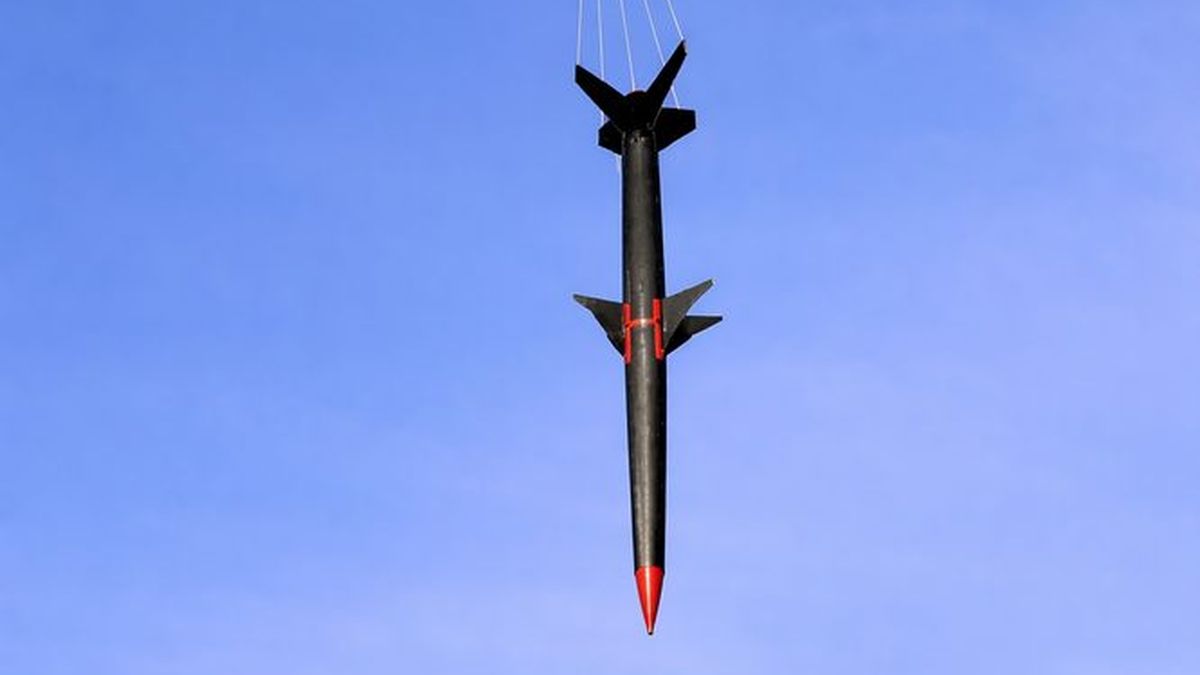
It was recently reported that a Ukrainian defense company is developing the DART missile, which can be launched from a stratospheric balloon. According to available information, the system is designed to be released from an altitude near the lower boundary of the stratosphere and is claimed to engage targets accurately even in environments affected by intensive electronic warfare (EW).
Developed by specialists at the Center of Innovative Technologies Program in Ukraine, the DART missile is intended to address one of Russia’s key battlefield advantages – its extensive electronic warfare capabilities. A stratospheric balloon carries the missile to an altitude of approximately 11–18 km before releasing it. During the initial descent phase, DART relies on satellite navigation. Once it descends to an altitude of about 6.5 km, the navigation system is switched off, after which a solid-propellant rocket motor accelerates the missile onto its pre-programmed flight trajectory.

This unconventional flight profile is intended to make the missile largely resistant to Russian electronic warfare (EW) systems. Because DART no longer relies on satellite navigation during the terminal phase of flight, it is expected to be considerably more difficult for enemy EW assets to disrupt its course.
Unlike conventional cruise missiles, which require expensive launch platforms and continuous guidance throughout their flight, DART is being developed as a relatively low-cost strike system. Launching the missile from a stratospheric balloon significantly reduces both the cost and operational complexity of deployment while also making the launch itself more difficult for air defense systems to detect. According to the developers, the system is intended to deliver precision warheads deep inside Russian territory while mitigating the challenges posed by electronic warfare.
According to available information, the current version of DART carries a warhead weighing approximately 10 kg. Rather than relying solely on blast effects, it disperses graphite filaments designed to create short circuits in electrical infrastructure, potentially causing temporary disruptions to power grids and military support systems. The weapon is currently undergoing evaluation and has reportedly not yet completed Ukraine’s military certification process.
This unconventional flight profile is intended to make the missile largely resistant to Russian electronic warfare (EW) systems. Because DART no longer relies on satellite navigation during the terminal phase of flight, enemy EW systems are expected to have limited ability to disrupt its trajectory.
Unlike conventional cruise missiles, which require expensive launch platforms and continuous guidance throughout their flight, DART is being developed as a relatively low-cost strike system. Launching the missile from a stratospheric balloon significantly reduces both the cost and operational complexity of deployment while also making the launch itself more difficult for air defense systems to detect. According to the developers, the system is intended to deliver precision warheads deep inside Russian territory while mitigating the challenges posed by electronic warfare. According to available information, the current version of DART is equipped with a warhead weighing approximately 10 kg. Rather than relying solely on blast effects, it disperses graphite filaments designed to create short circuits in electrical infrastructure, potentially causing temporary disruptions to power grids and military support systems. The weapon is currently undergoing evaluation and has reportedly not yet completed Ukraine’s military certification process.
Read also:
- Saab to Supply Gripen E Fighter Jets to Ukraine: Major Agreement Signed
- Secrets of the Defense Alliance: Ukraine Negotiates with Paris on Domestic Production of SCALP Cruise Missiles
Source: interestingengineering