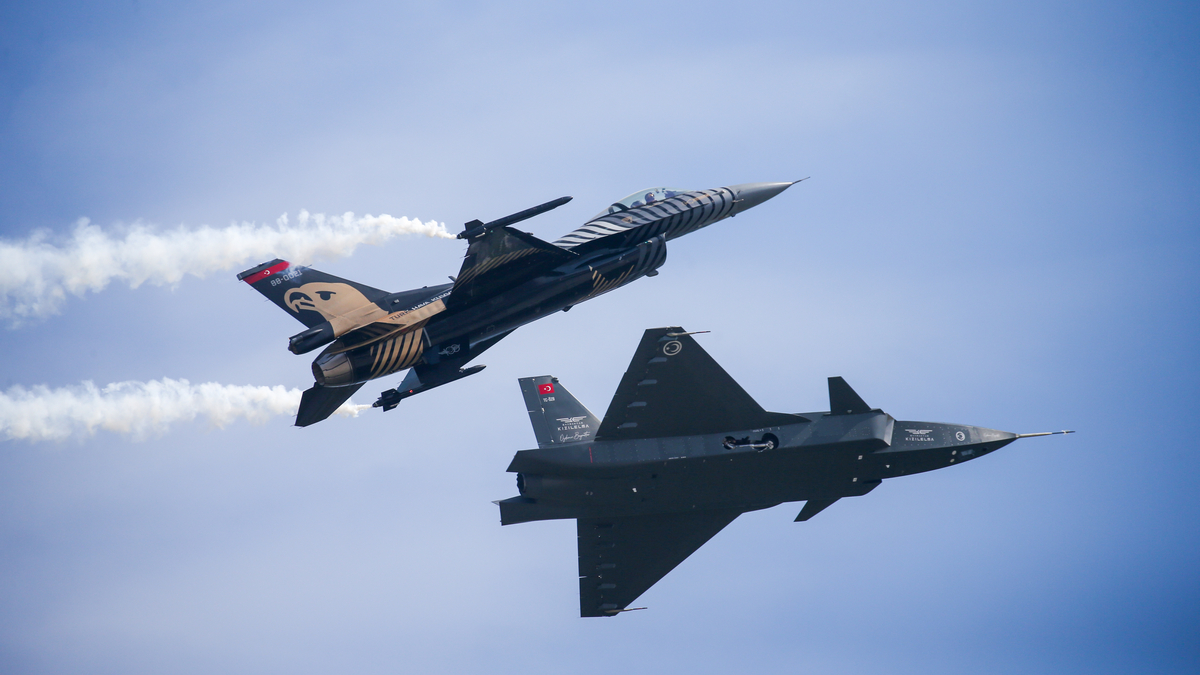
On November 30, 2025, Turkey achieved a historic milestone in unmanned aviation. Baykar announced that its jet-powered unmanned fighter, the Bayraktar Kizilelma, successfully struck an aerial target beyond visual range for the first time in the world, using an air-to-air guided missile. During tests over the Black Sea near Sinop, the Kizilelma employed its Aselsan MURAD AESA radar to guide a Gökdoğan missile, produced by TÜBİTAK SAGE, onto a high-speed aerial target, resulting in a confirmed hit. According to Baykar and video documentation, this marks the first verified instance of a beyond-visual-range (BVR) interception carried out by a jet-powered combat UAV. (Editor’s note: BVR refers to engagements where the missile tracks the target without direct visual contact.)

The test was conducted as a joint operation involving five F-16s from the 5th Air Base in Merzifon. Flying in formation alongside the fighters, the Kizilelma carried a Gökdoğan missile under its right wing, while a Bayraktar Akıncı handled aerial recording. After the target drone was launched, the UAV independently detected and tracked the target before launching the missile, which resulted in a direct hit. Baykar CEO Selçuk Bayraktar, who was aboard a two-seat F-16 during the test, described the event as the beginning of a “new era in aviation history.”
The success was made possible through the integrated use of Turkey’s advanced defense systems in a single platform. The Kizilelma is a low-observable, jet-powered UAV with a takeoff weight of approximately 8.5 tons, a payload capacity of up to 1.5 tons, and a combat radius of around 500 nautical miles (approximately 926 km). It is capable of launching from ships like the TCG Anadolu and reaching speeds of about Mach 0.9. Its MURAD AESA radar provides simultaneous air-to-air and air-to-surface modes, long-range detection, and guidance for BVR missiles. The Toygun electro-optical system complements the radar with passive tracking and laser designation. The Gökdoğan missile, featuring an active radar seeker and a range exceeding 65 km, supports lock-on after launch and trajectory updates via a data link.
This test marks the culmination of the accelerated development of the MIUS program, which began in 2013. After its first flight in December 2022, the Kizilelma underwent an extensive series of trials, including formation flights with F‑16s and public demonstrations at Teknofest. The first flight equipped with the MURAD radar took place in October 2025, followed by a simulated F‑16 interception in November. The Sinop test turned that simulated capability into a demonstrated operational result.
At the tactical level, the achievement indicates that the Kizilelma can take on a portion of traditional fighter roles: operating as a “loyal wingman,” entering high‑risk areas, conducting interceptions, or performing target detection while reducing the workload on crewed aircraft. Its sensor suite enables both active and passive target acquisition, and its internal weapon bays help reduce radar cross‑section for missions that require lower observability.
From a geopolitical perspective, Turkey has demonstrated the ability to complete a fully national air combat cycle – from platform to radar, missile, and communication links. This enhances its defense autonomy and affects the balance of power in the Black Sea, Eastern Mediterranean, and the Middle East. At the same time, the Kizilelma is becoming part of a broader sixth-generation concept alongside the TF Kaan and Anka‑3, which are expected to operate in networked formations with distributed roles, coordinated from aboard the Kaan.
&pp=ygUJS2l6aWxlbG1h0gcJCRUKAYcqIYzv
The Sinop test demonstrates that jet-powered UAVs are no longer limited to strikes against ground targets. The confirmed beyond-visual-range strike indicates that the era in which only crewed fighters could engage at long distances is coming to an end. In future air combat scenarios, mixed formations are expected to play a key role, with low-observable unmanned “wingmen” delivering strikes while operating in coordination with networked sensor systems and autonomous control.
Read also:
- All About the Turkish UAV Bayraktar Kizilelma: Development History and Prospects
- Everything About the P1-Sun – SkyFall’s Ukrainian Interceptor Drone
Source: Armyrecognition