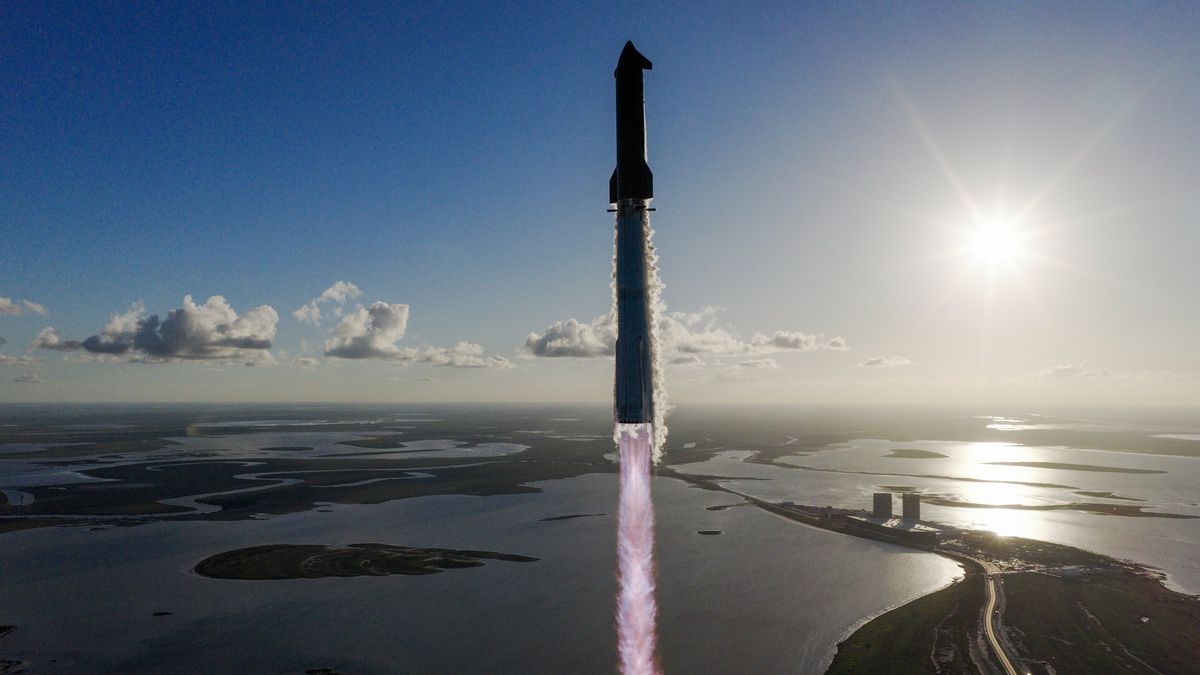
SpaceX has successfully launched its giant Starship rocket, marking the eleventh test flight and the second consecutive mission to achieve all planned objectives. The rocket lifted off from the company’s Starbase facility in South Texas. This flight represents the final test for the current version of Starship, which will soon be replaced by an even more powerful iteration.
Starship is being developed as part of Elon Musk’s long-term vision of colonizing Mars. The entrepreneur has repeatedly stated that he founded SpaceX in 2002 to help humanity expand beyond Earth. At the same time, Starship is set to play a key role in NASA’s Artemis program, which aims to return astronauts to the Moon for the first time since the Apollo era. If the current schedule holds, the Artemis 3 mission, which will land near the Moon’s south pole, is expected to take place in 2027.

Elon Musk personally observed the eleventh Starship launch, noting during a brief appearance on the broadcast that it was the first time he watched a launch from outside rather than from the control center. “This will be much more emotional,” he said.
Starship is designed to transport exceptionally large payloads into space. The rocket can carry up to 150 metric tons of cargo, and both of its stages – the Super Heavy booster and the upper stage, known as Ship – are built for reuse. SpaceX intends to recover both components after each launch by returning them to the launch site, where they would be caught using the tower’s mechanical arms. This recovery method has already been tested three times with the Super Heavy booster, though it has not yet been attempted with the upper stage. According to Musk, the ultimate goal is to enable several Starship launches per day from a single launch platform.
The current version of the rocket, Starship V2, stands at approximately 123 meters tall. Future variants are expected to be even larger: the V3 will reach 124.4 meters, while the Future Starship, introduced by Musk in spring 2025, is projected to be around 142 meters tall. The V4, scheduled for its debut in 2027, is expected to feature 42 Raptor engines – three more than in the previous versions.
It has not been an easy path. During the winter and spring, SpaceX lost three consecutive rockets: the seventh and eighth exploded less than ten minutes after liftoff, and the ninth broke apart during reentry. In June, another vehicle was destroyed during preflight testing. However, the tenth launch, conducted on August 26, went smoothly. Both stages of Starship completed controlled ocean splashdowns, and the Ship successfully demonstrated the capability to restart its Raptor engine in orbit – a critical milestone.
The eleventh flight repeated these achievements. Its primary objectives were to return the Super Heavy booster to the Gulf of Mexico and to bring the Ship down in the Indian Ocean near Western Australia, following an in-space engine restart and the deployment of eight Starlink satellite mock-ups. During this mission, SpaceX also tested a new braking strategy: the Super Heavy ignited 13 engines at the start of its landing phase, then switched to a five-engine configuration for fine trajectory adjustments. This approach is expected to improve the reliability of upcoming V3 versions.
Flight 11 also marked another instance of booster reuse – the same Super Heavy unit had previously flown on Flight 8. Before this launch, only 9 of its 33 engines were replaced. The upper stage, Ship, was also modified: several heat shield tiles were intentionally removed to test how exposed sections of the hull would withstand reentry conditions. In addition, the vehicle executed a complex maneuver simulating the return trajectory to the Starbase launch site.
This mission was reportedly the final launch from Starbase’s first orbital pad, which is now being upgraded to support the new V3 version. According to the company’s chief engineer, Jake Berkowitz, the site will receive a new launch mount, a flame trench system, and upgraded tower arms designed to catch the rocket stages.
About two and a half minutes after liftoff, the stages separated, and four minutes later, the Super Heavy booster made a controlled splashdown in the Gulf of Mexico. The upper stage deployed eight Starlink test satellites, successfully reignited its Raptor engine, and completed all planned maneuvers during reentry before landing in the Indian Ocean just over an hour after launch. A buoy-mounted camera captured the moment of splashdown, marking a symbolic conclusion to the Starship V2 phase.
Read also:
- Chinese Startup Successfully Launches the World’s Largest Solid-Fuel Rocket for Second Time
- SpaceX to Launch Four Falcon Heavy Rockets Under New U.S. National Security Program
Source: space