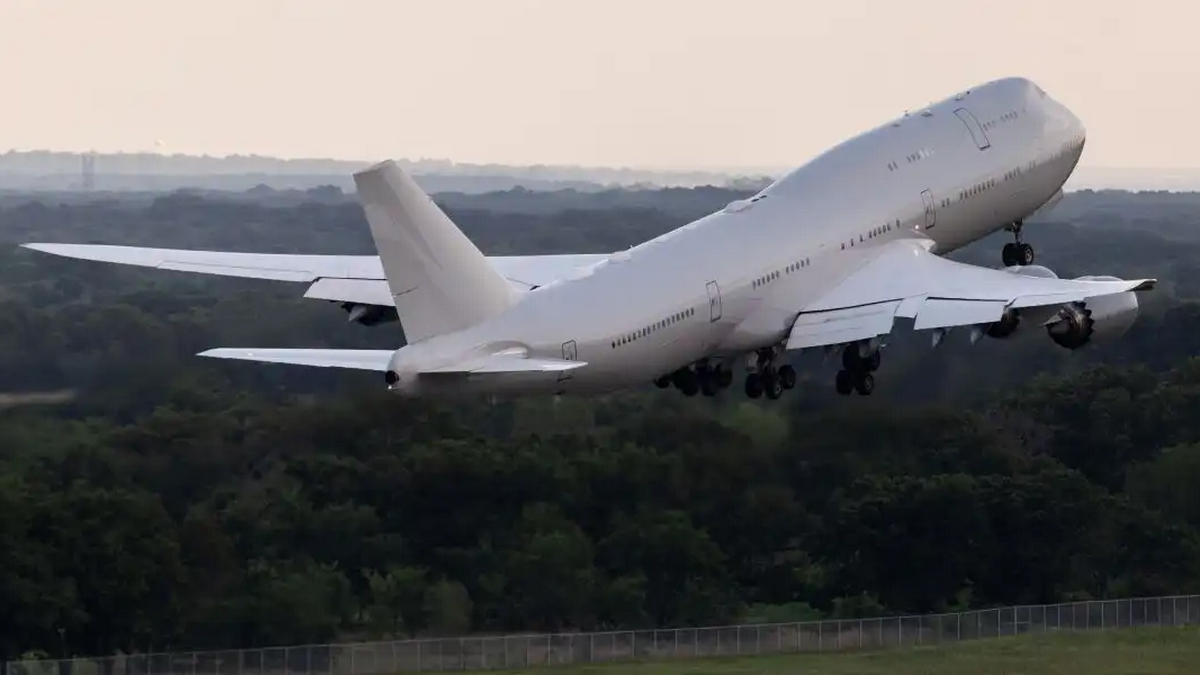
The modified aircraft under the U.S. Air Force’s VC-25B Bridge program has officially completed its retrofit and flight testing phases and is currently undergoing painting. It is expected to be presented this summer in a new livery combining red, white, and blue elements.
The Bridge program reflects a revised approach to delivering critical capabilities within the Air Force structure. By applying a model similar to portfolio management with direct accountability, authorities were aligned with operational control, enabling accelerated delivery timelines. As noted by Dale White, who oversees key armament programs, the project illustrates how clear individual responsibility and the alignment of stakeholders around a shared objective can support the rapid implementation of solutions aimed at reducing the operational burden on the aging VC-25A fleet.

Delays in the delivery of the new VC-25B aircraft – originally planned for 2024 – combined with extended maintenance cycles for the VC-25A fleet, made the development of an interim solution necessary. In February 2025, a dedicated task force initiated intensive work on the Bridge program while continuing efforts to accelerate the primary VC-25B production timeline.
Given that requirement instability is a common source of delays in programs of this type, the interagency team defined a constrained set of baseline parameters for both efforts. The focus was limited to core capabilities required for the safe and secure transport of the President of the United States. This approach improved coordination among participating organizations and contributed to an estimated one-year reduction in the delivery timeline for the new VC-25B aircraft, which are currently expected in 2028.
To support the accelerated timeline of the Bridge program, several Boeing 747-8 aircraft were sourced from different operators. A Boeing 747-8i previously used by the head of state of Qatar has been designated as the primary interim platform until the VC-25B enters service. A Boeing 747-8F operated by Atlas Air was leased and used for pilot training between October 2025 and February 2026. Two additional Boeing 747-8i aircraft formerly operated by Lufthansa were assigned distinct roles: one serves as a training platform for flight crews and maintenance personnel, while the other has been integrated into the spare parts supply chain to support long-term sustainment.
In December 2024, the U.S. Air Force initiated a market assessment of Boeing 747-8i aircraft to identify suitable VIP-configured platforms for interim use. As a result, an aircraft previously designated for the head of state of Qatar was selected as a bridging solution pending the introduction of the VC-25B.
L3Harris Technologies was chosen to carry out the aircraft’s complex modification. The company has experience in secure communications systems and VIP aircraft integration. Additional schedule gains were supported through cooperation with Boeing, which provided engineering data required for structural changes. Specialists from multiple government agencies also developed updated protocols for identifying and mitigating potential technical risks associated with previously operated aircraft. This approach effectively establishes a structured model for integrating such platforms into military use.
The Bridge program has increased operational readiness for both the U.S. Air Force and supporting White House functions, with delivery timelines exceeding earlier expectations. To support entry into service, a full-scale interior mock-up incorporating virtual reality tools was developed, allowing personnel to familiarize themselves with the configuration in advance.
According to Troy Meink, the integration of the 747-8i platform already addresses near-term capability gaps while contributing to the longer-term sustainment framework of the fleet. This enables the early development of training programs, logistics chains, and maintenance systems designed for an expected service life of 30–40 years.
The aircraft serves as a critical interim capability, ensuring continuity in the execution of presidential airlift missions while also forming a foundation for the future fleet. In parallel, the U.S. Air Force is introducing an updated livery for the VC-25B, 747-8i, and other government aircraft, including four C-32 units, which are based on the Boeing 757 platform.
In February, U.S. Air Force officials indicated that the new aircraft would adopt a color scheme proposed by Donald Trump. The design combines red, white, gold, and dark blue elements. It was originally developed during his first presidential term but later set aside under the administration of Joe Biden. Trump had previously stated that the new Air Force One should reflect U.S. national colors and represent a high standard of design and capability.
Since the administration of John F. Kennedy, Air Force One aircraft have traditionally used a light blue and white livery. In 2022, the Air Force declined to proceed with a revised scheme due to technical and cost considerations, including concerns about potential overheating associated with darker colors. In 2023, an alternative design closer to the traditional scheme, but with a darker tone, was proposed.
The updated livery is now planned for application to two modified Boeing 747 aircraft undergoing conversion, as well as to the aircraft transferred from Qatar. This aircraft is expected to begin supporting Air Force One missions as early as this summer. Images have also emerged of a C-32 in the new color scheme. The aircraft is used for Air Force Two missions when the Vice President is on board and was recently observed during takeoff in Texas.
Aircraft manufactured by Boeing have been used to transport U.S. presidents since 1943, when Franklin D. Roosevelt first flew on the Boeing 314 Clipper. From the VC-25A to the forthcoming VC-25B, Boeing 747–based aircraft with presidential markings remain among the most recognizable symbols of executive authority.
Air Force One is effectively a “flying Oval Office,” with an interior area of approximately 371.6 m². It is equipped with advanced communications systems that maintain continuous connectivity for the president during flight. The aircraft is designed to operate autonomously at international airports without external support, with onboard systems supporting safe and reliable execution of logistics operations under a wide range of conditions.
The development of presidential aircraft involves a broad network of aerospace suppliers. Through an extensive partner base and distributed production capabilities, Boeing supports the integration of one of the most technically complex categories of aircraft used for head-of-state transport.
Read also:
- Strike at 1,700 km: Ukraine hits Su-57 and Su-34 aircraft at airbase in Chelyabinsk region
- Old Aircraft, New Weapons, New Tactics: Ukraine Is Redefining Counter-Drone Warfare
Source: theaviationgeekclub