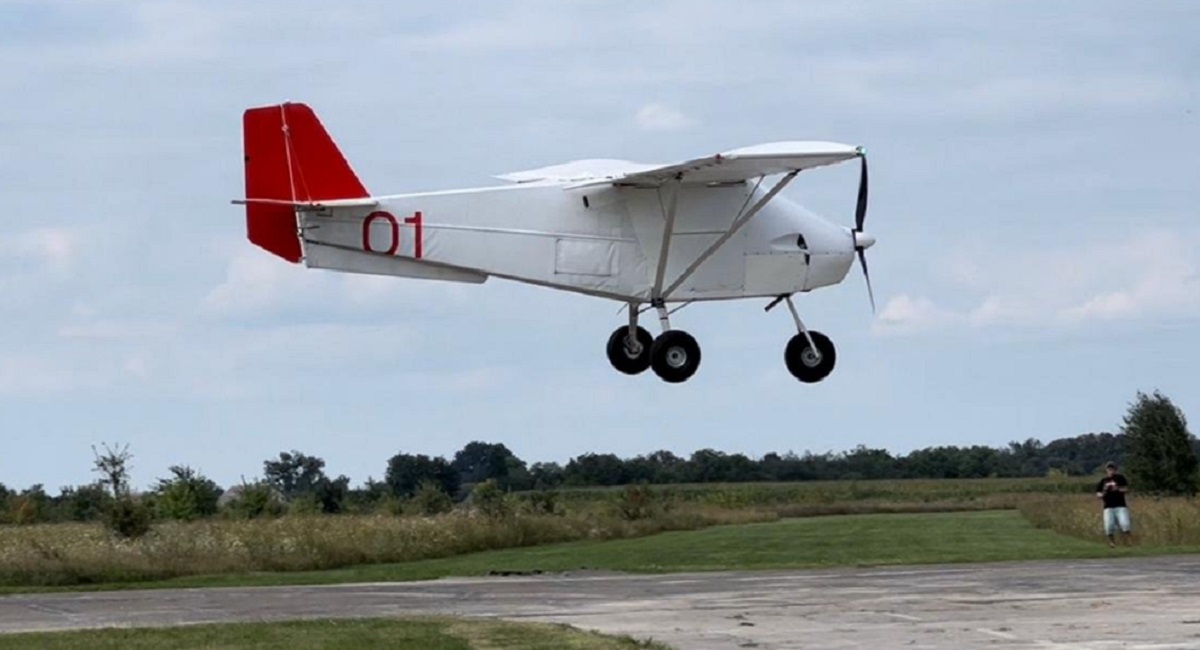
The Ukrainian E-300 Enterprise strike drone can be characterized as large, relatively slow, and cost-efficient. Despite its utilitarian and unrefined appearance, the platform has been reported as being used in multiple strikes against targets located within Russian territory, indicating its practical effectiveness in real operational conditions.
TABLE OF CONTENT:
Concept
One of the key requirements for achieving strategic objectives has been the ability to conduct systematic strikes against targets deep within enemy territory – at distances measured not in hundreds, but in thousands of kilometers. At the start of Russia’s full-scale invasion in February 2022, Ukraine lacked dedicated systems capable of performing such deep-strike missions. As a result, early efforts relied on improvised solutions, including the conversion of legacy Soviet-era Tu-141 drones into improvised cruise-missile–like platforms.
Notably, the aggressor state, despite possessing a broad inventory of air-, sea-, and ground-launched cruise missiles that appeared suitable for deep-strike operations, also struggled to achieve its stated objectives. One of the limiting factors was scale: effective pressure required systems that could be deployed not in small numbers, but in large volumes – potentially hundreds per day. Achieving this level of use necessitated platforms that were inexpensive and relatively simple to produce. Strike unmanned aerial vehicles ultimately emerged as a practical response to these requirements.
The class of long-range strike UAVs has evolved along notably different conceptual paths in Russia and Ukraine. Russia, having obtained the technology of the Iranian Shahed-136, established domestic production of close copies of this loitering munition and has continued to refine the design incrementally. In contrast, Ukraine does not rely on a single standardized platform in this category. Instead, production is distributed across multiple manufacturers – nearly a dozen – resulting in a diverse set of designs with substantially different technical solutions and performance characteristics.
One of the heaviest platforms in this category is the E-300 Enterprise, developed by AeroDrone. The company was previously known for manufacturing agricultural drones used for crop spraying.
AeroDrone’s development program began in 2015 with small UAVs designed for aerial imaging and field analysis. In early 2017, the company introduced the AeroDrone DR-60 prototype with a payload capacity of 60 kg. This was followed by an extended period of testing and iterative refinement. By early 2022, AeroDrone had accumulated significant experience in designing and producing UAVs capable of carrying payloads weighing several tens of kilograms – sufficient to transport a combat payload of meaningful mass to a designated target.

Read also:
- Everything About Three Generations of PC-7: Predecessor of Pilatus Turboprop Aircraft Family
- Everything About the P1-Sun – SkyFall’s Ukrainian Interceptor Drone
Design
The E-300 Enterprise is built around a conventional high-wing aircraft configuration with a standard tail assembly and a fixed tricycle landing gear featuring a nose wheel. Takeoff and landing are performed in the same manner as with manned aircraft, meaning the platform requires a runway, albeit shorter than those used by conventional airplanes. This approach eliminates the need for additional ground equipment such as catapults or arresting systems.
Propulsion is provided by a piston engine driving a tractor (puller) propeller. The airframe design is deliberately simple, consisting of an aluminum frame covered with fabric, prioritizing ease of manufacturing and maintenance over aerodynamic refinement.
Originally, the UAV was conceived as a courier aircraft for transporting small cargo loads. The stated payload capacity of 300 kg refers to the total load, including fuel. The cruising speed is relatively low, reaching up to approximately 150 km/h.
Public information about the potential operational use of the E-300 Enterprise UAV first emerged in December 2022, when AeroDrone completed certification and received authorization to operate two of its unmanned aviation systems, including the E-300 Enterprise. In March 2023, AeroDrone signed a contract with the Ministry of Defense of Ukraine, enabling the start of serial production of UAVs for the Armed Forces of Ukraine. The number of units ordered from AeroDrone has not been publicly disclosed.
Combat Employment
Although at the early stage of its service with the Ukrainian military the E-300 Enterprise was presented as a transport UAV, in practice it has been employed as a strike platform. Its use is not limited to one-way kamikaze missions; the platform has also been adapted for reusable bomber-style operations. In this role, operational range is reduced, as fuel must be allocated for both outbound and return flights.
Conversely, when configured as a one-way system with a relatively light payload – on the order of several tens of kilograms – the E-300 Enterprise theoretically offers extremely long reach. Under such conditions, it may be capable of flying distances extending as far as the Ural region, although such a mission would require a very long flight time, potentially approaching a full day.
The first publicly reported information about the combat use of the new UAV appeared in spring 2024. In the early hours of April 2, a facility involved in the production of Geran-2 strike drones in Yelabuga (Tatarstan) was reportedly attacked, with open-source assessments suggesting the use of a UAV consistent with the E-300 Enterprise.
The first publicly reported information about the combat use of the new UAV appeared in spring 2024. In the early hours of April 2, a facility involved in the production of Geran-2 strike drones in Yelabuga (Tatarstan) was reportedly attacked, with open-source assessments suggesting the use of a UAV consistent with the E-300 Enterprise. Since that incident, the platform has been associated with strikes against targets in several other regions of Russia. On February 27, 2025, an instance was documented in which a 250 kg bomb was reportedly released from a UAV of this type against a target in the Bryansk region.
Specifications of the E-300 Enterprise UAV
- Wingspan – 8.5 m
- Aircraft length – 5.72 m
- Wing area – 14.1 m²
- Maximum take-off weight of the UAV – 540 kg
- Payload weight, including fuel – up to 300 kg
- Payload capacity (excluding fuel) – 38-243 kg
- Maximum flight altitude – 5000 m
- Flight range – 675 km (3150 km with additional fuel tanks)
- Flight duration – 5 hours (23 hours with additional fuel tanks)
- Cruising speed – 135-150 km/h
Read also: