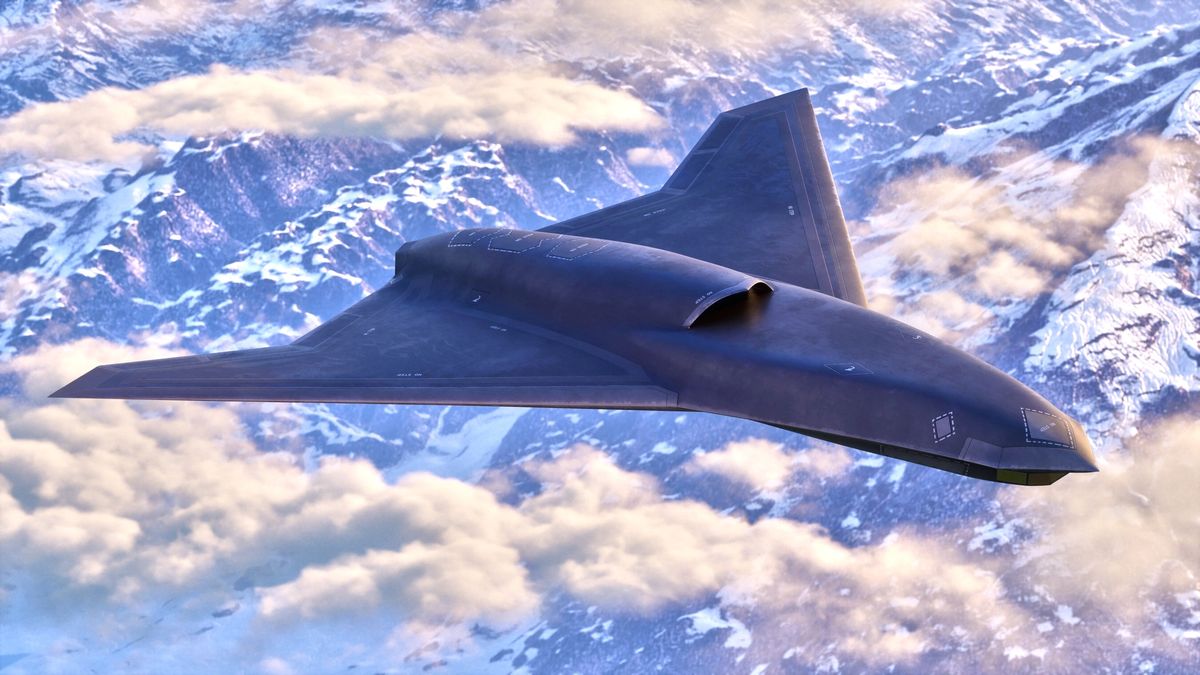
Lockheed Martin’s Skunk Works division has officially unveiled the Vectis, a new unmanned combat aerial vehicle developed independently for the Collaborative Combat Aircraft (CCA) program. Company representatives describe the platform as a survivable, high-performance, yet relatively affordable fifth-generation drone, intended to enhance the aerial capabilities of the U.S. and its allies.
According to Skunk Works Vice President and General Manager O. J. Sanchez, Vectis reflects decades of experience in stealth technologies, manned aircraft integration, and autonomous systems. “We are not just building a new platform – we are establishing a new paradigm of air power based on a high-performance, adaptable, and cost-effective flexible platform,” he said in a press release.

Lockheed Martin emphasizes that the Vectis was designed for integration with fifth- and next-generation fighters under the Family of Systems concept of the Next Generation Air Dominance (NGAD) program. The drone is intended to operate alongside the F-35, although video demonstrations show scenarios where F-22s are controlling the drones. In missions, it can perform a range of tasks, from precision strikes and electronic warfare to intelligence, surveillance, reconnaissance, and air defense support.
Video materials from Lockheed Martin suggest that the Vectis is equipped with sensor modules similar to the F-35’s EOTS system, along with integrated antennas. The drones detect threats in the airspace, while an F-22, positioned at a safe distance, coordinates the group and issues commands.
Particular emphasis has been placed on “multi-domain interoperability.” The Vectis can operate independently or as part of a larger network. It is designed for extended missions across various regions – from the Indo-Pacific to Europe and the Middle East – where range and endurance are critical. Lockheed Martin highlights three main advantages of the Vectis: stealth, affordability, and openness. Drawing on decades of experience in stealth technology, the company promises top-tier survivability within the CCA platform class.
Another key principle of the Vectis is its open architecture. Lockheed Martin aims to avoid reliance on specific suppliers and ensure compatibility with a wide range of command and control systems, including the existing Mission Domain Control eXperience (MDCX). Development is already underway: components have been ordered, and design teams are assembling initial prototypes. Skunk Works states its goal is to “develop, build, and field the platform within two years.”
The introduction of this drone represents the latest move in the competitive landscape of the U.S. Air Force’s Collaborative Combat Aircraft program, which aims to develop a fleet of relatively affordable, survivable, and mass-producible unmanned systems to enhance the capabilities of manned fighters. Meanwhile, Boeing, Northrop Grumman, General Atomics, and Anduril are advancing their own projects. Boeing has already showcased the MQ-28 Ghost Bat, General Atomics’ YFQ-42 drone has completed its first flight, and Anduril is preparing tests for the YFQ-44.
Lockheed Martin’s involvement underscores the company’s intent to remain central to the development of U.S. combat aviation, leveraging its NGAD experience and position as the prime contractor for the F-35 program. The focus on a rapid development cycle and cost-effectiveness signals a shift away from traditional multi-year defense programs, which have often faced criticism for their length and expense. The CCA program takes a different approach, aiming to deliver operationally capable platforms within a shorter timeframe and at a more reasonable cost.
Read also:
- Ukrainian Intelligence Reveals the Inner Workings of Russia’s “Geran-3” Drone
- The UK to Produce Ukrainian Interceptor Drones
Source: theaviationist