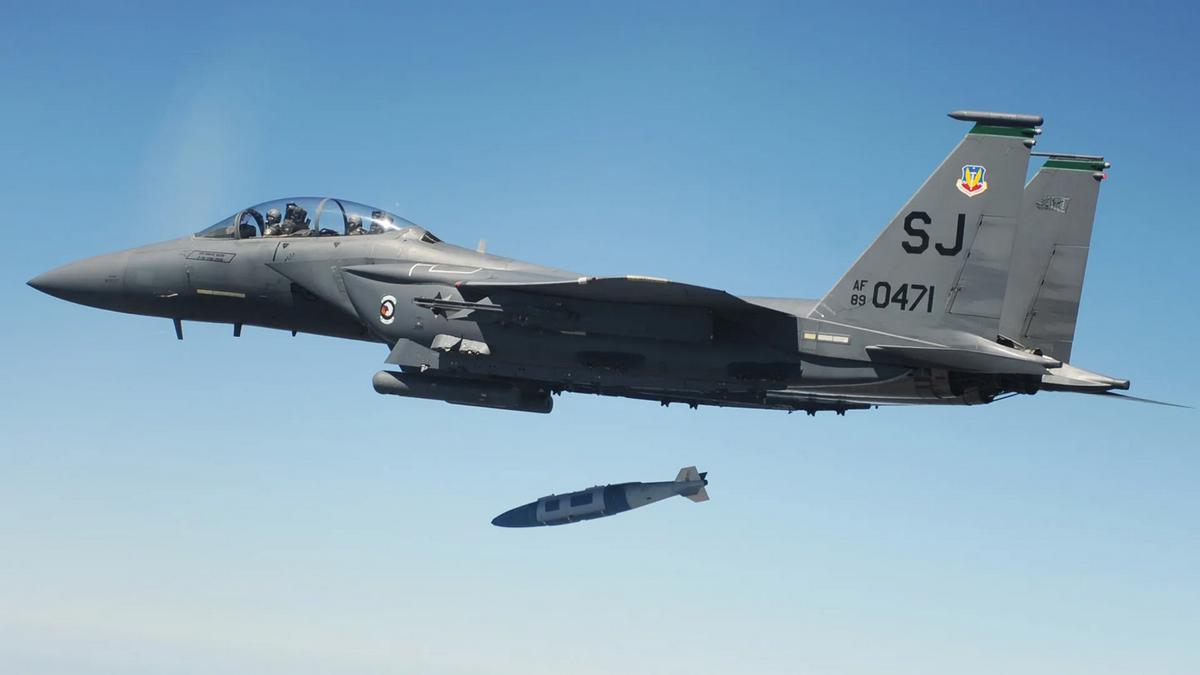
A U.S. Air Force F-15E Strike Eagle crew attempted to take down Iranian long-range kamikaze drones using precision LJDAM laser-guided bombs after running out of missiles during an intense Iranian barrage targeting Israel.
Speaking at the Air & Space Forces Association’s 2025 Air, Space, and Cyber Conference, TWZ correspondent Howard Altman interviewed Col. Timothy “Diesel” Coezy, commander of the 494th Fighter Squadron, and Maj. Benjamin “Irish” Coffey, the unit’s chief of staff. Their account confirmed that during the April 13, 2024 attacks, the squadron resorted to unconventional tactics to counter the overwhelming number of airborne threats.
The 494th Fighter Squadron, based at RAF Lakenheath in the United Kingdom, was deployed to the Middle East a few weeks after the unprecedented terrorist attacks on Israel on October 7, 2023, and returned to base in May 2024. At the time of those events, Coezy was serving as the unit’s director of operations.

During the April 13 episode, Iran launched dozens of long-range kamikaze drones, including platforms nearly identical to the Shahed-136 – the same type regularly used by Russia against Ukraine – along with a large number of cruise and ballistic missiles. The drones flew at relatively high speeds, comparable to light aircraft, and their mass deployment overwhelmed air defense systems, creating a chaotic situation in the skies. At times, U.S. aircraft even had to land to rearm.
Coezy said that even in the early preparation stages in December 2023 and January 2024 they expected scenarios where crews would exhaust their missiles. He recalled asking during training, “We knew from the start, when we began this process in December (2023) and January (2024), that we would be firing missiles. So if someone eventually shoots everything, what do I want them to do then?” He stressed the importance of training crews for unpredictable situations so that junior pilots aren’t placed in circumstances without established procedures or exposed to unnecessary risk.
The F-15E is equipped with air-to-air missiles (AIM-9 Sidewinder and AIM-120 AMRAAM) and a wide range of air-to-ground munitions, including multiple JDAM variants. It also carries a 20 mm M61 Vulcan cannon. JDAMs are classified by the weight of the underlying “iron” bomb – 500 lb (≈227 kg), 1,000 lb (≈454 kg), and 2,000 lb (≈907 kg) – to which a GPS guidance kit is fitted for precision strikes against fixed coordinates. The LJDAM variant adds a laser seeker to the bomb’s nose, enabling engagement of moving targets; standard JDAMs are intended for stationary targets only.
Coezy noted that the crews had discussed alternative actions in case they ran out of missiles. “So we talked about whether we could drop a bomb and guide it with a laser? Or could we use the cannon, since we have an air-to-air gun,” he said. They also considered non-kinetic methods for countering the drones.
In a previous CNN interview, Maj. Coffey described an unsuccessful attempt to use the Vulcan cannon to engage an Iranian drone during the same series of attacks. At the time, Coffey was the pilot, while Capt. Lacy “Sonic” Hester served as the weapons officer in the rear seat.
There is a historical precedent: during Operation Desert Storm in 1991, an F-15E destroyed an Iraqi Mi-24 attack helicopter during takeoff using a Paveway laser-guided bomb. In that case, the weapons officer continued to illuminate the target with a laser, and the bomb struck the helicopter as it lifted off.
Coezy explained that the command discussed specific procedures and safety measures before authorizing such actions. “It was important for us to have this conversation because then I can tell the squadron: you won’t just do this. If you find yourself in a situation where you need to drop a bomb, here are a few things we’ve considered. Here are some techniques. Here’s how you would execute the process,” he said. He emphasized the importance of ensuring the detonation area is clear of civilians and vehicles, ideally an empty desert; otherwise, that method of employing the weapon would have to be abandoned.
Ultimately, Coezy faced a situation where he had to decide whether to employ an LJDAM against an Iranian drone. “Over my career, I’ve dropped a lot of JDAMs… in the past, I’ve dropped JDAMs on moving vehicles,” he said. “So now I’m thinking: okay, if I run out of missiles, what am I going to do? This thing, this drone, it’s close to the ground, at low altitude, but not on the ground. It’s moving a little faster than the vehicles we usually train on, but not much faster. So I’m considering what adjustments I need to make to my current procedures to make this work.”
He described the incident in detail: “We had launched all our missiles. We flew all the way east. Turned around. Came back west. Launched a few more missiles. Spotted another drone,” Coezy continued. “We basically set everything up like we were attacking a vehicle and made a few key adjustments to the actual procedure. Then we dropped the bomb. The bomb flew as expected.” Describing the moment after release, he added: “So the drones are coming this way. We approach, drop the bomb, and now we wait,” he said. “The bomb seemed to hit, a big explosion. And I thought: hit. Then out of this huge cloud, like in Star Wars, the drone appeared, just out of the cloud. And I thought: oh, a miss.”
After that, a decision was made not to attempt another strike using the same method. The next two attempts to destroy Iranian drones with laser-guided bombs also failed. “They missed farther than I did. My bomb was the closest, just to make it clear,” Coezy said.
Coffey explained that at one point he coordinated the cessation of this tactic due to concerns about an acceptable level of miss risk: “Ultimately, I coordinated through command and control to stop doing this completely, because my comfort with the acceptable level of risk of a miss is now outside the tactical [realm],” Coffey said. “If something happens due to a bomb missing, it will have strategic consequences, so we just stop until we can test some ways to improve.” He also noted, “I think it would be appropriate to conduct tests in a controlled environment on a range to verify, but that requires time and money.”
Both officers agreed that despite the unsuccessful attempts, using LJDAM as a tactic against mass drone attacks remains a viable option in extreme situations, when other means are exhausted and the threat to friendly forces is high. Cozzi also highlighted the economic aspect: employing LJDAM can be significantly cheaper than using air-to-air missiles. While JDAM kit prices vary, historically they have ranged roughly from $20,000 to $30,000, with the laser guidance module for LJDAM adding about another $20,000. The cost of the “iron bomb” itself, consisting of the main munition body, adds a few thousand more. In comparison, modern AIM-120 missiles cost around $1 million each, and current-generation AIM-9X missiles about $450,000 apiece.
Earlier this year, the Air Force rushed to integrate air-to-air versions of the 70 mm laser-guided APKWS II rockets into the F-15E, allowing the Strike Eagle to carry up to 42 of these rockets per sortie alongside eight traditional air-to-air missiles. This significantly increased its ammunition capacity for countering drones and subsonic cruise missiles.
Whether the use of laser-guided bombs to destroy enemy drones will become a standard tactic remains unclear. However, the experience highlights the growing threat from mass drone attacks and the need to find effective, cost-efficient, and safe solutions for protecting both military forces and civilians.
Source: TWZ