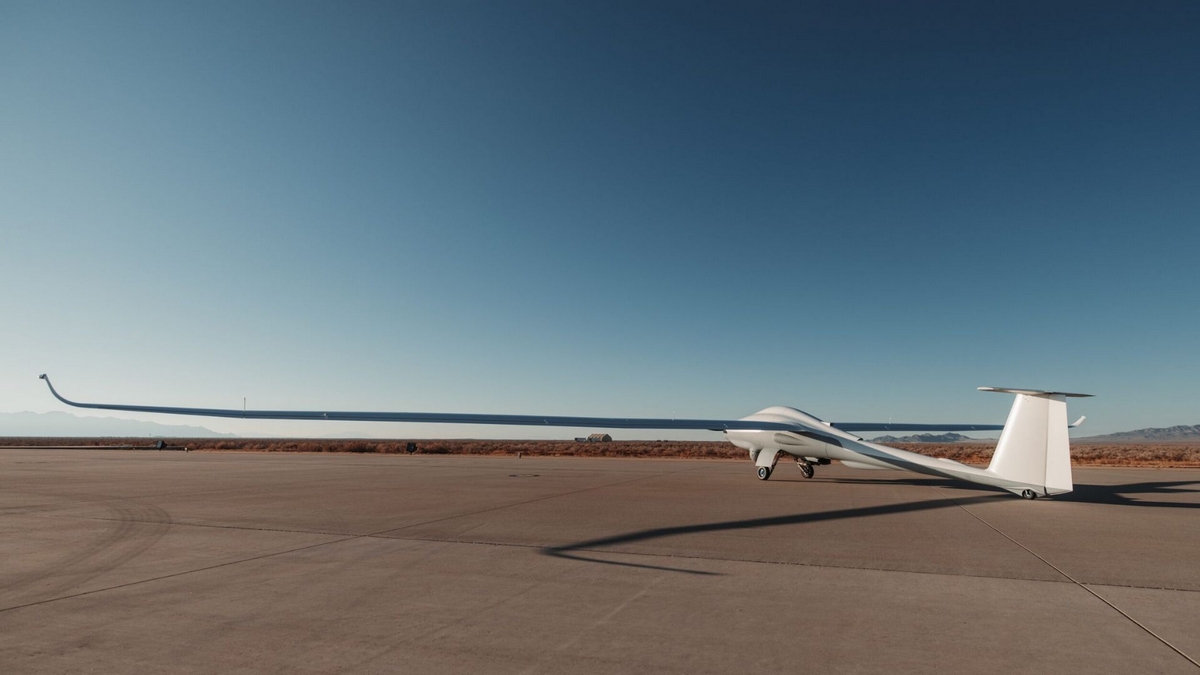
The United States Air Force is preparing to deploy an upgraded version of its ULTRA unmanned aerial vehicle to the Middle East for real-world testing. The platform, which features a glider-like design, will be evaluated in one of the world’s most heavily monitored and operationally active airspaces. This next-generation reconnaissance drone is expected to offer improved speed, higher operational altitude, and significantly extended endurance, making it suitable for long-duration intelligence, surveillance, and reconnaissance missions.

The updated version of the unmanned system, designated ULTRA Turbo, is equipped with a turbocharged engine. At the same time, the aircraft retains the key advantage of the base platform – its ability to remain airborne continuously for several days.
According to U.S. defense budget documents cited by The War Zone, the aircraft will undergo operational evaluation within the area of responsibility of U.S. Central Command. This will mark another step toward a broader assessment of the system’s combat capabilities. The testing program is scheduled to begin in fiscal year 2026 and continue through fiscal year 2027, alongside further expansion of the platform’s technical capabilities.
This decision comes amid a steadily growing demand for continuous intelligence, surveillance, and reconnaissance in the Middle East. The requirement is driven by ongoing military operations linked to Iran, as well as persistent maritime monitoring missions in the region. The ULTRA family of unmanned systems was developed by DZYNE Technologies in collaboration with the U.S. Air Force Research Laboratory, aiming to create a more affordable platform for long-endurance reconnaissance missions.
Unlike traditional military UAVs, the design is based on a civilian sailplane. This approach gives the drone its distinctive high-aspect-ratio wing profile, ideally suited for extended time aloft and long-duration flight operations.
The standard ULTRA variant is capable of performing missions for more than 70 hours, reaching altitudes of up to 7,620 meters, and carrying a payload of approximately 204 kg. The newer ULTRA Turbo version trades a portion of endurance for improved flight performance in other areas. According to DZYNE, it can stay airborne for over 60 hours, reach speeds of up to 222 km/h, and operate at a service ceiling of 9,144 meters.
The aircraft is powered by a Rotax 916 turbocharged piston engine. Developers note that integrating this engine improves performance at altitudes above 7,620 meters, enhances resilience in challenging weather conditions, and increases overall operational flexibility.
Earlier this year, the company reported a successful 60-hour test flight that fully simulated a real mission profile. The flight took place at 7,620 meters with a sustained speed of 185 km/h. In addition, the platform is positioned as a multi-role system capable of intelligence gathering, electronic warfare, communications relay, and even deploying autonomous strike payloads or other mission-specific cargo.
The Middle East is already a familiar deployment environment for ULTRA drones. Earlier testing phases in real-world conditions took place there in 2024. At that time, indications emerged that the aircraft were operating from Al Jafra Air Base in the United Arab Emirates, conducting missions toward Afghanistan.
These sorties complemented the operations of MQ-9 Reaper drones, which typically offer shorter on-station endurance in target areas due to significant transit time requirements.
U.S. command has shown growing interest in platforms that occupy a middle ground between expensive strategic systems and more vulnerable tactical UAVs. MQ-9 Reaper drones remain actively used in the region but have suffered losses in recent local conflicts. At the same time, highly classified next-generation systems such as the RQ-180 belong to an entirely different category in both cost and capability.
The ULTRA platform is intended to fill precisely this gap, providing long-endurance reconnaissance capabilities at a relatively moderate cost. To support further development and testing of the ULTRA system, the U.S. Department of Defense is requesting $16.57 million in fiscal year 2027 funding.
Read also:
- Weapons of Ukraine’s Victory: FP-1 – A Drone Capable of Reaching Moscow
- The “China Loop”: How U.S. Restrictions on DJI Created a Drone Supply Gap
Source: interestingengineering