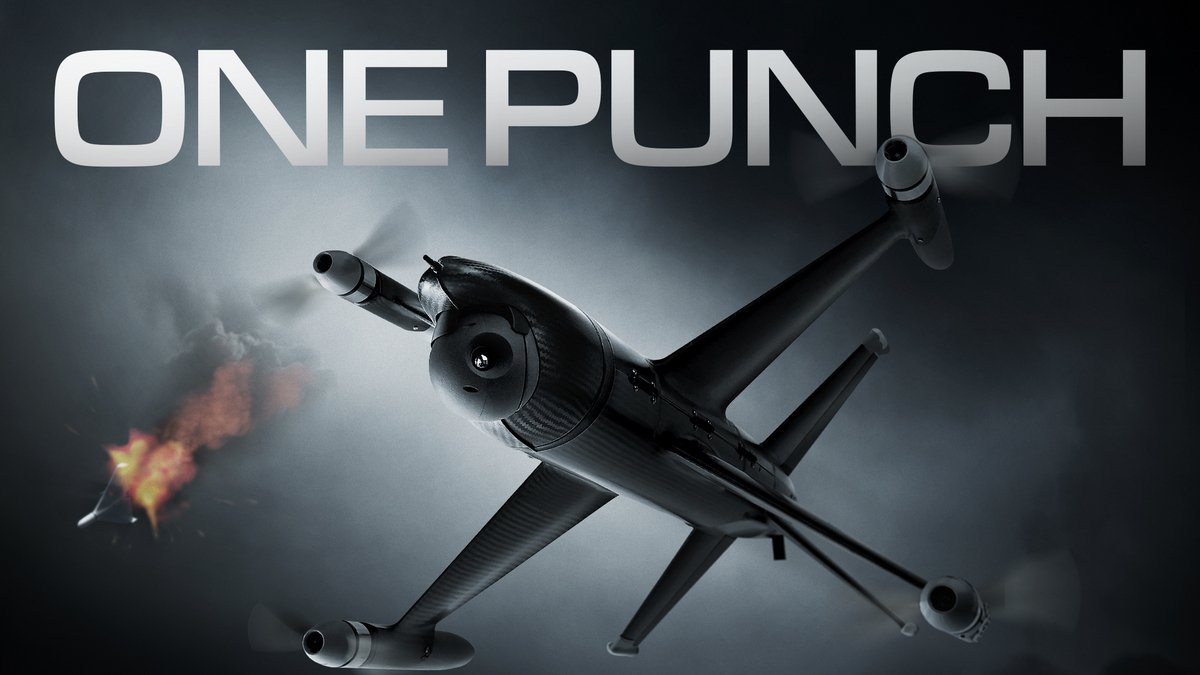
Ukrainian company Ukrspecsystems has announced the launch of its latest product, the One Punch, a specialized unmanned aerial system designed primarily for the interception of airborne threats, including the strike UAVs employed by opposing forces. During the development of the system, the engineering team focused on three key characteristics that directly affect the effectiveness of engaging aerial targets in operational conditions. These priorities were rapid response capability, a high degree of autonomous operation, and the minimization of operator workload.

From a technical standpoint, the new interceptor has an operational range of up to 45 km, while the maximum distance at which it can acquire a target is 800 m. The drone can remain airborne for up to 15 minutes when flying at its cruising speed of 190 km/h. At the same time, its maximum flight speed reaches 340 km/h. The manufacturer has equipped the system with a standard 1.2 kg munition featuring a directional fragmentation warhead. If required, however, the aircraft can also carry out interception missions without an explosive payload. In such cases, the destruction of large aerial targets, including Shahed-type drones, is achieved through the kinetic energy generated during impact.
Control of the One Punch unmanned system is implemented through a portable computer using a standard computer mouse. Operators do not require specialized joysticks, monitors, or control consoles typically associated with FPV drone operations. The aircraft is equipped with an onboard AI assistant powered by machine-vision technology. This digital system automatically identifies and highlights detected targets, while also maintaining target lock through the tracking system. Such an approach significantly reduces the likelihood of operator errors caused by fatigue and lowers the overall cognitive burden placed on personnel during missions.
The system’s readiness indicators allow it to be prepared for combat and deployed from virtually any unprepared location within approximately 15–20 minutes. When transported on a specially equipped vehicle, this setup time can be reduced to as little as 10 minutes. Operation of the aerial system is entirely independent of fixed infrastructure. Once deployed, the drone can remain on continuous combat alert thanks to an integrated launch hub that continuously maintains the required battery charge level. After the crew receives the precise coordinates of a target, the aircraft can be launched in no more than 30 seconds.
Regarding armament and configuration, it should be noted that the system is delivered to customers together with serially produced munitions. This eliminates the need for users to source additional components or to manufacture improvised explosive devices on their own. The developers also addressed safety considerations by equipping the interceptor with a remotely controlled detonation function, activated via a dedicated control button. In the event of an emergency scenario involving complete loss of communication, the self-destruct mechanism is triggered automatically.
For direct maintenance and combat employment of the system, a crew of three personnel is required: a technical specialist, a navigator, and a pilot-operator. The training program for military personnel who already possess basic skills in operating unmanned aerial systems lasts only seven days. This short duration enables rapid redeployment of service members from other units without the need for extended retraining. In turn, this creates opportunities for quickly equipping mobile fire groups with the new system or forming separate private teams.
Representatives of Ukrspecsystems emphasized that the market currently offers a wide range of interception solutions. However, they made a deliberate design choice to keep the human operator as a central element of the overall system. They explained that during intense enemy attacks, air defense systems can become heavily overloaded due to the large number of incoming targets, forcing personnel to operate continuously without rest. This, in turn, negatively affects overall interception effectiveness. By contrast, when the process of engaging hostile aerial targets is reduced to a few mouse clicks, while the system handles all complex and repetitive tasks autonomously, operators are left with significantly more capacity and endurance. According to the developers, this results in a net operational advantage for all involved parties.
Read also:
- Operation Deep Strike: Ukrainian UAVs Conducted a Coordinated Large-Scale Strike on Oil Refineries in Moscow and Across Regions of the Russian Federation
- Ukraine presents the DRAGON system: Adapting air-to-air missiles for air defense applications
Source: Ukrspecsystems