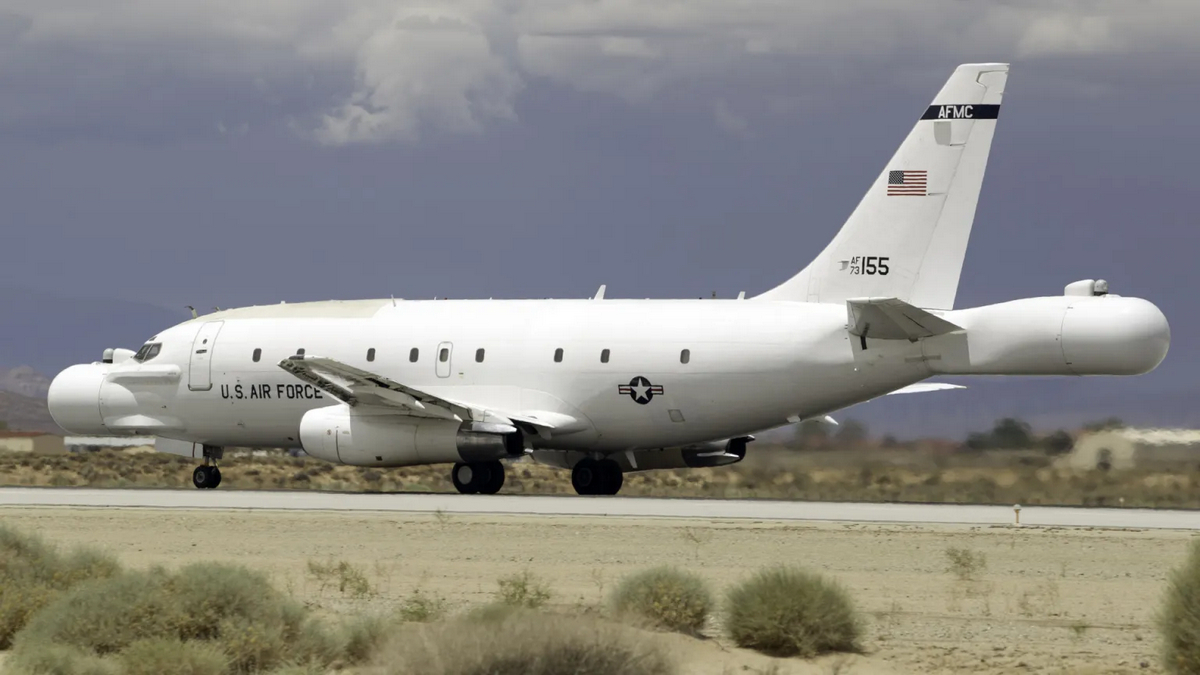
According to TWZ, the highly classified Boeing NT-43A platform, used for radar cross-section measurement by the U.S. Air Force, took part in support of the Artemis II launch. This marks the beginning of a new operational phase for the aircraft, which is also known by the callsign RAT55.
A U.S. Air Force representative stated that after decades of supporting various missions, the NT-43A Radar Test Bed is transitioning into a new stage of its service. Starting with data collection during the Artemis II launch, the aircraft is expected to continue its role in supporting complex and technologically demanding national programs.
The platform was rarely observed in public over the past year, with one of the few documented appearances occurring at Rick Husband Amarillo International Airport, where it was captured on video.

A U.S. Air Force representative did not provide additional details regarding the aircraft’s future use. The War Zone has also contacted NASA to clarify whether further missions involving the platform are planned.
It is worth noting that any official acknowledgment of RAT55 is considered highly unusual. The aircraft is often described as one of the most secretive Boeing 737 derivatives in existence. It is known to be based at Tonopah Test Range Airport, a remote and restricted site historically associated with classified aviation programs.
When the Boeing NT-43A has been observed, it has typically been at a distance during operations near U.S. Air Force test locations, including Area 51 and Edwards Air Force Base. Public appearances outside such environments have been крайне limited.
The aircraft is easily identifiable due to its heavily modified nose and the large radome mounted on the rear section of the fuselage. RAT55 is equipped with multiple additional systems designed to support its primary mission – measuring radar characteristics in support of low-observable aircraft development programs.
Two large radar arrays, positioned at the front and rear, enable precise measurement of the radar signatures of nearby aircraft. This data is used to evaluate coatings and other design features intended to reduce detectability. In addition to the main radomes, the platform is fitted with electro-optical and infrared sensors. Airborne data collection provides advantages over ground-based methods, as it allows targets to be observed from multiple angles, including from above.
RAT55 has been in service for over half a century, and experts are monitoring the prospects for its eventual retirement. The aircraft is a heavily modified T-43A, which itself is a military version of the Boeing 737-200. The last standard T-43As were retired by the U.S. Air Force in 2010. Globally, the use of early-generation 737s in any modification is declining, and maintaining the remaining aircraft is becoming increasingly challenging. To date, no direct successor to the NT-43A has been identified, though observers continue to watch for potential replacements.
In the near term, the NT-43A may play a key role in supporting spacecraft launches and recoveries. It could also be used for other testing and development tasks unrelated to space or stealth technology. If the aircraft were made accessible to a wider range of users, its unique capabilities would likely be in high demand, particularly given the current surge in development of unmanned combat platforms, such as Collaborative Combat Aircraft.
Read also:
- Could This Be a Secret RQ-180? An Unknown “Flying Wing” Spotted in Greek Skies
- Tool of Global Power Projection: All About U.S. Air Force Aerial Refueling Aircraft
Source: TWZ