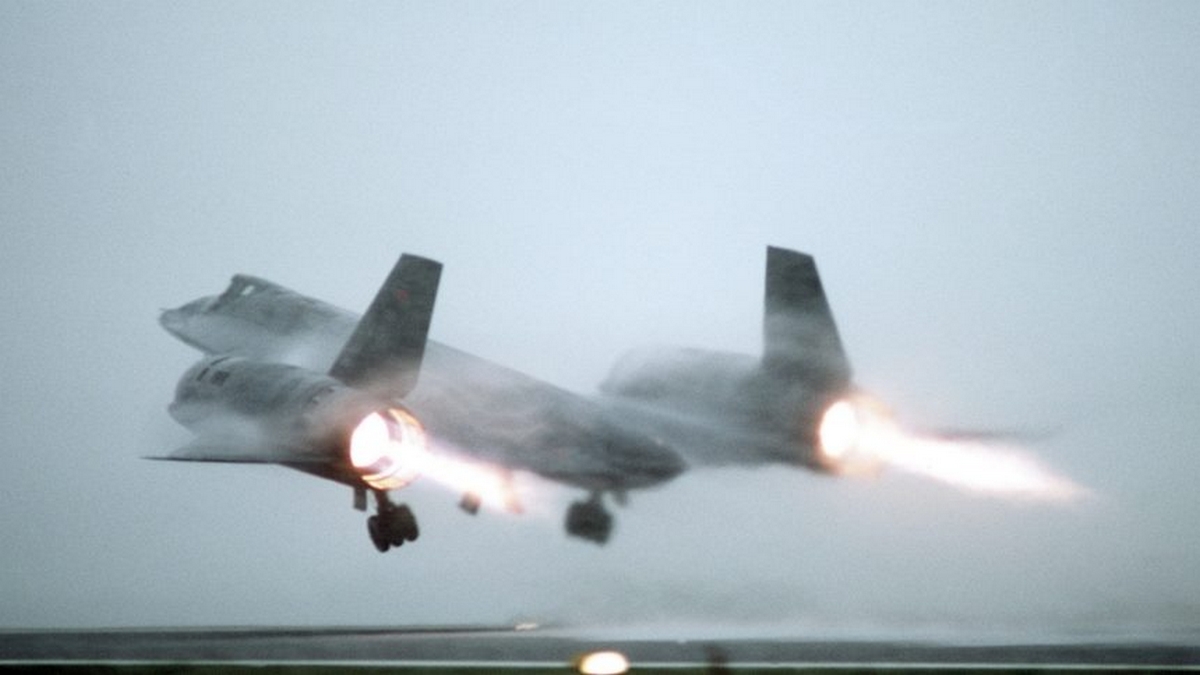
Following the completion of Operation El Dorado Canyon, a Lockheed SR-71 Blackbird was tasked with conducting a high-risk reconnaissance flight over Libyan territory. The mission required crossing the so-called “Line of Death,” a boundary declared by Muammar Gaddafi, in order to collect critical data on the effects of the strikes.
After the joint attack on key Libyan targets carried out by forces of the United States Air Force and the United States Navy, there was an immediate requirement to assess strike effectiveness. This process, commonly referred to as battle damage assessment, was essential for decision-making at the Pentagon. However, obtaining such information necessitated overflight of a high-risk area designated as restricted by Libyan authorities. At the time, the SR-71 Blackbird remained the only platform capable of executing this mission with sufficient speed and survivability.

Operation El Dorado Canyon was conducted as a response by the United States to actions attributed to Muammar Gaddafi, who had long been regarded as a threat to U.S. interests and its allies. He was accused of supporting militant groups and facilitating their training. Gaddafi had also asserted claims over a large portion of the international waters of the Gulf of Sidra, warning of consequences should U.S. forces cross this boundary.
The immediate trigger for military action was the bombing of the La Belle discotheque in West Berlin on April 5, 1986, a venue frequently visited by U.S. military personnel. The attack resulted in the deaths of two U.S. citizens and one Turkish national, and injured 229 individuals, including 79 Americans. U.S. President Ronald Reagan attributed responsibility to Libya, citing intercepted communications between Libyan diplomatic missions in East Berlin and Tripoli. In response, Reagan authorized military action against Libya, which became known as Operation El Dorado Canyon.
The air component of Operation El Dorado Canyon involved forces from both the United States Air Force and the United States Navy. The U.S. Air Force contribution included 24 General Dynamics F-111F aircraft operating from RAF Lakenheath in the United Kingdom, as well as five EF-111 Raven aircraft from RAF Upper Heyford, equipped for radar jamming and suppression of enemy air defenses. An additional six F-111s and one EF-111 were designated as reserves. Aerial refueling support was provided by McDonnell Douglas KC-10 Extender and Boeing KC-135 Stratotanker platforms.
Read also: “Invisible” Aircrafts: How Stealth Technology Works in Aviation
Naval and Marine Corps aviation operated from the aircraft carriers USS America (CV-66) and USS Coral Sea (CV-43). The strike group included 14 Grumman A-6E Intruder aircraft, 12 McDonnell Douglas F/A-18 Hornet aircraft, six LTV A-7E Corsair II aircraft, and one Grumman EA-6B Prowler. Air cover was provided by Grumman F-14 Tomcat fighters. Naval aviation was tasked with striking targets in the Benghazi area, including suspected training facilities and the Benina airfield.
The General Dynamics F-111F aircraft departed RAF Lakenheath on April 14 at 17:36 GMT and conducted an extended sortie exceeding 6,400 km round trip. The mission lasted approximately 13 hours and required multiple aerial refueling operations. Due to the refusal of France and Spain to grant overflight rights, the aircraft were forced to take a longer route around Europe, transiting the Strait of Gibraltar before approaching targets over the Mediterranean Sea. Designated targets included military facilities, aircraft at the Tripoli airfield, and the Bab al-Azizia complex, where Muammar Gaddafi was believed to be located.
Operating under restrictive rules of engagement, the General Dynamics F-111F strike packages reached the Tripoli area around midnight GMT. EF-111 Raven aircraft conducted suppression of air defenses, while naval aviation targeted surface-to-air missile systems. Strikes were carried out against targets in Benghazi and Tripoli. All United States Navy aircraft returned to their carriers; however, one F-111 was lost along with its crew. Libya maintained a relatively capable air defense network and had been placed on alert, complicating immediate assessment of strike effectiveness. As a result, a follow-on reconnaissance mission was required.
As early as 1976, the United States had secured permission to deploy Lockheed SR-71 Blackbird aircraft at RAF Mildenhall. In 1982, two aircraft were assigned there on a more permanent basis, enabling operational flexibility without requiring additional approvals for each mission. These aircraft were tasked with conducting post-strike reconnaissance.
At approximately 05:00, one SR-71 departed Mildenhall, refueled over southwest England, and proceeded toward the target area. Its crew consisted of Lieutenant Colonels Jerry Glasser and Ron Tabor. A second aircraft departed at 06:15, piloted by Major Brian Shul with Major Walt Watson serving as reconnaissance systems officer. During the flight, Shul observed returning F-111 aircraft, and the crews acknowledged each other visually.
The SR-71 aircraft were equipped with high-resolution imaging systems for detailed reconnaissance. Approximately six hours after the initial strikes, they approached Libyan airspace, at a time when the country’s air defense network was operating at full alert.
During the mission, Brian Shul and Walt Watson crossed the so-called “Line of Death” at a speed exceeding 3,400 km/h (approximately Mach 2.8). While over Libyan territory, their Lockheed SR-71 Blackbird was engaged by surface-to-air missiles, including S-75 Dvina and 2K11 Krug systems, both capable of high supersonic speeds. Upon receiving missile launch indications, the crew elected to increase speed and continue the planned route.
The aircraft exceeded standard operational speed limits, accelerating to over Mach 3.5 at an altitude of approximately 24,000 meters before executing a turn and exiting the engagement zone. The missiles were unable to intercept the aircraft. After leaving the area of operations, the SR-71 remained at high speed for an extended period and temporarily overshot a rendezvous point with a tanker aircraft near the Strait of Gibraltar.
Follow-on missions were conducted in subsequent days to refine the assessment of strike results. Initial weather conditions complicated imaging, but sufficient data was eventually collected to evaluate the effects of the operation.
The collected intelligence confirmed the effectiveness of Operation El Dorado Canyon. At the Benina airfield, multiple aircraft were destroyed, including Mikoyan-Gurevich MiG-23 fighters, as well as transport aircraft and helicopters. In Tripoli, additional aircraft were reported destroyed, including Ilyushin Il-76 and Boeing 727.
At the same time, not all General Dynamics F-111F sorties achieved their intended objectives. Some aircraft were unable to complete assigned tasks due to technical issues or restrictions imposed by rules of engagement, and certain munitions failed to strike their targets accurately, resulting in unintended damage. One bomb fell near the Embassy of France in Tripoli, prompting debate regarding the circumstances of the incident. The strikes resulted in the deaths of 37 civilians, with several others injured. Reports also indicated the death of Hana Gaddafi and damage to the residence of Muammar Gaddafi.
The Lockheed SR-71 Blackbird mission further demonstrated the platform’s ability to conduct reconnaissance in high-threat environments, relying on a combination of speed, altitude, and crew proficiency. In 1987, SR-71 aircraft were again employed for reconnaissance over Libya, although no new significant targets were identified.
Read also:
- U.S. Aerial Refueling Fleet Under Pressure: Expert Evaluates Risks of Major War
- Iran Downs a Second U.S. Combat Aircraft in a Day – A-10 Thunderbolt II
Source: theaviationist