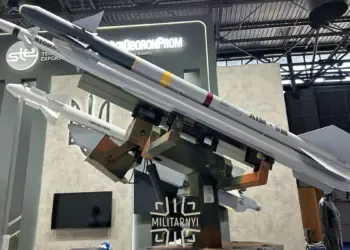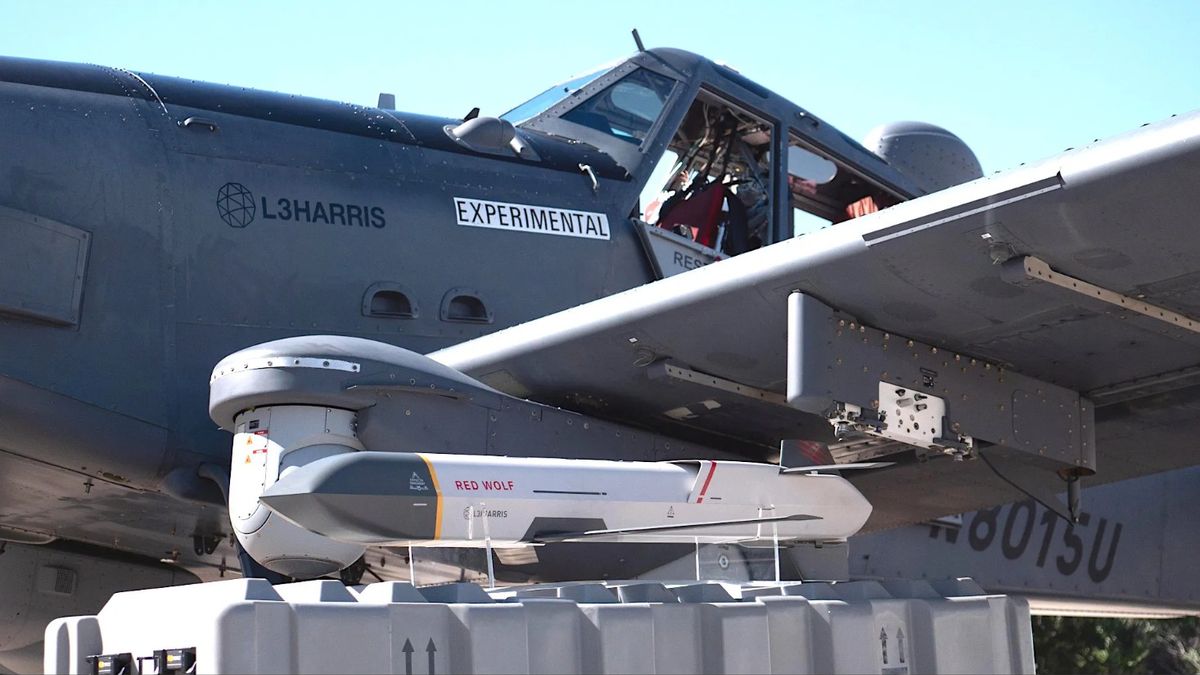
L3Harris has outlined the potential advantages of integrating the compact Red Wolf cruise missile onto the U.S. Air Force’s new OA-1K Skyraider II aircraft. According to the company, this integration could significantly expand the platform’s operational profile. Rather than functioning primarily as a close air support and reconnaissance aircraft, the OA-1K could assume an additional role as a carrier of precision-guided, longer-range munitions. This would enable the aircraft to engage targets from distances that reduce exposure to areas covered by active enemy air defense systems.

“Our customers require a compact, maneuverable aircraft capable of operating from a wide range of locations and equipped with a diverse set of payloads,” said Jason Lambert of L3Harris. “The combination of Red Wolf and Sky Warden illustrates the ability to rapidly reconfigure and adapt key L3Harris capabilities.”
The OA-1K, developed under the Armed Overwatch program, was originally intended for low-intensity operations, including surveillance, patrol, and support of special operations forces in relatively permissive airspace. The integration of munitions such as Red Wolf would broaden the range of potential missions. A comparable approach is being pursued by the U.S. Marine Corps, which is procuring Red Wolf to enhance the strike capabilities of its AH-1Z Viper attack helicopters.
L3Harris has demonstrated the technical feasibility of integrating the Red Wolf missile onto the Sky Warden aircraft, a platform based on the turboprop Air Tractor AT-802. In 2022, Sky Warden was selected as the winner of the Armed Overwatch competition and subsequently received the official designation OA-1K and the name Skyraider II. The U.S. Air Force plans to procure up to 75 aircraft of this type.
Red Wolf, along with its related system Green Wolf – equipped with electronic warfare payloads rather than a conventional warhead – was formally introduced in July of last year. According to L3Harris representatives, pairing Red Wolf with the Sky Warden highlights the platform’s adaptability and its capacity to accommodate different mission sets and payload configurations.
The Skyraider II can carry up to 2,720 kg of weapons and other stores across eight external hardpoints, four under each wing. The aircraft is also fitted with an advanced communications suite and data links that support operations both within and beyond line of sight. Integrating Red Wolf effectively enables the OA-1K to function as a launch platform for longer-range munitions, allowing crews to operate at greater stand-off distances from potential threats.
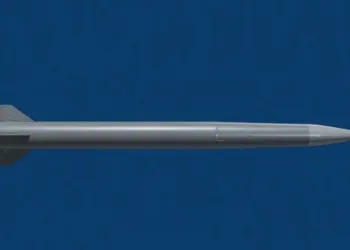
The Wolf family of systems features an aerodynamic configuration broadly comparable to that of cruise missiles. They are powered by a compact turbojet engine and incorporate design elements intended to reduce detectability. According to L3Harris, flight testing has demonstrated that the Red Wolf can operate at subsonic speeds with a range exceeding 370 km at low altitude and an endurance of more than 60 minutes. The company also states that the missile is capable of conducting autonomous strikes beyond line of sight.
A concept of cooperative employment has been proposed in which Green Wolf would detect and suppress enemy air defense systems, creating conditions for follow-on strikes by Red Wolf.
L3Harris appears to be pursuing a modular approach based on a common core design. During experimentation, one Red Wolf vehicle was reportedly configured not as a munition but as an airborne communications relay. “We can adjust the size of the warhead and the fuel tank, and we can even integrate a parachute at the rear,” said Matthew Klunder, L3Harris Vice President of Business Development. “The effect can be kinetic, non-kinetic, or even serve as a decoy.”
Integrating Red Wolf would provide the OA-1K with a stand-off strike capability that it has not previously possessed. The addition of Green Wolf could further expand its functional scope, particularly in counter–air defense roles. In theory, this combination could increase the platform’s relevance in higher-intensity conflicts, including potential scenarios in the Indo-Pacific, where long distances and dense air defense networks are significant operational factors.
At the same time, the overall effectiveness of this concept remains open to debate. One of the Skyraider II’s primary advantages is its limited logistical footprint and its ability to operate from austere or remote locations. However, its combat radius is approximately 320 km, and its survivability in contested airspace – even when equipped with longer-range weapons – remains uncertain.
It is likely that the OA-1K could perform useful functions in higher-intensity conflicts, albeit from relatively secure distances outside the most significant threat envelopes. In a Pacific theater scenario, for example, the aircraft could support localized security, surveillance, and force protection tasks at forward operating locations and island outposts. At the same time, requirements for low-intensity operations are expected to persist. In that context, the Skyraider II remains aligned with its original design purpose and may be better suited to such missions than to sustained operations in heavily contested airspace.
Read also:
- Ukrainian Defense Forces Conducted Drone and Missile Strikes on Infrastructure at the Kapustin Yar Test Range
- MQ-25 Stingray Drone for U.S. Navy Aircraft Refueling Begins Testing
Source: twz