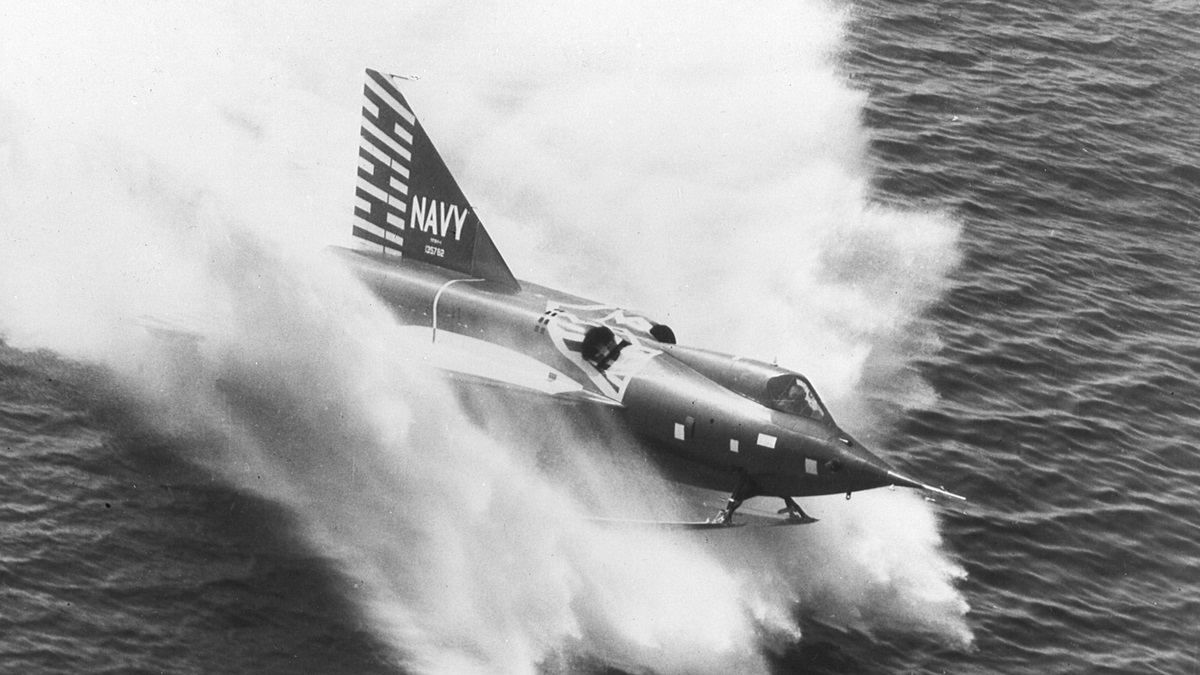
The Convair F2Y Sea Dart, designed and built at the request of the U.S. Navy’s Bureau of Aeronautics, was the first seaplane with a delta wing and the first combat aircraft equipped with retractable hydro-skis (V-shaped planing surfaces).

In the late 1940s, Convair proposed a series of unconventional seaplane designs, one of which featured a so-called “blended hull.” The blended hull concept envisioned the aircraft sitting deep in the water, with its wings touching the surface and contributing to overall buoyancy (without the need for additional floats). Convair’s approach to designing the seaplane involved creating an advanced hydrodynamic model, which would then serve as the foundation for developing a highly efficient aircraft.
The aircraft was developed by Convair under a Navy contract for the creation of a supersonic interceptor. The challenges were seen in the long takeoff and landing distances of supersonic aircraft and their high landing speeds. One solution to these issues was the design of a jet-powered seaplane fighter, which led to the development of the F2Y Sea Dart.
The first prototype of the Sea Dart, the XF2Y-1, was launched in San Diego Bay on December 16, 1952. After extensive water testing, it made its first flight on April 9, 1953. On August 3, 1954, during a shallow dive at an altitude of 10,400 meters, the YF2Y-1 aircraft exceeded the speed of sound.
The Sea Dart remains afloat until it reaches sufficient speed, at which point the hydro-skis generate the necessary hydrodynamic lift to raise the aircraft’s fuselage above the water surface before takeoff.
Read also: Lesser-Known Pages in Aviation History: The McDonnell XF-85 Goblin Fighter
The XF2Y-1 aircraft was powered by two Westinghouse J-34-WE-42 turbojet engines, each producing 1,540 kg of thrust. The second prototype, also designated XF2Y-1, which was destroyed in a crash in November 1954, had a slightly extended tail section designed to accommodate afterburners, giving its two Westinghouse J-46-WE engines a thrust of 2,700 kg each. Without afterburner, the engine’s thrust was 2,090 kg.
Convair received an order to produce 12 F2Y-1 Sea Dart fighters, but it was canceled, and further work was concentrated on a modified version, the XF2Y-2. This version was to be equipped with a single turbojet engine (either a Wright J-67 with 5,450 kg of thrust or a Pratt & Whitney J-75 with 6,800 kg of thrust). Additionally, one variant of the XF2Y-1 was fitted with a single hydro-ski for experimental purposes.
Main technical characteristics of Convair F2Y Sea Dart:
- Modification: YF2Y-1
- Wingspan: 10,26 m
- Length: 16.03 m
- Height: 6,32 m
- Wing area: 52.30 m²
- Airplane’s run-up: 1680 m
- Mileage: 305 m
- Empty weight of the airplane: 5793 kg
- Normal takeoff weight: 7497 kg
- Engine type: 2 Westinghouse J34-WE-32 turbofan engines
- The thrust is not forced: 2 x 1542 kgf
- Maximum speed: 1118 km/h
- Cruising speed: 980 km/h
- Practical range: 826 km
- Maximum lifting capacity: 9965 m/min
- Practical ceiling: 15300 m
- Crew: 1 pilot
- Armament: Combat payload – 907 kg (calculated)
Read also: Lesser-Known Pages of Aviation History: Bachem Ba-349A Natter – One-Time-Use Rocket Interceptor
The Convair F2Y Sea Dart took to the air for the last time on January 16, 1956. The goal was to assess the aircraft’s maximum seakeeping capabilities. The sea state was at level 5 (with wave heights up to 3 meters) and strong winds of 37 km/h. During takeoff, pilot Billy Long attempted to lift off early to avoid the severe shaking and hydraulic shocks. As a result, the aircraft bounced off the water and then began to skip across the surface. The impacts were extremely harsh. Long’s only thought during this ordeal was to prevent the plane from diving into a wave and, if possible, to take off. Eventually, the Sea Dart lifted off. After gaining altitude and circling the bay, Billy prepared for landing. The landing was also rough, accompanied by several hard impacts. During the landing, Long hit his head and broke his nose. Despite this, he managed to keep the aircraft from submerging and brought the Sea Dart to a stop, safely returning to San Diego. This was the seaplane’s final flight.
Read also: “Invisible” Aircrafts: How Stealth Technology Works in Aviation
The final blow to the Sea Dart program came with the emergence of “supercarriers” (as they were called by the Americans due to their massive displacement of 60,000-75,000 tons at the time) of the Forrestal class. As a result, the Sea Dart lost out to the heavy aircraft carrier, which it was intended to replace if successful. In January 1956, the Navy’s Bureau of Aeronautics withdrew the technical requirements for a seaplane fighter, and the program was closed.