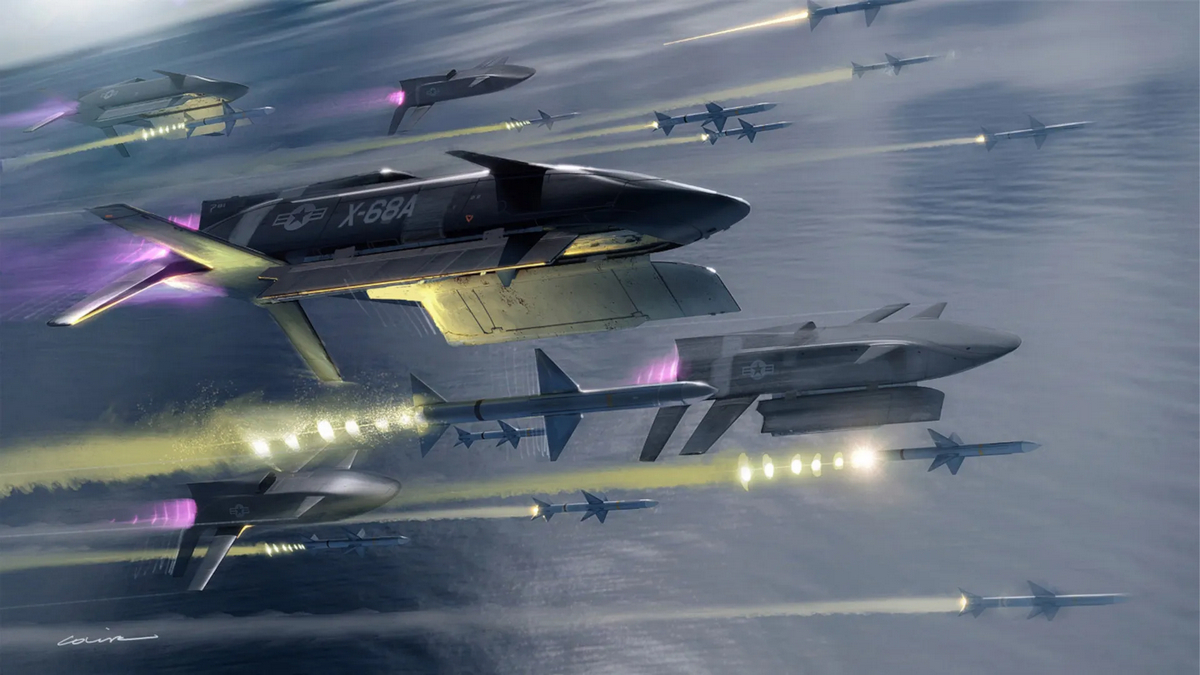
The X-68A LongShot drone, designed for air-to-air missile launches, is approaching flight tests from an F-15. The program also envisions using such drones with bombers and transport aircraft, enabling them to counter aerial threats while reducing their own vulnerability.

General Atomics has announced a new phase in the development of the LongShot aerial drone, now officially designated X-68A. Following a series of ground tests, including demonstrations of its weapon-release system, the drone is approaching its first flight. Initially, it is expected to be launched from an F-15 Eagle fighter. The core concept of the project is for the drone, armed with air-to-air missiles, to extend the engagement range while reducing risk to the carrier platform.
DARPA, which oversees the initiative, has released new details about the program. It involves multiple U.S. government entities, including units from the Air Force, Navy, Army, and NASA. Initial contracts in 2020 were awarded to General Atomics, Lockheed Martin, and Northrop Grumman; however, in 2023, DARPA selected General Atomics’ concept for further development. While the first flight was originally planned earlier, the current objective is to begin flight testing by the end of the year.
According to DARPA, full-scale wind tunnel testing has been completed, along with evaluations of the parachute recovery system and the weapon separation mechanism, indicating readiness for the next phase. Previously released images showed LongShot’s capability to launch at least one AIM-120 AMRAAM missile from an internal fuselage bay.
In terms of design, LongShot resembles a cruise missile with an elongated fuselage and a distinctive nose shape. Its main wings are swept-back, positioned closer to the tail, and deploy after launch. The configuration includes a twin-tail in an inverted V shape and an air intake on the upper fuselage. Publicly available information indicates the drone is powered by a Williams WJ38-15 turbojet, suggesting a top speed in the high-subsonic range. A similar engine is used in the Taurus KEPD-350 missile, which has a reported speed of up to Mach 0.95.
The parachute system is currently intended primarily for testing and training purposes. In operational scenarios, the drone is not expected to be recovered, as its concept envisions use as an expendable asset.
The first operational launch of LongShot is planned from an F-15, a platform known for carrying large and unconventional payloads. Future plans include integrating the drones into bomber internal bays and deploying them from transport aircraft using the Rapid Dragon system. This approach would allow rapid saturation of a given airspace sector with combat assets, creating a temporary protective layer for more vulnerable platforms.
LongShot is designed to move the missile launch point closer to high-risk areas while keeping the carrier aircraft at a safer distance. The drones can receive targeting data not only from the launching aircraft but also from other nodes within extended command networks, including long-range communication systems. The system allows for control transfer between nodes and supports increased levels of autonomy.
At the same time, questions remain about the cost-effectiveness of using an expendable drone compared with reusable unmanned systems or longer-range missiles. However, military planners may consider this approach necessary for specific mission types that are not covered by other assets.
The LongShot program could also become part of broader initiatives to develop next-generation unmanned combat systems, including integration with projects such as the Collaborative Combat Aircraft program.
Read also:
- U.S. Army Tests Drone Equipped with “Invisible Weapon” Capable of Disabling Swarms Without Explosives
- Ukrainian Defense Forces Conducted Drone and Missile Strikes on Infrastructure at the Kapustin Yar Test Range
Source: TWZ