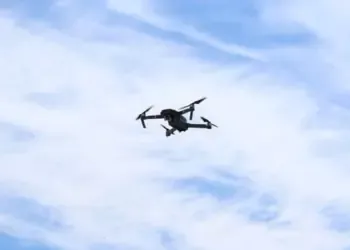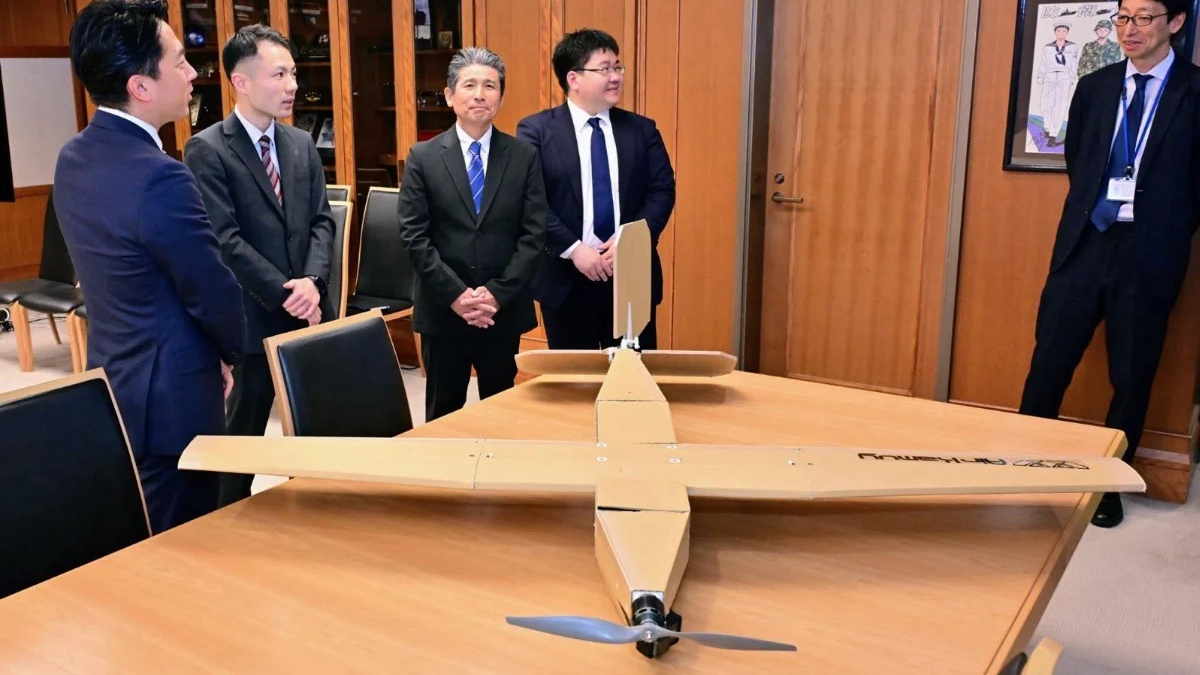
Japan is exploring unconventional approaches to military technology, as the country’s defense minister has met with a startup developing drones made from cardboard. The company Air Kamui has already supplied its low-cost drones to the Japan Maritime Self-Defense Force for use as aerial targets, indicating initial operational adoption. Constructed from corrugated cardboard, these drones are characterized by low weight, low cost, and the ability to be rapidly produced at scale.

The concept reflects a broader shift toward scalable and expendable unmanned systems, as Japan seeks to strengthen its defense capabilities through practical and cost-effective solutions. Recently, students at Pennsylvania State University developed a low-cost rescue drone with 3D mapping, capable of autonomous navigation in dark, GPS-denied environments for indoor search operations.
Several startups have already introduced drones primarily constructed from corrugated cardboard for low-cost, single-use missions. The choice of material offers clear advantages: such platforms are lightweight, inexpensive, biodegradable, and can be rapidly produced in large volumes. This makes them suitable for scenarios where asset loss is expected, including training exercises, according to Defence Blog.
Beyond training roles, the military is considering additional applications for these drones. Their cardboard construction reduces radar reflectivity compared to metal or carbon fiber, making detection more difficult. This lower observability may support reconnaissance missions, allowing target identification while remaining less visible to adversary sensors.
At the center of Japan’s efforts is the AirKamuy 150 model developed by Air Kamui. Built from corrugated cardboard with a water-resistant coating, the drone is lightweight and low-cost, and can be delivered in a disassembled form for assembly in approximately five minutes. Its unit cost is about $2,500, significantly lower than that of conventional fixed-wing unmanned systems.
The Japan Maritime Self-Defense Force is already using this platform as an aerial target, indicating practical viability. Beyond training, its reduced radar signature may support reconnaissance use cases where a lower probability of detection is important.
Japan is also adjusting its defense strategy, shifting from simple procurement toward deeper integration of unmanned systems across all service branches. This approach involves not only acquisitions, but also the development of doctrine, training programs, logistics networks, and sustained operational use in real-world conditions.
Shinjiro Koizumi, Japan’s Minister of Defense, has outlined ambitions to position Japan as a global leader in the use of unmanned aerial systems. As part of this direction, the Japan Ground Self-Defense Force has established dedicated units focused on unmanned systems to improve planning and integration capabilities. These initiatives are part of a broader framework known as Synchronized, Hybrid, Integrated and Enhanced Littoral Defense (SHIELD). The concept envisions a large-scale network of relatively low-cost unmanned systems designed to provide continuous surveillance of Japan’s southwestern islands.
Low-cost platforms developed by Air Kamui are already playing a role in this transformation. At present, they are used as aerial targets, enabling maritime units to conduct more frequent and realistic live-fire and missile defense training at reduced cost, without the need for recovering and repairing the aircraft after each exercise.
The “Shiraha” project illustrates Japan’s intention to build a fully domestic drone supply chain. In April 2026, the local startup JISDA presented the ACM-01 Shiraha, a low-cost unmanned platform featuring a wooden fuselage and an estimated unit cost of around $450. Built entirely from locally sourced components, it is designed to reduce dependence on foreign materials.
This policy aligns with Japan’s broader expansion of its defense sector and increasing military expenditure, influenced in part by lessons learned from the war in Ukraine. Beyond military use, similar drone technologies are also being considered for disaster response applications, including rapid damage assessment and search-and-rescue operations, highlighting their dual-use potential.
Read also:
- Everything About Ukrainian Interceptor Drone JEDI Shahed Hunter
- Ukrainian “Sky Map” Supports U.S. Operations: Pentagon Deploys Ukrainian Drone Control System Following Iranian Attacks
Source: interestingengineering