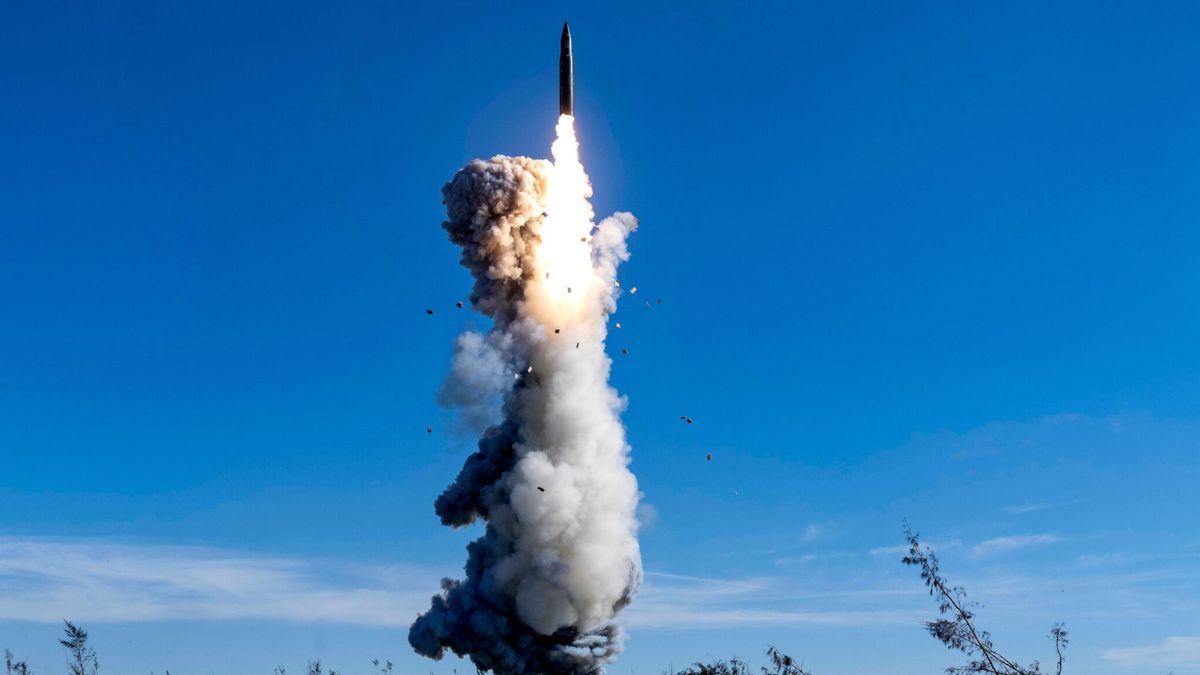
The Main Directorate of Intelligence of Ukraine (HUR) has conducted two successful rocket launches that reached altitudes of over 100 km and 204 km, respectively. This was reported by Fedir Venislavskyi, Head of the Subcommittee on State Security, Defense, and Defense Innovation within the Verkhovna Rada Committee on National Security, Defense, and Intelligence. In an interview with RBC-Ukraine, he stated that these launches were carried out as operational missions under the leadership of then–HUR head Kyrylo Budanov and other officials within the agency.
The reported activities are not limited to these two high-altitude flights. The same HUR working group also carried out an air-launch operation, deploying a launch vehicle from a transport aircraft at an altitude of approximately 8,000 meters. According to Venislavskyi, this marked the first such operation conducted over the European continent and the second instance globally. He noted that a comparable approach had previously been implemented by the United States in the mid-1970s, while also stating that the achieved deployment altitude represents a record in this context.

The official emphasized that these launches were not experimental or research-oriented. According to him, they were conducted as operational missions under the leadership of then–Head of the Main Directorate of Intelligence, Kyrylo Budanov, and other agency officials. He noted that the unit achieved both technically notable results and fulfilled specific military objectives.
He also referred to a separate class of weapons that remains largely undisclosed to the public. According to his statement, these systems include missiles capable of striking targets at distances of up to 500 km while operating at hypersonic speeds. He added that such capabilities are already being used in ongoing operations, with their primary role associated with specialized or non-standard mission profiles.
This information suggests a link between the hypersonic missiles and the launch vehicles used in the described space missions, indicating a shared technological foundation behind these developments.
Launching a rocket from an aircraft at an altitude of around 8 km provides measurable advantages compared to ground-based launches. In this configuration, the rocket bypasses the densest layers of the atmosphere, where the highest energy losses typically occur. This can improve overall flight efficiency and extend operational range.
As Venislavskyi explained, the lower layers of the atmosphere impose the greatest aerodynamic and energy constraints on a launch vehicle. Starting from a higher altitude allows the system to operate more efficiently during the initial phase of flight. He characterized these results as a notable outcome of the group’s work under HUR supervision and noted that development in this area is ongoing.
According to his statement, the platform developed in Ukraine could, in the future, function as an “air-based launch system,” with potential applications beyond military use, including civilian purposes, as well as roles related to countering specific threats.
This capability carries strategic implications. Venislavskyi stated that Ukraine has preliminary agreements with international partners willing to provide satellites, as well as the technical capacity to place them into orbit.
He also noted that Ukraine belongs to a limited group of countries with operational space technologies. According to his assessment, the country is capable of producing launch vehicles, further developing existing systems, and building spacecraft. The necessary scientific and industrial base is already in place, while future progress in this area will largely depend on the level of available funding.
Funding remains the primary constraint. Venislavskyi acknowledged that, under wartime conditions, the majority of the budget is allocated to the security and defense sector, which limits the resources available for technically complex research and development projects. At the same time, he expressed expectations of increased involvement from international partners in supporting such initiatives. Regardless of funding sources, the underlying technical base is already established, as evidenced by two high-altitude launches and one air-launch operation conducted under active operational conditions.
Read also:
- Ukraine Develops Air-Launched Ballistic Missile: What Is Known
- Ukraine deploys part of a private air defense system: how the technology works
Source: defence-blog