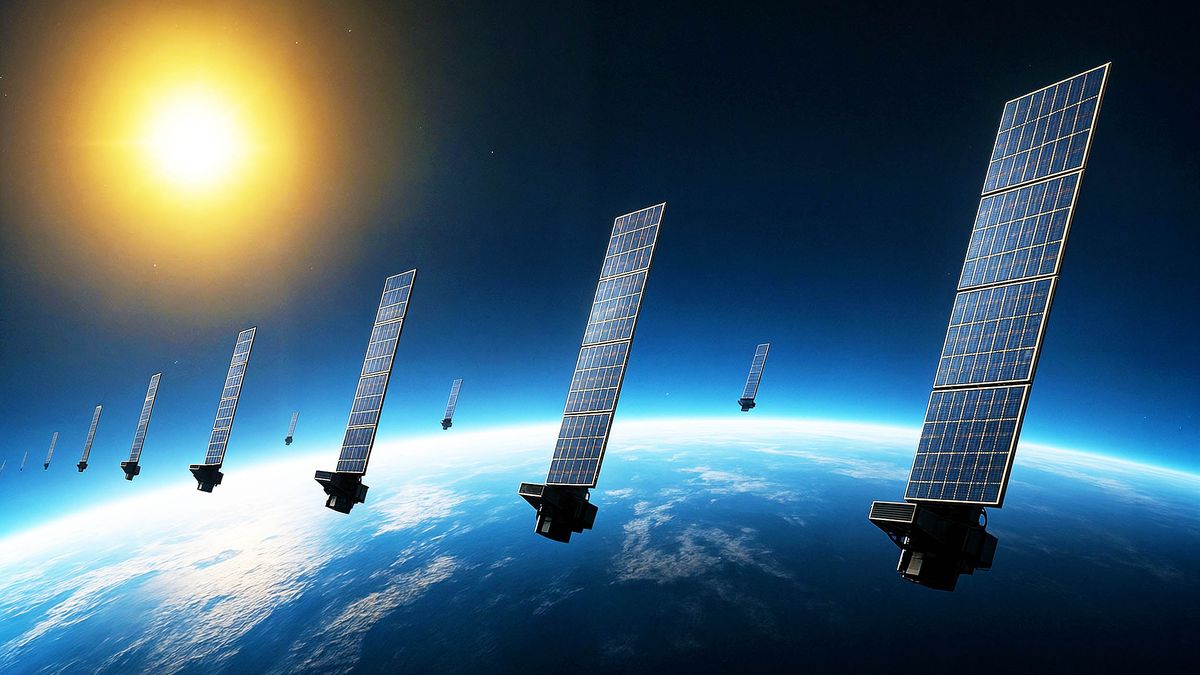
Intelligence agencies from two NATO countries warn that Russia may be working on a new type of weapon aimed at targeting the Starlink satellite constellation by creating clouds of small debris in low Earth orbit. Materials reviewed by Associated Press journalists on condition of source anonymity describe a so-called “area-effect” system intended to weaken Western space capabilities, which have played an important role in supporting Ukraine during Russia’s full-scale invasion.
Rather than relying on the traditional approach of destroying individual satellites with interceptors, the concept involves saturating Starlink’s operational orbits with hundreds of thousands of high-density metal fragments. By creating a hazardous zone in a specific orbital region, such a system could potentially disable multiple satellites at once and pose a risk to other spacecraft operating on similar trajectories.

According to the concept, Starlink orbits could be “seeded” with microscopic projectiles measuring only a few millimeters. Taken together, they would form a dense field of ultra-high-velocity particles, effectively functioning as a distributed kinetic threat. These elements are reportedly envisioned to be deployed into orbit by groups of small satellites.
Due to their extremely small size, such dense particles would be nearly impossible to track with existing ground-based or orbital monitoring systems, which are designed to detect much larger objects. Because the debris would remain below standard detection thresholds, any damage they cause would be extremely difficult to conclusively attribute to a specific attack.
The Starlink satellite network has become a critically important communications system for Ukrainian military and government institutions during the war. According to intelligence assessments, Moscow views Starlink as a serious threat, as this infrastructure enhances Ukraine’s resilience and directly links Western technological capabilities to developments on the battlefield.
Russian authorities have repeatedly stated that commercial satellites supporting Ukrainian military operations may be considered legitimate military targets. In addition, Russia recently announced the deployment of a new S-500 ground-based missile system, which it claims is capable of engaging objects in low Earth orbit. However, even among allied governments and the expert community, there is ongoing debate about whether weapons of this type are technically and strategically viable. Analysts who have not reviewed these materials question whether Russia could implement such a system without triggering an uncontrolled cascade of debris that would pose a threat to satellites operated by other countries, including China and Russia itself.
Some experts consider it unlikely that Moscow would accept such a high level of risk to its own space programs. Victoria Samson, a space security specialist at the Secure World Foundation who leads the organization’s annual assessment of anti-satellite systems, said she does not believe such a concept is practically feasible. In her view, work on a system of this kind may remain limited to laboratory experiments or theoretical research, rather than indicating the imminent emergence of a real operational capability.
The disclosed materials do not provide information on specific timelines for when Russia might deploy such a system, nor do they outline testing phases or clear research and development milestones. According to an official familiar with the intelligence, the project is in an active development phase, but details regarding potential deployment timelines are considered too sensitive for public disclosure.
Analysts cited by journalists note that after an attack involving such particles, the residual fragments would gradually decay and enter denser layers of the atmosphere. Before that, however, they could intersect with the orbits of other satellites. Since Starlink operates at altitudes of around 550 km, while the ISS and China’s Tiangong space station are positioned lower, both platforms could potentially face increased risk due to the migration of debris.
Read also:
- GUR Releases Schematic of the Russian “Molniya-2R” FPV Drone Equipped with a Starlink Terminal
- Sabotage Targeting Russian Su-30 Fighters in Lipetsk Caught on Video
Source: techspot