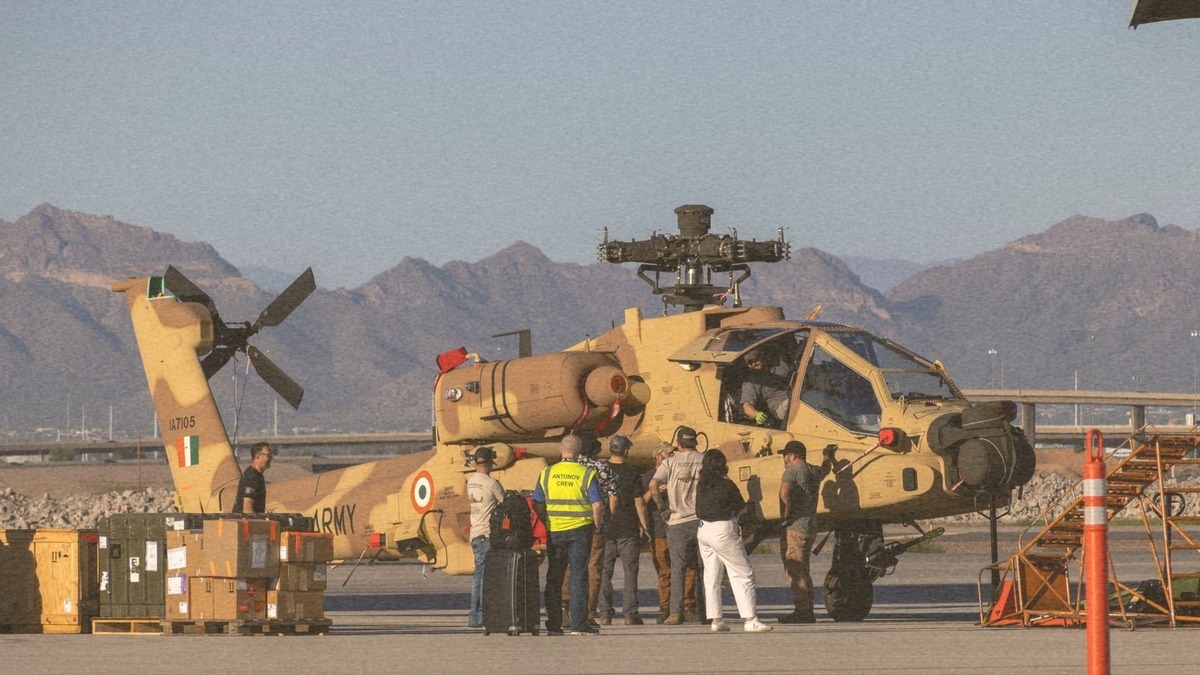
Turkey blocked the transit of Apache attack helicopters to India through its airspace, forcing Boeing to draw up a new delivery schedule for the last three aircraft intended for the Indian Army. An earlier attempt to transport the helicopters at the beginning of the month failed precisely because Ankara refused to grant overflight permission.
Security officials reported that on November 1, the heavy transport aircraft Antonov An-124 with tail number UR-82008 departed Mesa-Gateway Airport in Arizona – also known as Phoenix-Mesa – carrying the second batch of three Apache helicopters for the Indian Army. It then made a refuelling stop at the UK’s East Midlands Airport. However, instead of a short technical pause, the aircraft remained grounded there for eight days and, on November 8, unexpectedly returned to the United States without ever continuing its journey to India.

According to sources, three helicopters were offloaded at a U.S. military base, after which the Antonov An-124 departed to carry out other missions. When asked to comment on the reason for returning to the United States, Boeing stated that it continues to coordinate with both the U.S. government and the Indian military to fulfill the contract within the established timeline, aiming to meet India’s requirements. The manufacturer noted that it is managing logistical challenges caused by external factors but intends to complete the delivery of the remaining aircraft. To date, the Indian Air Force has received 22 of these helicopters, while the army has received three units.
Informed sources indicated that the underlying reason for the delay was Turkey’s refusal to grant overflight permission for the Antonov along its air corridor. While efforts were made to identify an alternative route, the transport aircraft already had a scheduled mission, leaving the choice between offloading the cargo in the United Kingdom or returning it to the United States. Ultimately, the latter option was selected.
Notably, the first batch of three Apache helicopters arrived in India in August using the same type of aircraft and also transiting Turkish airspace. At that time, there were no restrictions, but in the current case, Ankara did not approve the overflight request.
Previously, the Indian side chose not to participate in the celebration of Turkey’s Republic Day at its embassy in New Delhi, effectively signaling discontent with Ankara’s stance. The decision was linked to Turkey’s support for Pakistan, particularly during Operation Sindhur, as well as critical statements made by Turkey regarding India’s policies in Jammu and Kashmir at international forums, including the UN General Assembly. This move by New Delhi served as a clear indicator of a deteriorating political climate between the two countries, which is now having a noticeable impact on defense logistics.
Sourse: ThePrint