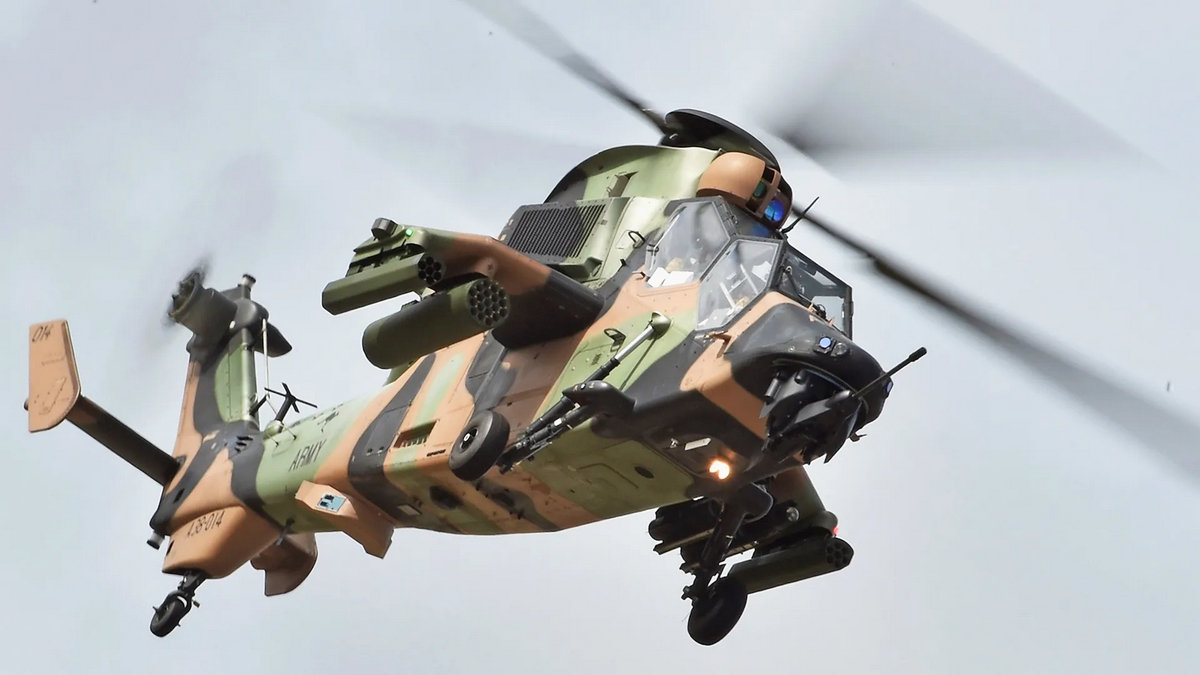
According to recent reports, Canberra and Kyiv are negotiating the transfer of decommissioned Tiger reconnaissance and attack helicopters. As the Australian Army transitions to new AH-64E Apache Guardian helicopters, Ukraine hopes to acquire European aircraft to strengthen its own fleet.

The Australian press reports that the government is considering sending 22 Airbus Helicopters-built Tigers. This move could be part of a future military aid package, although the attack aviation component will likely be handled as a separate supply process. Canberra has previously approved the transfer of a significant batch of M1A1 Abrams tanks.
The operational history of the Tiger in Australia has been fairly complex. The purchase contract was signed in 2001, but the helicopters only achieved full operational capability in 2016, while still facing several unresolved technical issues. Due to high maintenance costs and low flight readiness, the Australian Department of Defence decided to replace them. In 2021, the choice fell on the American AH-64E, which outcompeted offers from Bell and upgraded Airbus variants. At the time, defence officials cited the American platform as more reliable and less risky.
Washington approved the sale of 29 AH-64E helicopters, along with associated equipment and armaments, in the summer of 2021. The Australian military had planned to operate the existing Tiger fleet until 2027, gradually cannibalizing some helicopters for spare parts to keep others operational. However, the retirement schedule may be accelerated, as the first new helicopters have already begun flying.
Ukrainian diplomats have confirmed their interest in this equipment. Ukraine’s ambassador to Australia, Vasyl Miroshnychenko, noted that Kyiv is grateful for any assistance of this kind. The Ukrainian side is keen to avoid a repeat of the MRH90 Taipan situation, in which the Australian government chose to decommission and scrap the helicopters rather than transfer them, despite an existing request.
The potential integration of the Tiger into the Ukrainian Armed Forces would require substantial effort. Flight and technical personnel would need to be trained, logistics and infrastructure adapted, and supplies of compatible weaponry secured – including AGM‑114 Hellfire missiles. An additional challenge is that the French training center for these helicopters is expected to cease operations in 2028.
The large-scale war in Ukraine has intensified discussions about the role of attack helicopters in modern combat. Their vulnerability to dense air defense systems and widespread drone use has led some countries to reconsider their strategies. For example, South Korea adjusted its plans to acquire Apaches in favor of unmanned systems and AI, taking lessons from the Ukrainian front. The threat from man-portable air-defense systems and advanced radar has significantly increased, making traditional tactics more hazardous.
Despite these challenges, attack aviation is adapting through the use of long-range weapons, electronic warfare systems, and new concepts for drone integration. Both Ukraine and Russia continue to deploy helicopters near the front lines, often using them as mobile artillery platforms.
In addition to the Tiger, Kyiv has also signed a letter of intent with Bell Textron regarding the possible supply of Viper and Venom helicopters. Acquiring any modern Western aircraft would represent a major leap forward for Ukraine’s Army Aviation, which currently relies on Soviet-era Mi‑24s and Mi‑8s. Western models surpass them in speed, maneuverability, and onboard systems, making them effective not only for supporting infantry but also for intercepting enemy drones.
So despite skeptical forecasts, writing off attack helicopters as obsolete appears premature.
Read also:
- Weapons of Ukrainian Victory: Multi-Purpose Helicopter UH-60 / S-70A Black Hawk
- Everything About the Bell AH-1Z Viper and UH-1Y Venom Helicopters: History, Specifications, and Prospects in Ukraine
Source: TWZ