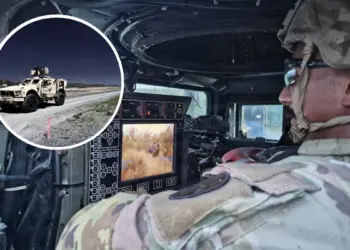
The US Army has taken a notable step forward in counter-UAV development by conducting live-fire exercises at Fort Hood in Texas, where the 1st Cavalry Division tested autonomous systems designed to protect armored vehicles against small unmanned aerial systems. The drills, held from April 7 to 9, were part of the Pegasus Charge initiative and the broader Golden Shield concept. The exercise focused on integrating sensors, effectors, and command-and-control systems into a layered defense network intended to detect, track, and engage aerial threats more rapidly, while reducing operator workload.

During the Golden Shield exercise, kinetic and non-kinetic effectors, modern sensors, and command-and-control systems were integrated into a unified architecture. The development involved the US Army’s DEVCOM Ground Vehicle Systems Center along with industry partners and is intended to protect maneuvering armored formations from aerial threats.
According to officials, a key objective was to reduce the time between target detection and engagement by automating parts of the decision and response chain. This approach is also intended to reduce cognitive load on soldiers in complex combat environments while maintaining continuous protection against drone attacks.
The system is based on an open and scalable architecture that allows for the rapid integration of new technologies. It combines sensors, weapon systems, and vehicle protection kits across different tactical platforms to form a coordinated defensive network. This structure enables flexible scaling depending on mission requirements. By linking detection and engagement nodes, Golden Shield is designed to improve tracking and response speed, which is particularly relevant for countering low-cost, high-volume aerial threats that are increasingly common on modern battlefields.
A key outcome of the exercises was the demonstration of an end-to-end automated engagement chain. During the scenario, a sensor on one platform detected and classified a hostile unmanned aerial vehicle, then transmitted the target data to another platform equipped with weapons systems. That second platform subsequently engaged and neutralized the target. The event was presented as a demonstration of an automated detect-to-engage workflow between separate systems during trials conducted by the division. The exercises took place at Fort Hood as part of the broader Golden Shield experimentation effort involving the 1st Cavalry Division.
According to Alfred Grein, the long-term direction is toward layered protection at the formation level, with the current trials representing an early stage in that development path. He noted that some subsystems are already at relatively high maturity, while others remain in evaluation, consistent with the purpose of experimental exercises prior to wider fielding decisions. The development effort is supported by the DEVCOM Ground Vehicle Systems Center and industry partners. It is structured as an open, modular system intended to integrate sensors, effectors, and command-and-control elements across multiple platforms, with the goal of improving response times against small aerial threats in operational environments.
These exercises reflect a shift toward distributed air defense, in which different platforms share detection and engagement roles rather than relying on dedicated, single-purpose systems. According to Army assessments, this approach improves the ability to adapt to emerging threats while maintaining the mobility and survivability of armored formations in complex operational environments. It is also consistent with broader modernization efforts aimed at network-centric combat systems.
Within the Golden Shield framework, new interceptor concepts were also tested, including micro-missile systems designed for short-range counter-UAV missions. These are intended for engagement of Group 1 and Group 2 unmanned aerial systems and are launched from compact multi-round launch modules. Each interceptor is designed with cost-efficiency in mind, with a reported engagement range of approximately 1,000 meters and a precision guidance approach based on radar and command input data.
According to Major Kevin Correa, head of air and missile defense for the 1st Cavalry Division, the next step will be the integration of the tested systems into the training programs of armored units. The objective is to evaluate not only the technical performance of the systems, but also the crews’ ability to operate them alongside other mission tasks in a combat environment. This phase is intended to support practical familiarization with the new capabilities and assess how effectively they can be incorporated into routine operational procedures without reducing unit combat effectiveness.
Data collected during the Golden Shield exercises is expected to inform future decisions regarding the fielding of autonomous counter-UAV systems within armored formations. The results are anticipated to contribute to the development of layered defense concepts under the Pegasus Charge and Transforming in Contact programs, with the aim of improving the ability of forces to respond to modern aerial threats.
Read also:
- Weapons of Ukraine’s Victory: The “Shvidun” Interceptor Drone
- Everything About Ukrainian Interceptor Drone JEDI Shahed Hunter
Source: interestingengineering