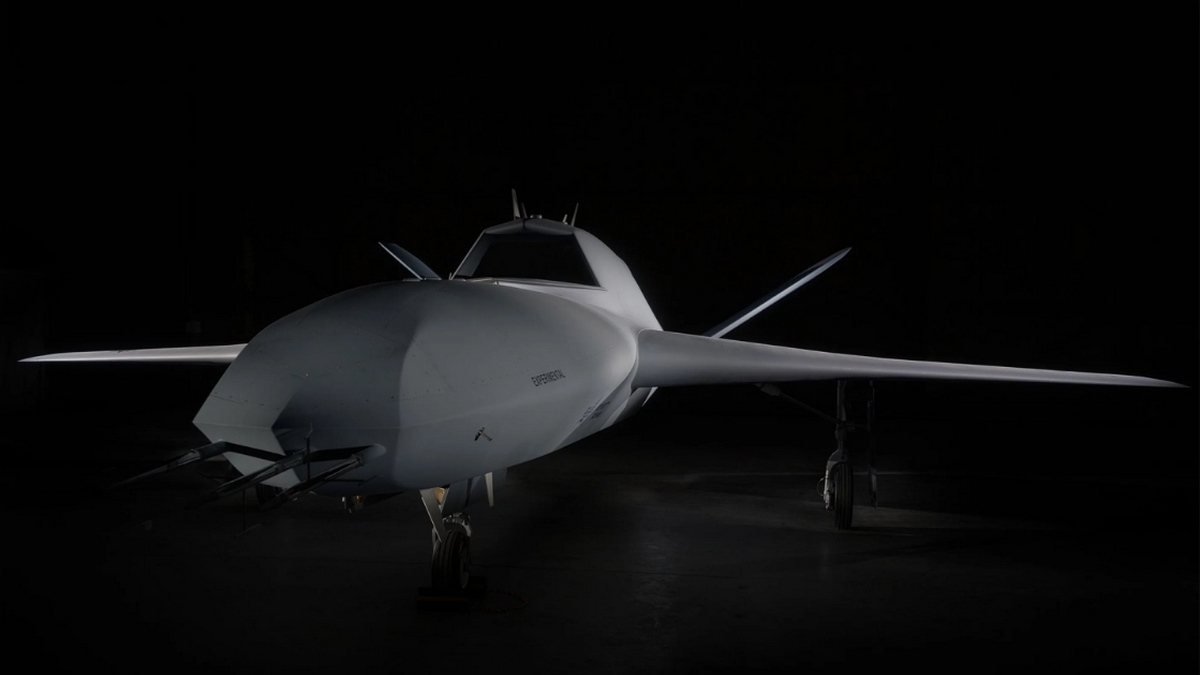
The market for autonomous unmanned drones, which only a few years ago looked like a promising new niche, has shifted into a space of active competition. It is at this stage that Northrop Grumman introduces its own solution – the Talon project. This autonomous drone is designed to operate alongside the F-35 and F-22, positioned as a multifunctional loyal wingman intended to extend the operational capabilities of manned fighters.
As with many technologies that initially appear expensive or highly specialized, combat drones are following a familiar trajectory – moving from experimental concepts toward broader, more standardized development. Costs are gradually decreasing, the underlying systems are becoming more refined, and each new program entering the market contributes to the overall momentum of the sector.

The U.S. Air Force has already stated its intention to procure at least 1,000 such systems. At the same time, the Navy is exploring its own concepts for unmanned escorts and strike platforms. The Department of Defense is advancing the Collaborative Combat Aircraft (CCA) program, aimed at accelerating the development of operational solutions with autonomous capabilities on a level approaching that of manned fighters.
Northrop Grumman is entering this segment with some delay. The company did not secure a win in the first phase of the CCA competition and instead found a new opportunity through the Lotus program, which now forms the basis of the Talon project. Meanwhile, competitors such as Lockheed Martin and General Atomics are moving ahead more rapidly, prompting Northrop Grumman to emphasize flexibility, multi-role functionality, and a less conventional design approach.
The primary objective of the Talon program is to improve the survivability of manned aircraft, reduce risks for pilots, and provide a platform capable of performing more than a single role. While earlier loyal wingman concepts focused mainly on air-to-air support, Talon is designed with a broader operational scope. It can function as a reconnaissance asset, absorb enemy fire, launch weapons, and apply autonomous algorithms with operator oversight during critical phases.
Another notable aspect of the Talon project is its emphasis on a rapid development cycle. Northrop Grumman reports that the period from early concept to ground testing took 15 months, with the first flight scheduled nine months later. For comparison, the F-35 program required more than a decade before its prototype took to the air.
An additional factor driving the accelerated pace is the set of budget constraints defined by the military. The Air Force aims to acquire loyal wingman platforms at a unit cost no higher than $23–25 million, while the Navy is targeting around $15 million. To meet these limits, Northrop Grumman is streamlining the Talon’s design – reducing its weight by roughly 453 kilograms compared to the company’s earlier concepts and cutting the total number of structural components by nearly half.
&pp=ygUWTm9ydGhyb3AgR3J1bW1hbiBUYWxvbtIHCQklCgGHKiGM7w%3D%3D
In this context, the Talon is positioned not only as a candidate for the CCA program but also as a potential template for an unmanned combat aircraft that can be developed more quickly, produced at scale, and built at a lower cost than previous generations. Its emphasis on multi-role capability and autonomous operation may determine its role within the emerging architecture of U.S. combat aviation.
Read also:
- Su-24, Radar, and Drones: Defence Intelligence Reports on “Prymary” Operations
- Pentagon Launches $1 Billion Program to Procure Thousands of Kamikaze Strike Drones
Source: newatlas