This week, U.S. forces in the Middle East intercepted and destroyed an Iranian Shahed-series drone using an interceptor drone that had previously been combat-tested in Ukraine, according to a U.S. official cited by Business Insider.
The engagement marked the first operational use by the U.S. military of the American-developed Merops system to destroy a hostile drone in combat. Ukrainian forces, meanwhile, have already used the system to neutralize more than 1,000 Russian Shahed drones. In addition, several Eastern European countries have acquired the system and integrated it into operational service.
Uncrewed aerial systems continue to play an increasingly significant role in modern warfare, as demonstrated by recent conflicts in Ukraine and the Middle East. This trend has driven strong demand for cost-effective solutions capable of intercepting aerial threats.

U.S. Army personnel stationed in Kuwait have confirmed at least one successful interception of an Iranian Shahed loitering munition, a single-use kamikaze drone.
For several weeks, following the collapse of a fragile ceasefire, the United States and Iran have continued exchanging strikes. U.S. forces have targeted Iranian military facilities, while Tehran has launched missiles and drones at locations across the Middle East hosting American military bases.
Last week, a U.S. official told Business Insider that since hostilities resumed earlier this month, American forces have intercepted dozens of Iranian missiles and drones. Despite these efforts, some Iranian munitions penetrated the defenses and reached their intended targets. As a result, at least four U.S. service members have been killed this month, while approximately 100 others have been wounded.
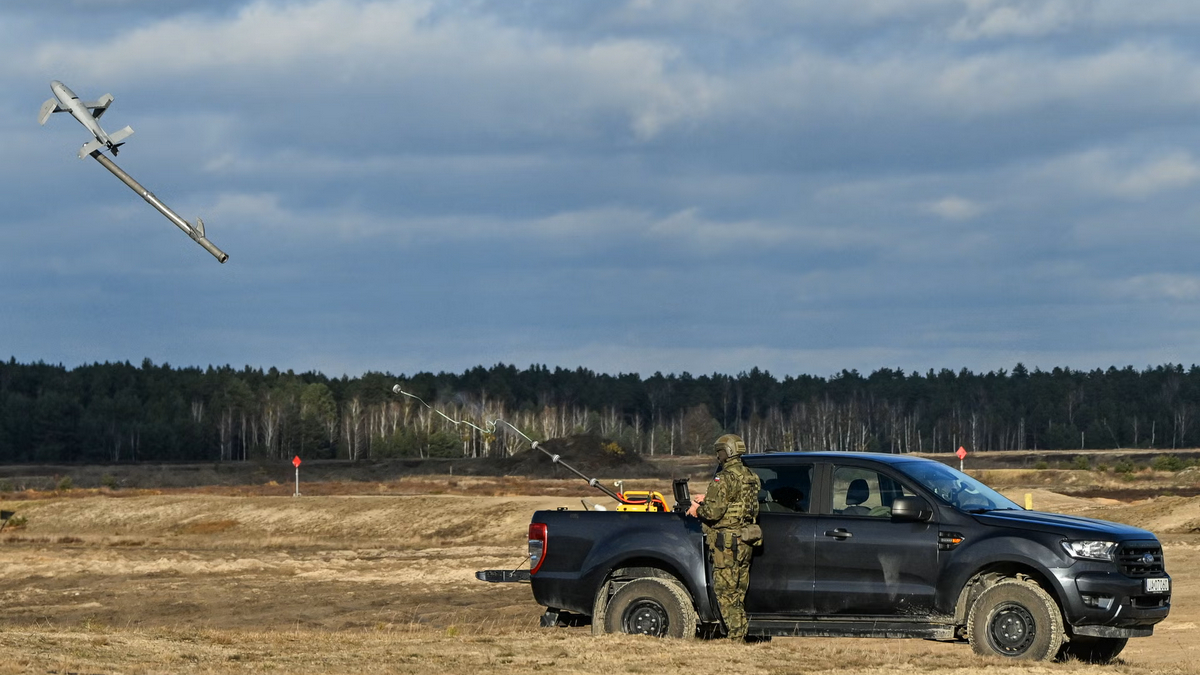
The U.S. Army deployed the Merops system to the Middle East in March, at the outset of the conflict with Iran, together with the personnel required to operate and maintain it. Over the following weeks, U.S. troops underwent intensive training to become proficient with the system. Developed by the U.S. company Perennial Autonomy, the Merops system consists of a radar, a launcher, a ground control station, and a $15,000 interceptor drone capable of speeds exceeding 175 mph. The interceptor employs AI-based navigation to operate effectively in environments with heavy electronic warfare interference.
The system is operated by a small team whose training requires only a few days. Shahed drones are defeated either through direct kinetic impact or by detonating the interceptor in close proximity to the target. The drone itself is controlled using commercially available Xbox game controllers.
Compared with most other short-range air defense systems in the Pentagon’s inventory, the Merops interceptor is significantly less expensive. It provides the U.S. military with a cost-effective means of countering Shahed drones while reducing reliance on substantially more expensive surface-to-air missiles. In April, U.S. Army Secretary Dan Driscoll told lawmakers that the service had procured thousands of these interceptors following the outbreak of the conflict with Iran. He also expressed confidence that, as production scales up, the unit cost could fall below $10,000.
The U.S. Army’s procurement of the Merops system underscores the growing interest among the United States and its NATO allies in affordable interceptor drones that have demonstrated strong operational performance during the war in Ukraine. The Merops system was first deployed on the Ukrainian battlefield, where it had destroyed more than 1,000 Russian Shahed drones by November 2025.
Poland and Romania acquired the Merops system after Russian aerial threats violated NATO airspace in September 2025. In April, Lithuania also announced plans to procure the system, becoming the latest country on NATO’s eastern flank to strengthen its air defenses with the Merops platform.
Read also: Weapons of Ukraine’s Victory: FP-1 – A Drone Capable of Reaching Moscow
Source: businessinsider