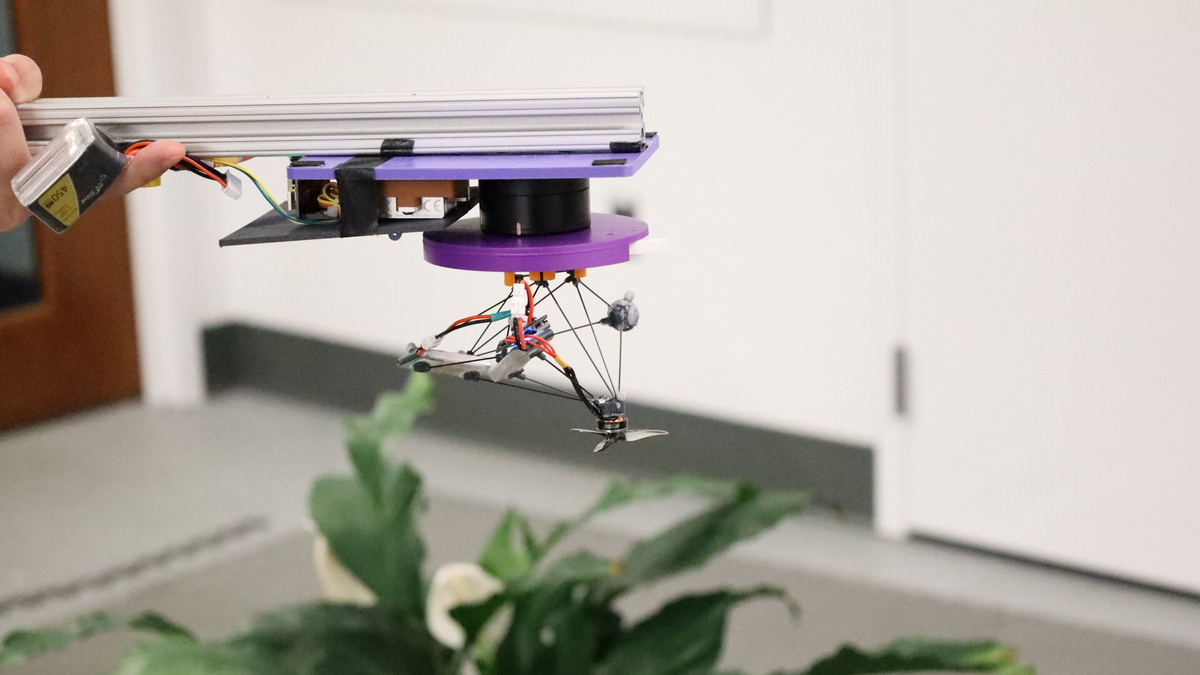
Researchers have developed a drone that becomes nearly invisible by spinning at 25 revolutions per second. Rather than relying on traditional camouflage, it exploits motion blur to make itself significantly harder to detect in plain sight. Conventional drones are generally easy to spot due to their rapidly spinning propellers and relatively bulky airframes. Engineers at Northwestern University, however, have designed a prototype that is much more difficult to visually track. Called Phantom Twist, the drone rotates at such a high speed that it appears as little more than a faint, blurred silhouette while in flight.

Instead of relying on camouflage paint, transparent panels, or light-bending materials reminiscent of those seen in the film Predator, Phantom Twist takes advantage of motion blur and the limitations of human visual perception. Its airframe rotates at a rate of 15 to 25 revolutions per second, causing the human eye to blend the moving structure with the background behind it. At its highest rotational speed, the drone becomes extremely difficult to distinguish, appearing as little more than a faint blur.
Unlike a conventional quadcopter, which uses four propellers mounted around a mostly stationary airframe, Phantom Twist features a single motor and a single propeller. While the propeller spins in one direction, the rest of the aircraft rotates in the opposite direction, leaving virtually no stationary components for the human eye to focus on.
Designing an aircraft that could remain both stable in flight and visually unobtrusive required far more than simply mounting components on a rotating frame. The researchers began by developing a computational model that generated approximately 20,000 viable design configurations. They then used AI-assisted optimization algorithms to rearrange the motor, batteries, control electronics, counterweight, and other components, identifying layouts that balanced stable flight performance with a minimal visual signature.
The most promising designs were then simulated while rotating and superimposed onto 100 different real-world backgrounds. A perception model developed to approximate human vision evaluated how visible each configuration would appear. The researchers selected the 500 least detectable designs and continued refining the placement of individual components until arriving at the final configuration.
The drone’s components are distributed across different heights and angles, with significant open space between them. This arrangement prevents solid sections from overlapping during rotation, reducing the likelihood of forming a dark, recognizable silhouette. According to the visibility metric developed by the research team, Phantom Twist is approximately ten times less visually noticeable than a conventional quadcopter of similar size.
The current prototype also has several limitations. It relies on an external optical tracking system for flight control, restricting its operation to controlled environments. In addition, exposed wiring and carbon-fiber support rods remain partially visible during flight. The drone also produces the characteristic noise associated with multirotor aircraft, meaning that even if it is difficult to see, it is still likely to be heard. Future iterations may incorporate a quieter propulsion system and more transparent structural materials to further reduce detectability.
Potential applications for the technology include wildlife observation with minimal disturbance to animal behavior, environmental monitoring of wetlands, and infrastructure inspections with reduced visual impact. A camera mounted on the rotating airframe could also capture a continuous 360-degree panoramic view, providing additional situational awareness and navigation capabilities.
Other aircraft designed for low-visibility operation include a mosquito-sized reconnaissance drone developed in China and Harvard University’s solar-powered RoboBee. Phantom Twist, however, takes a fundamentally different approach to the same objective. Rather than minimizing its size, it relies on high-speed rotation, making it too visually blurred for the human eye to clearly perceive.
Read also:
- First Shot Without a Pilot: What the YFQ-44A Flight Tests Mean for the Future of Air Combat
- Foundation of the FREYJA System: Ukraine Unveils the FP-7.X Interceptor Missile for Countering Russian Ballistic Threats
Source: techspot