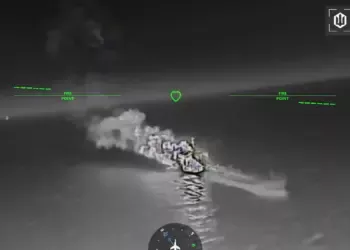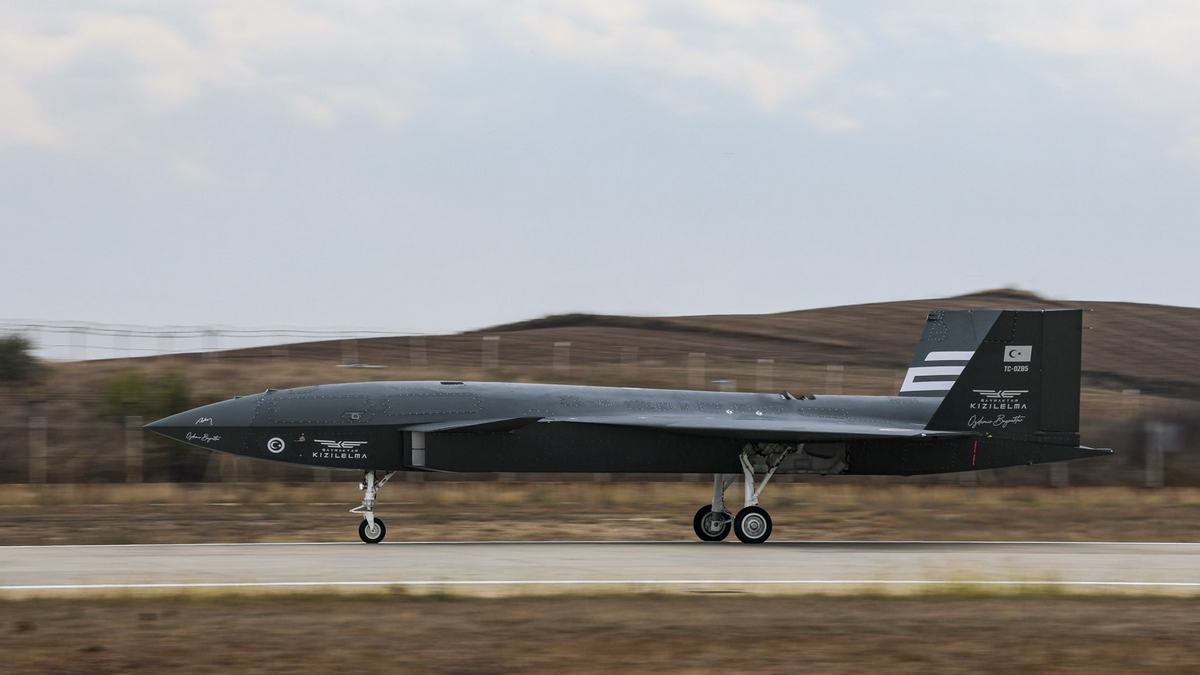
Baykar has showcased a new stage in the development of its advanced Kizilelma jet drone, releasing footage of test flights in which the UAV carries two Gökdoğan air-to-air missiles on internal wing pylons. The company published video from the PT-5 phase, during which the behavior of the UCAV under combat load and the operation of key sensor systems – such as the Murad AESA radar and the EOTS electro-optical targeting system – were evaluated.
Read also: All About the Turkish UAV Bayraktar Kizilelma: Development History and Prospects
&pp=ygUOS0laSUxFTE1BIFBULTXSBwkJCwoBhyohjO8%3D
In the published materials, Kizilelma is presented as a jet‑powered UAV that Turkey positions not simply as a strike platform, but as a future component of an integrated air‑combat structure. The aircraft is designed for deep‑penetration missions in high‑risk areas, coordination with fifth‑ and sixth‑generation manned fighters, and tasks traditionally carried out by crewed aircraft – long‑range strikes, operations in environments with active air‑defense systems, and joint missions within mixed formations.
Baykar states that Kizilelma is equipped with an advanced sensor suite, including the Murad AESA radar, an electro‑optical system, and an infrared surveillance unit. The company describes the aircraft as “the world’s only jet‑powered unmanned platform capable of carrying air‑to‑air missiles,” presenting it as a system that expands the scope of aerial combat capabilities.

Ongoing tests with the Gökdoğan missiles, a Turkish beyond‑visual‑range armament, indicate an intention to integrate air‑to‑air capabilities into Kizilelma’s core functions. This suggests a shift in the role of strike UCAVs toward platforms capable of participating in air‑defense tasks, airspace control, and escort operations.
&pp=ygUOS0laSUxFTE1BIFBULTU%3D
Baykar previously stated that Kizilelma is being developed with compatibility for a wide range of domestic weapons and sensors, as well as the capability for autonomous group operations. The aircraft is designed to operate from short runways and future naval platforms, aligning with Turkey’s long‑term strategy to expand autonomous capabilities within its air forces.
Recent footage indicates that the program is progressing steadily through its development phases and is approaching a stage where it could become a key asset in future air operations, in which autonomous systems are expected to play a central role.
Read also:
- Baykar to Supply Indonesia with Bayraktar TB3, Akinci Drones and Build a Factory
- Leonardo and Baykar Discuss Potential Collaboration in UAV Development
Source: Defence-blog