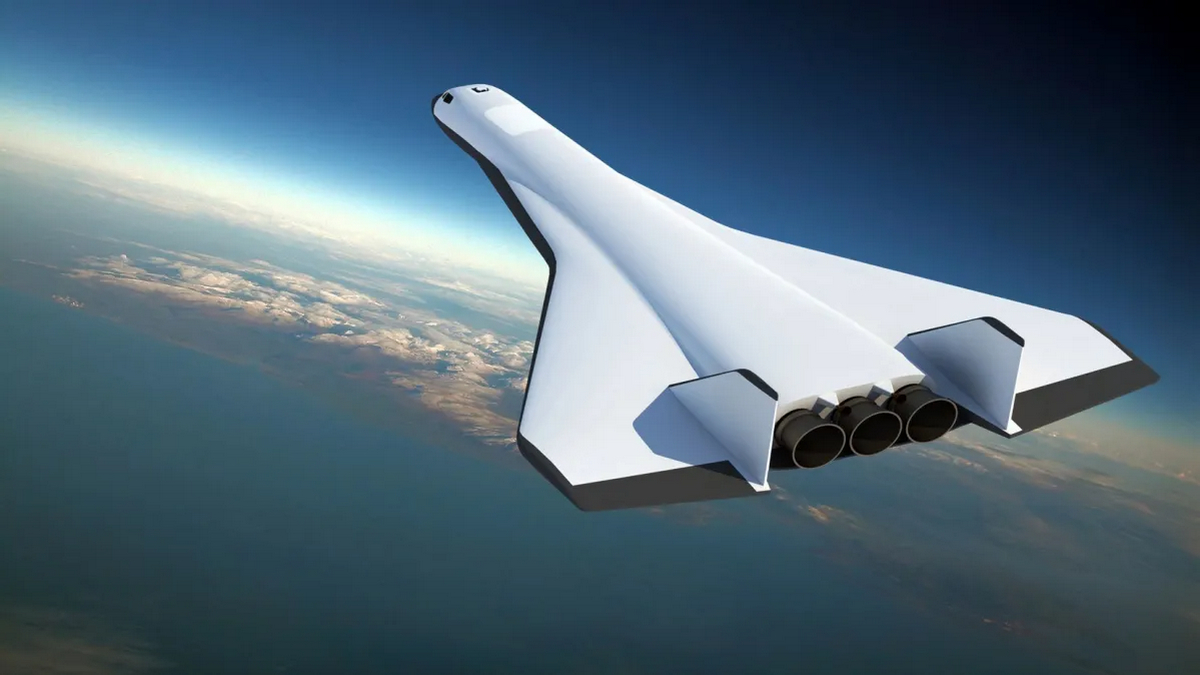
Radian Aerospace has taken another step closer to achieving the “Holy Grail” of spaceflight: a reusable spacecraft that can take off from an airfield and land on a runway like a regular airplane. The startup recently announced the completion of a series of ground tests in Abu Dhabi earlier this summer.
The tests were conducted with a subscale prototype of the aircraft, which the company calls PFV01. The primary goal of the tests was to gather data on how the aircraft will fly and be controlled, and to compare this data with simulations that the company has been conducting over the past few years. While the aircraft did not actually fly, it completed a series of small “hops” on the runway, as company executives shared in a recent interview with TechCrunch.

The PFV01 is significantly smaller than the final spacecraft – about 4.5 meters in length – but the data gathered is still crucial for determining key elements of the final design and flight control system, such as where to place the landing gear or how to position the center of gravity to maximize stability in the air, explained the company’s co-founder and CTO, Livingston Holder.
“This prototype allows us to adjust the center of gravity forward and backward, up and down, and it gives us the ability to fine-tune the landing gear placement. These adjustments provide real feedback that supports what our analytical data is telling us,” he said. “Wherever there’s uncertainty… that’s one of the things the PFV really helps us with – it reduces uncertainty so we can improve our analytical processes as we move forward faster with the prototype and conduct more flights.”
The Radian One spacecraft is expected to take off from a track approximately 3.2 kilometers long, ignite its engines in orbit, and then return to Earth on a conventional runway. This concept is regarded as the Holy Grail because eliminating the need for a rocket launcher makes space as accessible for spacecraft as the upper layers of the atmosphere are for airplanes.
The economic prospects are also promising: a reusable spacecraft could conduct flights to space and back daily, or even more frequently, with greater profitability. This has been attempted before; one of the most notable examples is NASA’s X-33 program, which aimed to develop a suborbital spacecraft. Holder led Boeing’s efforts on the X-33.
“The least interesting thing this system can do is launch satellites,” said Radian co-founder and COO Jeff Faye. “What’s truly impressive about Radian is that this system can perform a wide, wide range of missions, giving it access to a much larger market than traditional rockets. Potentially, you can not only launch something but also service and recover it. We can bring entire payloads or satellites down from space. We can lift people. We can descend into the atmosphere and theoretically either drop things or observe them on the planet. So, there’s a much broader range of possibilities.”
The design of the rocket is fundamentally different from that of a vertical rocket, which means that the development process is also distinct, Faye noted: “You have to mitigate many risks at early stages.” Thus, while rocket companies need to build full-scale vehicles, the phased development of spacecraft is more akin to how airplanes are developed.
The Seattle-based startup has not disclosed any technical specifications from the tests, such as the maximum speed of the aircraft or the duration of the flight, but Holder stated that the PFV01 “achieved the speed necessary for takeoff.” Now, the company will spend some time analyzing all the data collected during the tests before embarking on a series of higher-speed tests and actual flight trials. Concurrently, the company will be working on obtaining regulatory approvals for flights from another airport in the UAE.
Company executives state that they hope to begin full-scale flights of the Radian One spacecraft in 2028. To date, the company has raised $32 million from investors, including Fine Structure Ventures, EXOR, The Venture Collective, Helios Capital, SpaceFund, Gaingels, Private Shares Fund, Explorer 1 Fund, and Type One Ventures.
Source: Techcrunch