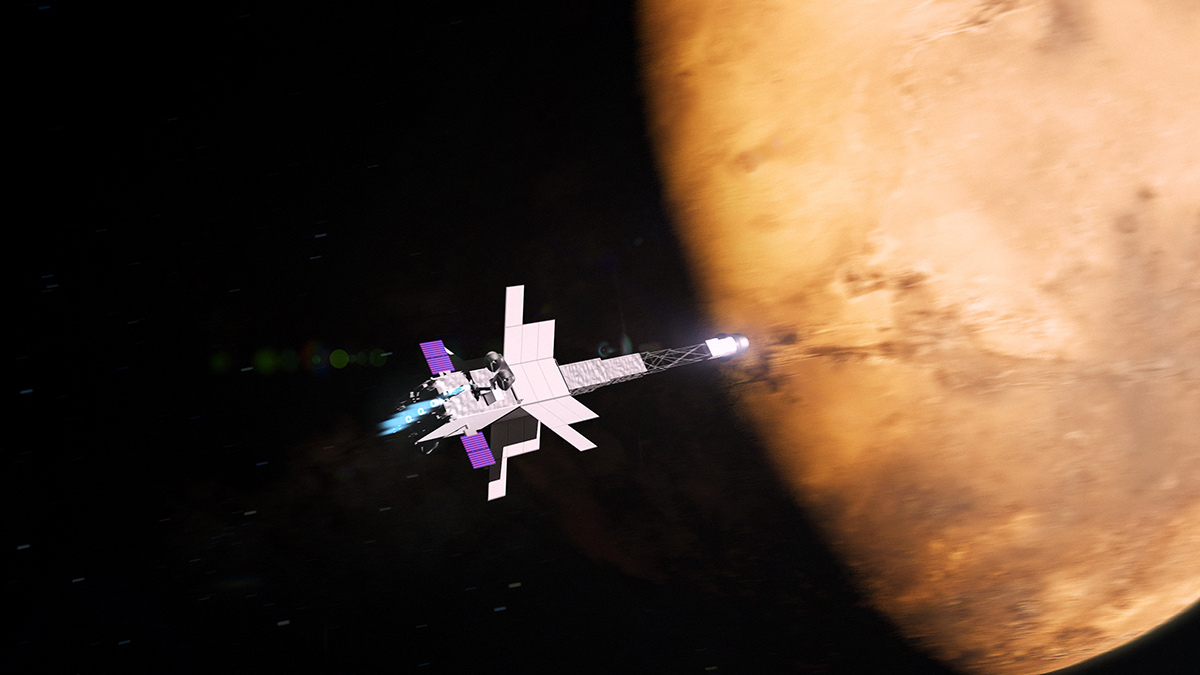
Following the executive order issued in December 2025, which declares “American space superiority” a strategic priority, NASA is advancing nuclear propulsion technologies under Administrator Jared Isaacman. A central element of this initiative is the Space Reactor-1 (SR-1) “Freedom” system. The planned launch date is December 2028. According to the program description, this would be the first interplanetary spacecraft powered by a nuclear fission reactor. The mission is intended to support the long-standing objective of enabling a Mars mission using nuclear electric propulsion.

If successful, this approach could pave the way for a permanent nuclear-powered base near the Moon’s south pole.
Nuclear thermal propulsion systems have remained in development cycles for decades without reaching operational deployment. The SR-1 “Freedom” program aims to break this pattern by relying on existing technologies where possible in order to meet the strict 2028 launch timeline.
Despite approximately 60 years of research efforts and an estimated $20 billion spent across various cancelled or incomplete programs, the mission is positioned as an attempt to achieve what earlier efforts could not. This includes reference points such as the short-lived SNAP-10A system.
To stay within the 2028 launch window, NASA has deliberately constrained the scope of the spacecraft design. The architecture combines a single new nuclear reactor system with flight-proven components, rather than pursuing a fully redesigned platform. Jared Isaacman has described SR-1 “Freedom” as a “70 percent solution” – a system intended primarily to demonstrate the viability of nuclear propulsion rather than serve as a fully mature end-state design.
The spacecraft is expected to use a 20 kW(e) reactor fueled by HALEU (high-assay low-enriched uranium) to power advanced electric propulsion systems. It is planned to be activated within 48 hours after launch, after which it would begin an approximately one-year transfer trajectory to Mars. The power conversion system is based on a closed Brayton cycle, intended to convert thermal energy into electricity, supported by heat pipes and a boron carbide radiation shield.
For thermal management and thrust control, the spacecraft is expected to employ lightweight composite titanium radiators. It also includes an advanced 48 kW electric propulsion system, which additionally functions as the primary bus for communications and onboard power distribution.
The primary objective of the spacecraft is to act as a mothership for “Skyfall,” a trio of helicopter-style drones inspired by Ingenuity. Equipped with subsurface radar, the drone swarm is intended to survey potential landing sites and identify subsurface ice deposits. This data is expected to support terrain validation for future crewed missions. The post-mission role of SR-1 “Freedom” has not yet been defined. At present, NASA has not made a final decision regarding the spacecraft’s trajectory after completing the Skyfall deployment.
Two options are under consideration: a simple flyby after payload delivery, or an attempt to enter Mars orbit following mission completion. According to Steve Sinacore, executive director of NASA’s space nuclear power systems program, the team is still evaluating possible post-mission scenarios for SR-1 “Freedom.”
The current development timeline indicates a transition from hardware development in June 2026 to a planned launch in December 2028. The mission is also positioned as a stepping stone toward a Lunar Reactor-1 system in 2030, which is part of a broader roadmap toward megawatt-class reactor systems intended for future crewed Mars missions and potential commercial applications.
To concentrate resources, the agency is pausing the Gateway orbital station program and redirecting efforts toward building a permanent surface base near the Moon’s south pole. By prioritizing nuclear power over solar energy, NASA aims to ensure stable heat and electricity supply required for operations in permanently shadowed regions of Shackleton crater.
The NASA roadmap, with an estimated budget of $30 billion, is structured in three phases. It begins with commercial cargo and crewed return missions to the Moon in 2026, then gradually scales toward the deployment of nuclear-powered infrastructure by 2032. By 2036, the plan targets continuous human presence supported by habitable outposts designed for four-person crews rotating through lunar expeditions.
Read also:
- NASA Shuts Down Scientific Instruments on Voyager 1 to Preserve the Mission: What Will Happen to the Spacecraft?
- NASA to Receive Two F-15 Fighter Aircraft for Supersonic Flight Research
Source: interestingengineering