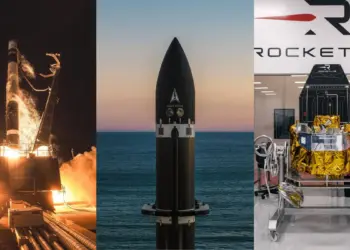
Former Google CEO Eric Schmidt, together with his wife Wendy, is launching one of the largest private astronomy initiatives in history. The couple is funding the development of four next-generation telescopes through their philanthropic organization, Schmidt Sciences.
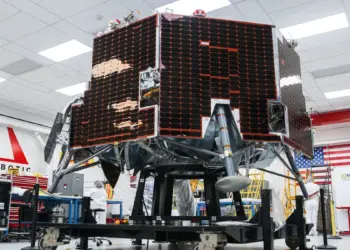
The project, named the Eric and Wendy Schmidt Observatory System, includes three innovative ground-based observatories and a revolutionary space telescope called Lazuli, which will serve as the initiative’s centerpiece. This will be the first fully privately funded space observatory in history. The telescope will feature a 3.1-meter mirror, providing a light-collecting area approximately 70% larger than that of the renowned Hubble Space Telescope.

The launch of Lazuli is planned for 2029. The telescope will be placed into a stable, Moon-resonant orbit, reaching up to 275,000 km at its farthest point. It will be equipped with advanced instruments, including a wide-field optical camera, an integral spectrograph, and a high-contrast coronagraph specifically optimized for direct exoplanet observation.
Lazuli’s scientific objectives are highly ambitious: studying the atmospheres of exoplanets around Sun-like stars, modeling supernova explosions, investigating the so-called “Hubble tension” in cosmology, and complementing future missions such as NASA’s Nancy Grace Roman Space Telescope. “We’ll do it in three years, and we’ll do it at a ridiculously low cost,” said Lazuli project CEO Pete Kloupar.
Alongside the space telescope, the ground-based systems will also be developed. The Argus Array, led by Nicholas Law at the University of North Carolina, will consist of 1,200 small telescopes working together as a single instrument equivalent to an 8-meter mirror. The observatory is expected to become operational in 2028. Its 8,000 square-degree field of view will allow coverage of the entire visible northern sky, making it well suited for discovering supernovae and gravitational wave sources.
Another component of the system is the Deep Synoptic Array (DSA), led by Gregg Hallinan at the California Institute of Technology. In the Nevada desert, 1,656 radio antennas, each 1.5 meters in diameter, will be deployed across a 20×16 km area, with operations planned to start in 2029. The DSA will be able to scan the radio spectrum extremely quickly and could potentially double the catalog of known radio sources on its first day of operation, revealing hidden black holes and dust-obscured galactic nuclei.
The fourth component will be the Large Fiber Array Spectroscopic Telescope (LFAST) at the University of Arizona. This is a modular spectroscopic system consisting of 20 scalable optical units (equivalent to a 3.5-meter mirror) housed in compact “mini-domes.” This approach significantly reduces costs and allows the telescope to be gradually expanded as needed.
According to The New York Times, the Schmidt team acknowledges that the project is launching during a challenging period for space science, amid significant budget cuts at NASA and the U.S. National Science Foundation. At the same time, the organizers emphasize that the new system is not intended to replace government programs but to complement them. “Between the overcrowding of space and government budget cuts, a storm of opportunities is forming,” said Pete Kloupar at a conference. The private sector has already changed the rules of access to space, and if this initiative succeeds, it could fundamentally alter how humanity explores the universe.
The Schmidt family is increasingly positioning itself as a serious player in the space sector. Last year, Eric Schmidt became one of the first public proponents of deploying AI data centers in space. He also announced the acquisition of Relativity Space, with the aim of deploying orbital computing platforms in response to the rapid rise in energy demand driven by the AI boom.
Read also:
- NASA’s X-ray Telescope “Weighs” the Nearest Dead Star to Earth
- Secret SpaceX Satellites Caught Transmitting Signals in a Restricted Frequency Band
Sourse: interestingengineering