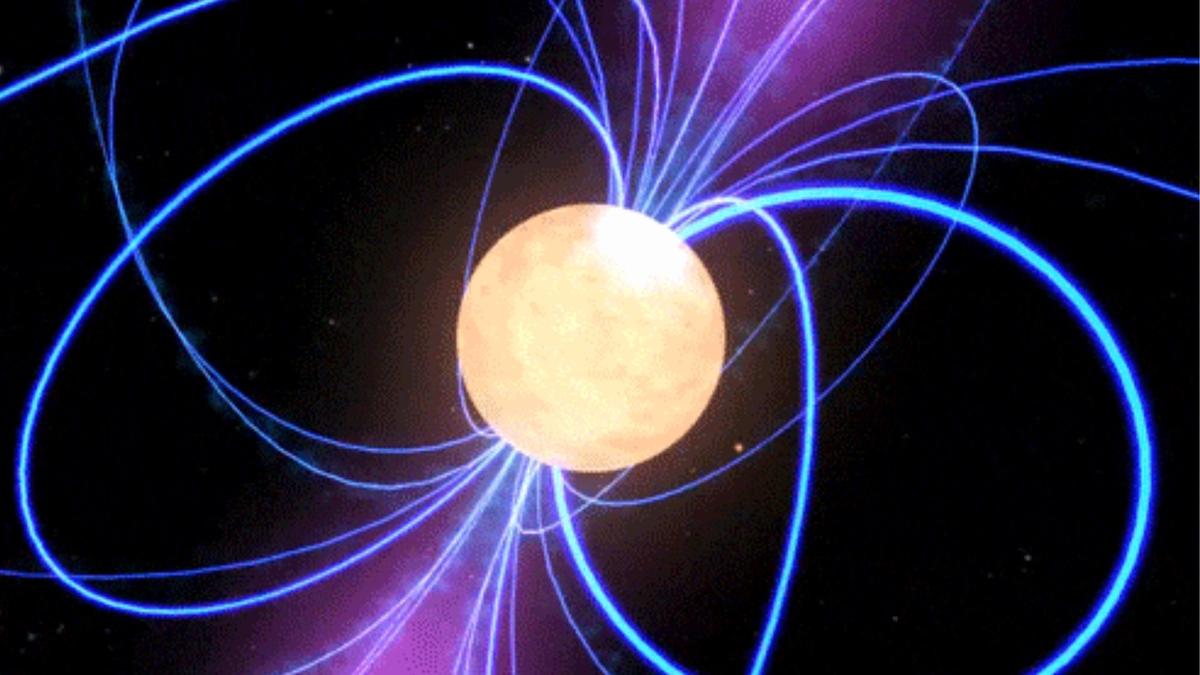
Using NASA’s X-ray telescope mounted on the International Space Station (ISS), astronomers have “weighed” a rapidly spinning dead star, which is the heart of the nearest millisecond pulsar to Earth.
Like all neutron stars, pulsars are born when massive stars die, but millisecond pulsars are unique because they spin hundreds of times per second. As they do so, beams of radiation and matter burst from the poles of these dead stars and spread across the universe, making pulsars resemble powerful “cosmic lighthouses.”

Located about 510 light-years from Earth in the constellation Pictor, PSR J0437-4715 (PSR J0437) is the closest example of a millisecond pulsar to our solar system and the brightest of its kind in the night sky. PSR J0437 spins 174 times per second, which means that every 5.75 milliseconds, it emits X-rays and radio waves toward Earth. These pulses are so regular that, like other pulsars, this rapid cosmic beacon can be used to keep time.
Scientists now know that the neutron star forming PSR J0437 is 22.5 kilometers wide and has a mass 1.4 times that of the Sun. The team also discovered that the hot magnetic poles of the neutron star are offset rather than directly opposite each other.
To gather new measurements of PSR J0437, the team turned to NASA’s Neutron star Interior Composition Explorer (NICER), which is attached to the ISS. They processed the X-ray data using a technique called “pulse profile modeling” and then created simulations of PSR J0437 using the Dutch national supercomputer Snellius.
“Previously, we hoped to accurately calculate the radius. It would have been great if we could also show that the hot magnetic poles are not directly opposite each other on the star’s surface,” says team leader Dewarshi Chaudhuri from the University of Amsterdam. “And we managed to do both!”
When stars with a mass ranging from eight to twenty-five times the mass of the Sun run out of fuel after billions of years, they can no longer sustain nuclear fusion in their cores. This not only cuts off most of the energy the star emits but also halts the outward flow of radiation pressure.
Throughout a star’s life, this radiation pressure balances against the inward pressure of its own gravity. When the fuel is depleted, the star can no longer prevent gravitational collapse. As the core collapses, shock waves are sent through the star’s outer layers, causing a supernova explosion that ejects most of the star’s mass. Regardless of the initial mass of the star, a neutron star is born with a much narrower mass range, between one and two times the mass of the Sun.
However, the collapse of this dying stellar core reduces the width of the progenitor neutron star to about 20 kilometers. Thus, the material that makes up the neutron star is so dense that one cubic centimeter of it, if brought to Earth, would weigh a billion tons.
There is another consequence of the rapid compression of the stellar core at the birth of a neutron star. Due to the conservation of angular momentum, the reduction in radius results in an increase in the rotational speed of the stellar remnant. Neutron stars that become pulsars can also gain additional acceleration from a companion star. When a neutron star and a companion star are close enough, the former can accrete matter from the latter. This stellar material carries angular momentum, further increasing the rotational speed of the neutron star.
PSR J0437 may have engaged in such stellar cannibalism in the past to achieve its rotational speed of 174 revolutions per second. Supporting this is the fact that it has a helium-rich white dwarf companion star with only a quarter of the Sun’s mass, from which the outer layers appear to have been stripped. While many measurements of PSR J0437 have confirmed scientists’ understanding of how these objects form, this millisecond pulsar has provided one surprise. The mass of PSR J0437 suggests to the team that the maximum mass of neutron stars might be lower than some theories predict.
“This, in turn, aligns well with what observations of gravitational waves show,” said team member and neutron star expert Anna Watts from the University of Amsterdam.
The team’s research was published in a series of pre-reviewed papers on the arXiv repository and in the Astrophysical Journal.
Source: Space