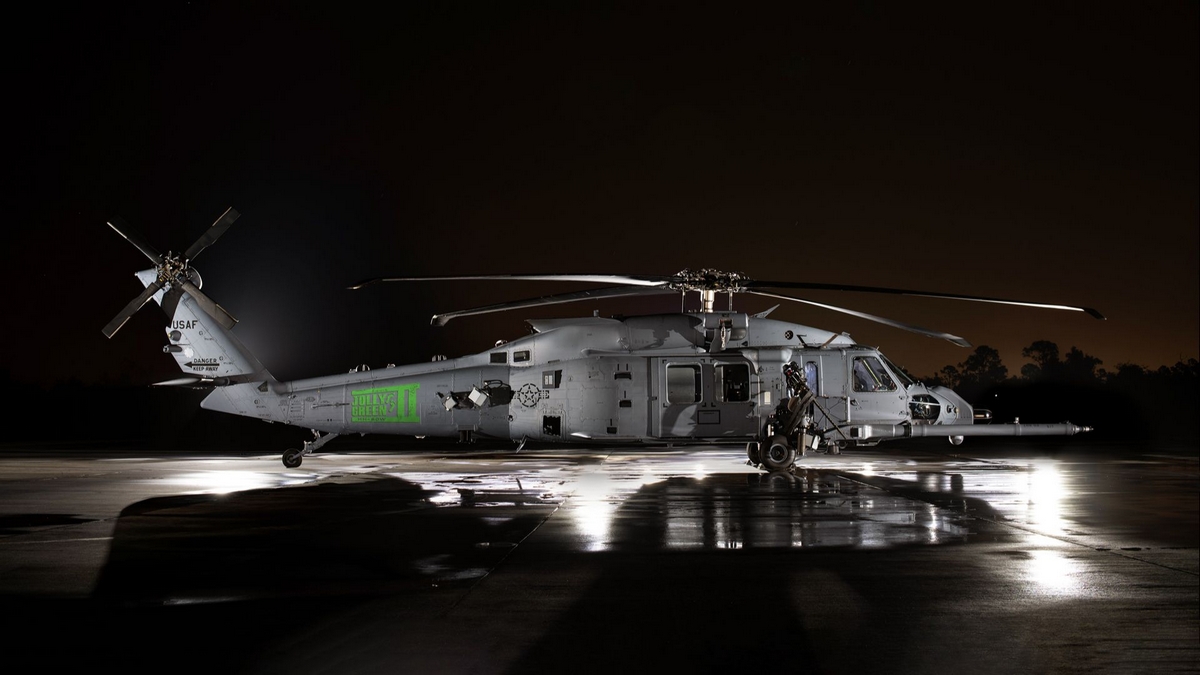
The United States Air Force has initiated a market research effort aimed at equipping HH-60W Jolly Green II helicopters with advanced missile defense systems. This step is intended to improve survivability during personnel recovery missions in high-risk combat environments. The primary focus is on integrating an upgraded infrared countermeasure system (AIRCM) capable of mitigating threats from modern heat-seeking missiles. Department leadership considers this a critical enhancement for operations in contested environments where adversaries possess advanced air defense capabilities. The initiative also reflects a broader effort to improve the survivability of the combat search-and-rescue helicopter fleet.

At present, the HH-60W Jolly Green II relies primarily on missile warning sensors that can detect incoming threats but do not provide any means of active neutralization. As a result, crews must depend solely on evasive maneuvers during low-altitude operations in high-threat environments. A maintenance unit report indicates that the absence of an effective infrared countermeasure (AIRCM) system significantly increases vulnerability to infrared-guided missiles, with implications for mission success, platform survivability, and personnel safety.
To address this capability gap, two established laser-based systems are under consideration: the Common Infrared Countermeasure developed by Northrop Grumman, and the Directed Infrared Countermeasure system from Leonardo. Both technologies use directed laser energy to disrupt missile seeker heads, detecting and engaging incoming threats within seconds, thereby significantly enhancing aircraft protection in contested airspace.
The selected AIRCM system will be provided as government-furnished equipment by the United States Department of Defense, while private contractors will be responsible for its integration across the entire HH-60W Jolly Green II fleet. The scope of work spans the full lifecycle, from research and testing through to final installation. Contractors are required to develop retrofit kits that comply with the helicopter’s technical constraints, including power availability, thermal management, compatibility with onboard avionics, and structural load limits.
According to the report, the primary objective is to identify contractors with deep engineering and technical expertise capable of executing full-cycle integration. The United States Air Force is also prioritizing open-architecture system design and the acquisition of full technical data rights, enabling easier future upgrades and long-term sustainment. The effort focuses specifically on system design and installation rather than procurement of the countermeasure systems themselves. Program oversight will be managed by the Air Force Life Cycle Management Center, with contract award expected by the second quarter of fiscal year 2027.
The HH-60W Jolly Green II already has operational experience in high-threat environments. During recent events in Iran, these helicopters were involved in the evacuation of a downed F-15E Strike Eagle pilot. The aircraft came under heavy small-arms fire, resulting in damage to equipment and minor injuries among some crew members, though the mission was completed successfully. While it has not been confirmed whether infrared-guided missiles were present in that engagement, the incident underscores the vulnerability of crews operating without active defensive countermeasures in modern conflict environments.
The service emphasizes that installing an AIRCM system is considered essential for reducing exposure to such threats. Budget planning also reflects the urgency of the requirement: the United States Air Force has requested $87.9 million in research and development funding for the HH-60W Jolly Green II program for fiscal year 2027, a substantial increase compared to the $40.5 million allocated the previous year.
Read also:
- All About Proteus: Self-Contained Helicopter with Potential Implications for Future of Aviation
- Everything About the Bell AH-1Z Viper and UH-1Y Venom Helicopters: History, Specifications, and Prospects in Ukraine
Source: interestingengineering