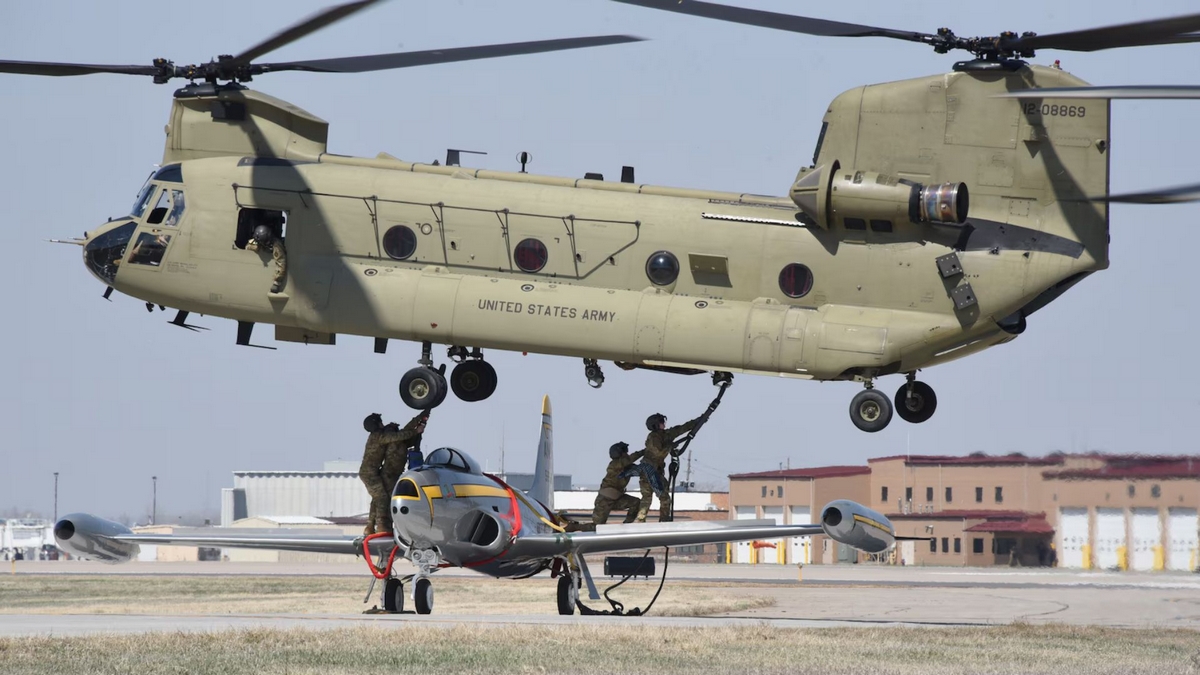
The U.S. Army’s CH-47F Chinook helicopter has taken a significant step toward full autonomy by completing its first automated approach and landing without any pilot intervention. The demonstration was conducted using Boeing’s specialized Approach-to-X (A2X) software, validating the heavy-lift helicopter’s ability to perform precise and repeatable maneuvers under real-world conditions.

The flight represents an important practical milestone in the development of controlled autonomy. The implemented system significantly reduces crew workload while maintaining full control of the aircraft even in complex operational conditions. This opens the way for broader integration of automation in near-frontline operations, where artificial intelligence functions as an assistive tool rather than a replacement for human operators.
The technological advancement in precision landing was enabled by an updated digital flight control architecture underlying the A2X system. The software allows the aircraft to autonomously manage all flight parameters during the approach phase. While pilots still define key inputs such as landing zones and descent profiles, the execution of the maneuver is carried out automatically.
Since January 2026, the system has undergone more than 150 automated approach tests, demonstrating a reported accuracy with deviations of no more than 1.5 meters from the target point. This level of precision is particularly relevant for operations in confined spaces or under reduced visibility conditions.
A2X uses real-time navigation data and adaptive control algorithms, allowing the twin-rotor helicopter to continuously adjust its flight path. This is intended to support reliable operation at night or in conditions such as heavy dust or fog. Importantly, the crew retains the ability to take over control at any moment or modify mission inputs during flight. This approach reflects the U.S. Army’s broader strategy of developing human–machine teaming concepts. According to the developers, pilots were involved throughout the design process to ensure system behavior aligns with operational expectations.
The Chinook remains a core platform for heavy-lift transport in the U.S. Army, supporting a wide range of missions from air assault operations to disaster relief. With the introduction of new autonomous capabilities, the Army aims to improve platform survivability and mission reliability. Precision landing capabilities reduce the time spent in exposed areas and improve overall logistical efficiency.
In parallel with the development of the software, the U.S. armed forces continue to expand their fleet of these aircraft. Boeing has received a $324 million contract to produce six additional CH-47F Block II units, bringing the total number of ordered aircraft of this variant to 24. According to Boeing Vice President Heather McBryan, steady procurement signals confidence in the Block II platform’s ability to perform logistical missions in the most demanding operational environments.
The Block II variant incorporates significant hardware upgrades, including a reinforced transmission system and an improved airframe structure, which together increase the maximum takeoff weight by nearly two metric tons. In addition, improved fuel efficiency enables longer mission durations. To date, six helicopters of this configuration have been delivered, and full equipping of the first unit is planned for mid-2028.
Read also:
- Lumberjack in Action: The U.S. Army Tests a New Autonomous Drone
- All About Proteus: Self-Contained Helicopter with Potential Implications for Future of Aviation
Source: interestingengineering