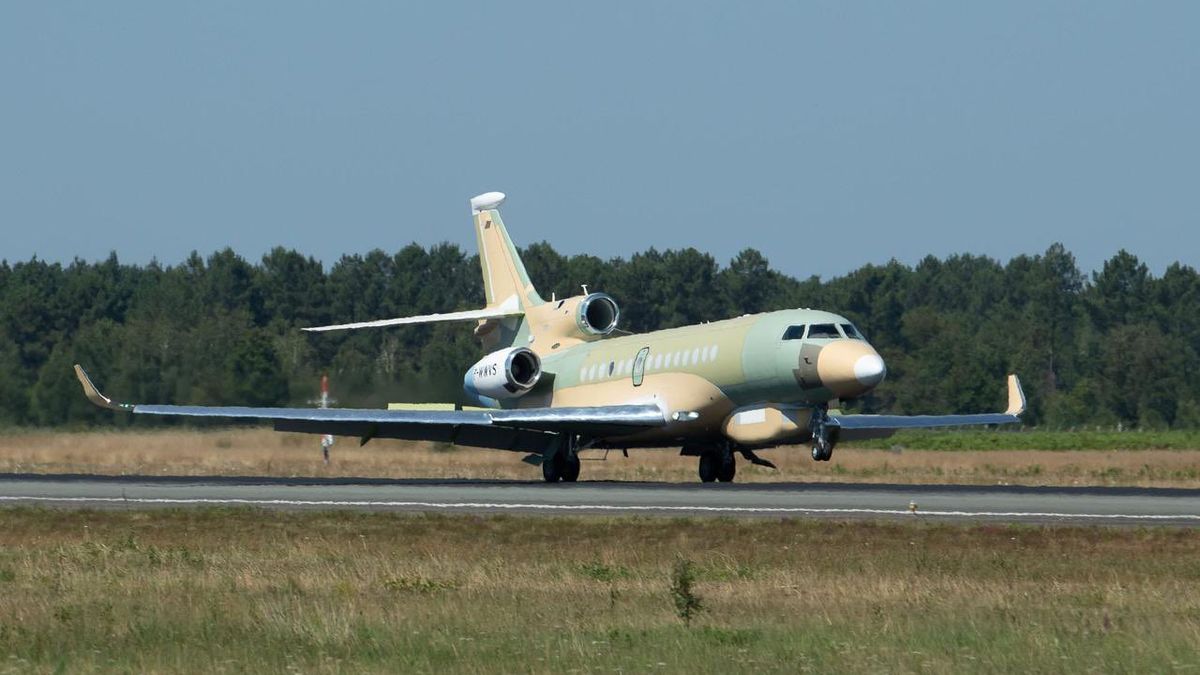
The new SIGINT (Signals Intelligence) aircraft developed for the French Air and Space Force (FASF) has completed its first flight from the Dassault Aviation facility in Bordeaux-Mérignac. Built on the Dassault Falcon 8X business jet platform as part of the Archange program, the aircraft retained its factory protective coating during the flight. The news was confirmed by French Minister of the Armed Forces Sébastien Lecornu.

Archange (Avion de Renseignement à Charge de Nouvelle Génération) is a next-generation reconnaissance aircraft program approved as part of France’s defense strategy for 2024–2030. By 2030, three of these aircraft are expected to be delivered, replacing the aging Transall C-160G Gabriel fleet – two of which were retired as early as May 2022, three years ahead of schedule.
French Minister of the Armed Forces Sébastien Lecornu confirmed that Thales has upgraded the Falcon 8X platform and integrated advanced signals intelligence (SIGINT) systems into the aircraft. “Our future reconnaissance planes will be equipped with cutting-edge technology capable of detecting communication signals and radar emissions,” he wrote on his Twitter account.
On December 30, 2019, Thales and Dassault signed a contract for the delivery of the first two Archange aircraft. The agreement also includes crew training and instruction for the French Air and Space Force (FASF), as well as technical support for all three planned aircraft. It remains unclear whether an order for the third aircraft has already been placed.
At the heart of the Archange system is the CUGE (Capacité Universelle de Guerre Électronique) platform – Thales’s next-generation universal electronic warfare system. Housed in a large fairing beneath the aircraft’s fuselage, CUGE enables the Archange to carry out high-performance signals intelligence (SIGINT) missions, detecting and analyzing radar emissions. According to Thales, the system is equipped with multi-polarization antennas and artificial intelligence capable of automatically processing intercepted signals. The analyzed data is then transmitted to the French Armed Forces’ intelligence centers for further use.
The Archange is based on the Dassault Falcon 8X business jet, which can carry up to eight passengers and a crew of three over a range of up to 12,000 kilometers. The aircraft is equipped with a state-of-the-art digital flight control system derived from Dassault’s experience with the Mirage 2000 and Rafale fighter jets. It also features the advanced FalconEye combined vision system, which merges imagery from six sensors and projects it onto a head-up display (HUD), significantly enhancing situational awareness in all weather conditions.
Following the retirement of the C-160G Gabriel, the French Air and Space Force faced a significant intelligence-gathering capability gap – especially in the context of increasing tensions and Russia’s aggression. Existing assets, such as the CERES reconnaissance satellites, ASTAC (Tactical Signal Analyzer) pods mounted on Mirage 2000D fighters, Beechcraft 350 ALSR aircraft, the ESM (Electronic Support Measures) systems on four E-3F AWACS, and a leased Saab 340 (more on that aircraft \[can be found here]), only partially compensated for the loss.
Thus, the maiden flight of the Archange is not just a technological milestone – it marks a crucial step toward restoring France’s strategic capabilities in signals intelligence (SIGINT). The introduction of these new aircraft is expected to close a critical gap and provide the French Air and Space Force with a powerful tool for intelligence collection.
Read also:
- Everything About Tempest – The UK’s Sixth-Generation Fighter Jet
- U.S. Air Force to Acquire 75 More KC-46 Tankers, Skipping Competition for Next-Generation Refueling Aircraft
Source: theaviationist