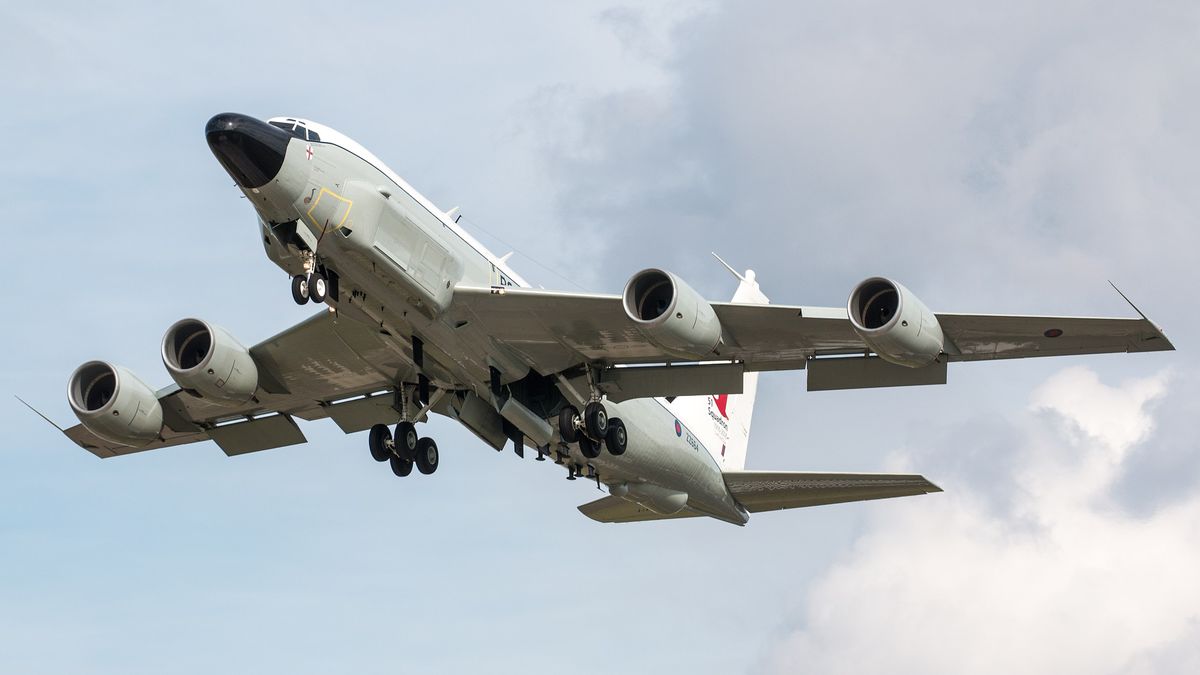
The Royal Air Force of the United Kingdom recently conducted another mission near Russian territory using an RC-135W Rivet Joint reconnaissance aircraft. The aircraft carried out an extensive surveillance flight around the Kaliningrad region. Flight tracking data showed a pattern typical for such missions, forming an elongated elliptical route over the Baltic Sea. These operations have been conducted regularly for many years, starting well before Russia’s full-scale invasion of Ukraine in 2022, though their frequency has noticeably increased since the outbreak of the war.
The UK, the United States, and other NATO allies maintain an almost continuous air presence over the Baltic, combining intelligence collection with deterrence. Unlike covert flights with surveillance equipment, Rivet Joint missions are conducted openly, with transponders on, allowing their activity to be visible in civilian tracking services and verifiable by external observers monitoring the region.

The Royal Air Force operates three RC-135W aircraft. These platforms detect “elements of the electromagnetic spectrum” through teams of specialist officers and weapons systems operators. The crew conducts interception, characterization, and analysis of communications, radar, and other electronic emissions to provide operational intelligence to commanders. Collected information is used to support real-time decision-making.
The aircraft is actively employed in reconnaissance and other operations. While officially designated as Airseeker within the UK service, it is widely referred to internationally as Rivet Joint. The RC-135 family is based on the C-135 platform and has been in service with the United States and the United Kingdom for over sixty years. Over that time, the fleet has undergone multiple upgrades, producing various modifications designed to gather intelligence efficiently, relying on crews that combine aviation specialists, electronic warfare operators, analysts, and technical systems personnel.
The RC-135V/W Rivet Joint variant is equipped with an electronic intelligence suite capable of detecting, identifying, and locating electromagnetic sources. Early versions were easily recognizable due to numerous external antennas, but subsequent upgrades replaced these with more compact elements and redesigned the lower fuselage equipment. Modernization and maintenance are carried out by L3 in Texas.
The United Kingdom acquired its RC-135Ws through the Airseeker program, converting three KC-135R aircraft to replace the retired Nimrod R1 fleet. These aircraft entered service between 2013 and 2017 and are currently assigned to No. 51 Squadron at RAF Waddington.
The dimensions and performance of the Rivet Joint align with its role as a large intelligence-gathering platform. The crew consists of around two dozen personnel. The aircraft is approximately 41 meters long, with a wingspan of nearly 40 meters, and is powered by four F108 turbofan engines. It can reach speeds of about 504 knots, operate at altitudes above 15,000 meters, and cover over 5,500 kilometers without refueling, making it well-suited for extended missions over the Baltic region.
Read also:
- A-60 Aircraft: Soviet Dream of Laser Weapons in the Sky
- Rafale for Ukraine: What Kind of Aircraft Is It and What Could It Mean?
Source: ukdefencejournal