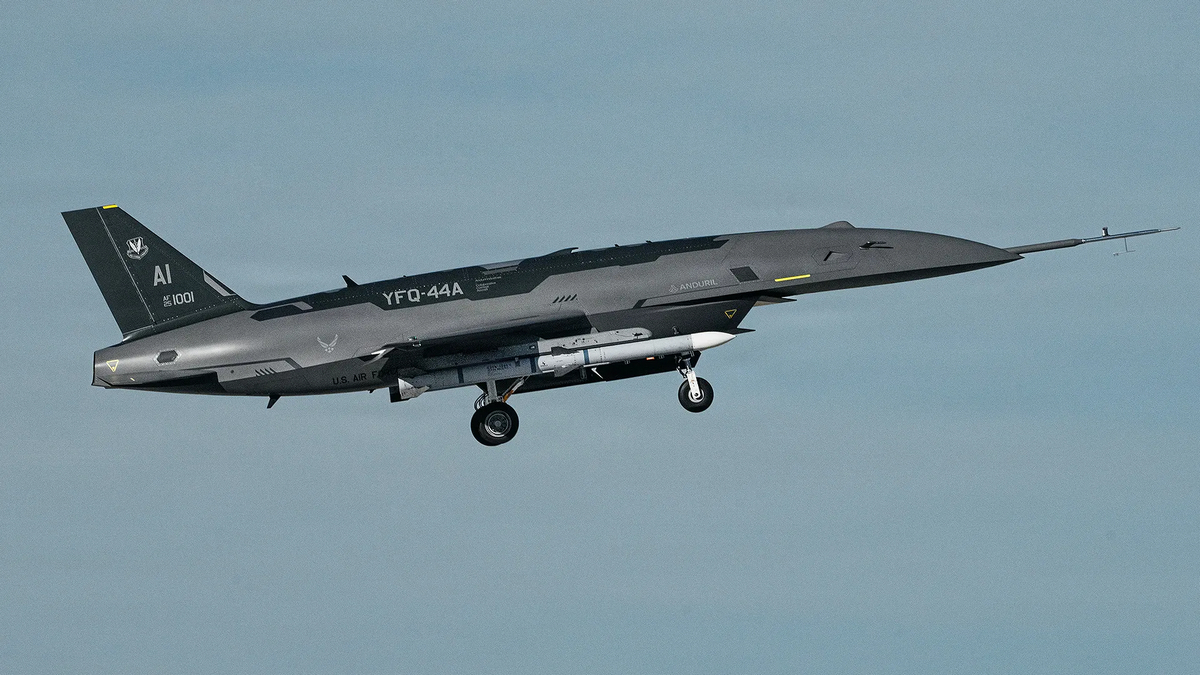
The U.S. Air Force recently showcased one of the prototype YFQ-44 Fury unmanned aerial vehicles from Anduril, equipped with an AIM-120 Advanced Medium Range Air-to-Air Missile (AMRAAM).
“The Air Force has moved to the next phase of the Collaborative Combat Aircraft (CCA) program, beginning disciplined weapons integration and evaluating safe carriage using inert training munitions to verify flightworthiness, safety, and system functionality,” the Air Force stated in a press release. “This phase represents a deliberate step forward in the process of integrating the CCA into the future force structure.”
The release emphasized that this stage remains experimental and focuses on safe system integration rather than combat employment. The use of inert munitions allows engineers and operators to assess flight characteristics and safe missile separation in a controlled environment without employing live ordnance.

At the same time, the Air Force emphasizes that throughout all testing, humans retain authority over weapons employment decisions. CCAs are designed to operate within established command structures and legal frameworks that govern the use of all Air Force weapon systems.
Gen. Kenneth Wilsbach, Chief of Staff of the Air Force, announced these developments during the annual War and Space Symposium, attended by TWZ. The YFQ-44 is one of two designs currently under development in the first phase (Increment 1) of the CCA program. The second is the YFQ-42A Dark Merlin from General Atomics. No images of the YFQ-42A carrying inert munitions have been released to date.
Earlier renders showed the Fury equipped with AIM-120 missiles under its wings. The current design does not include an internal weapons bay. Anduril previously discussed weapons testing as part of the broader development of the YQ-44A following its acquisition of Blue Force Technologies, which originally led the Fury project.
“We follow the same rigorous approach applied across all aircraft testing programs to verify structural integrity, flight characteristics, and safe munition separation,” Wilsbach said. “This ensures the safe integration of inert weapons before any future operational use.”
“CCAs are a key component of a larger, integrated system that will provide our forces with an advantage,” he added. “The program is designed to create a network of effects that observe, engage, and protect our forces in complex environments. It enables teams to take calculated risks and rapidly deliver this capability to deter – and, if necessary, defeat – any adversary.”
It is currently unknown which other munitions, aside from the AIM-120, may be included in future test plans. The Air Force has previously indicated that future operational CCA unmanned aircraft are likely to carry AIM-260 Joint Advanced Tactical Missiles (JATM), the successor to the AMRAAM.
It is worth noting that the U.S. is not the first to test a CCA-style drone with AIM-120 missiles. In December, Australia and Boeing successfully conducted the first test launch of an AMRAAM from the MQ-28 Ghost Bat. In November, Turkish manufacturer Baykar performed a similar test with its Kizilelma drone using a Gökdoğan radar-guided missile.
Although the start of weapons integration and testing is a significant milestone for the CCA program, both the YFQ-42A and YFQ-44A conducted their first flights only in the second half of last year. Transporting air-launched missiles is the primary mission of these drones at this stage. They also enhance the sensor capabilities of manned fighters with which they operate in coordination. The Air Force believes that CCAs will provide critical combat mass, reduce operational risk, and open new tactical options, particularly in potential high-end conflicts against adversaries such as China.
A decision has not yet been made on which Increment 1 drone will be purchased in large quantities. The selected platform will become the first operational “combat drone” capable of employing live ordnance alongside manned aircraft.
Read also:
- A-10 Thunderbolt II Retires After 40 Years of Service
- Blackwater Founder Erik Prince Joins Ukrainian Drone Software Startup
Source: TWZ