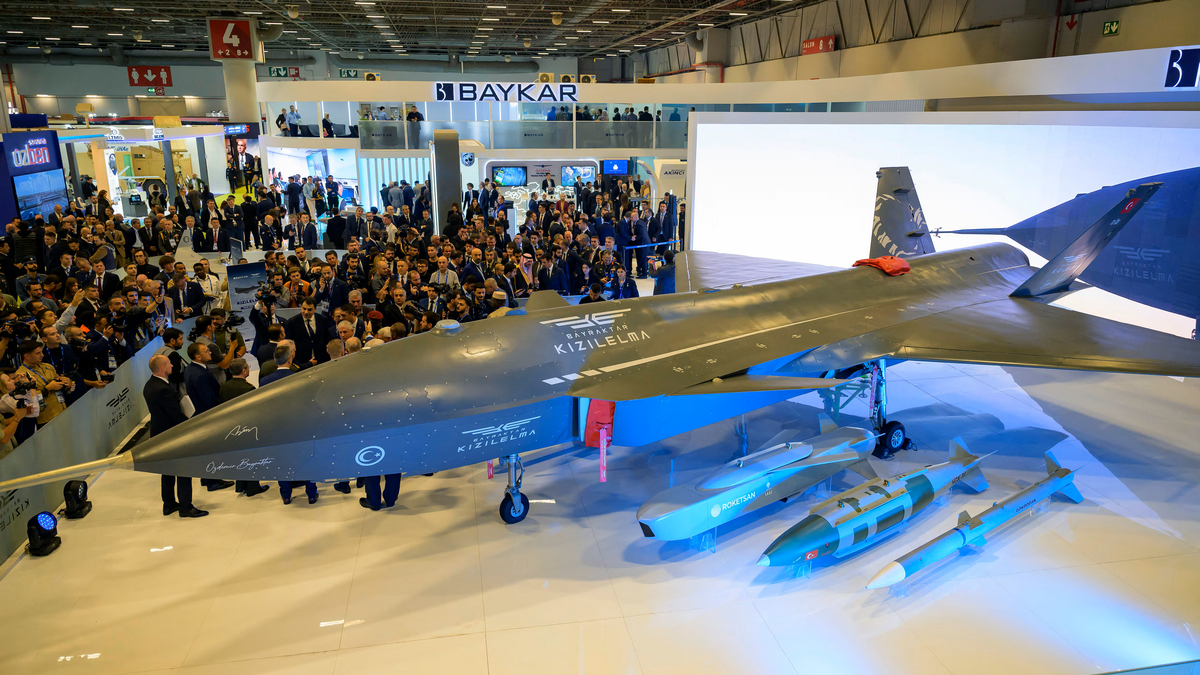
The Istanbul Exhibition Center is hosting SAHA 2026, a large-scale international event covering the defense, aviation, and space industries. The event, organized by SAHA Istanbul, brings together more than 1,700 companies from over 120 countries. The exhibition runs until May 9 and includes a broad program featuring presentations of new technologies, signing of strategic contracts, business negotiations, and demonstrations of developments from leading Turkish defense corporations.

The official opening of the forum was attended by the head of the defense ministry Yaşar Güler, the Minister of Industry and Technology Mehmet Fatih Kacır, the head of the Defence Industry Agency Haluk Görgün, and the head of SAHA Istanbul Haluk Bayraktar. In his speech, Yaşar Güler emphasized that contemporary armed conflicts, including the war between Russo-Ukrainian War as well as conflicts involving the United States, Israel, and Iran, have led to significant changes in regional and global security structures. According to him, these developments have provided valuable insights for shaping modern defense doctrines while also introducing new strategic responsibilities.
Güler noted that Türkiye has transitioned from a country that, until the 1980s, was heavily dependent on foreign procurement to one that now independently designs, manufactures, and exports its own defense systems.
He emphasized that the national defense industry must maintain high-rate serial production to meet the needs of allied countries, while also preserving flexibility during mobilization scenarios. He identified key development priorities, including unmanned aerial systems, strike drones, autonomous land and naval platforms, as well as advancements in space technologies, cybersecurity, and electronic warfare systems focused on signal disruption and jamming. In addition, on the sidelines of the forum, Güler held meetings with military representatives from Somalia, Lebanon, and Iraq.
Mehmet Fatih Kacır emphasized that Türkiye’s industrial base meets NATO standards, which facilitates the integration of Turkish defense systems into allied platforms. He stated that over the past 23 years, 1,112 defense-sector investment projects have been implemented through state incentives, with a total value of approximately 460 billion Turkish lira (around $14.5 billion). Kacır also announced plans to establish new industrial mega-regions aimed at decentralizing production across Anatolia and developing specialized sectoral clusters.
Haluk Görgün reported that over the past year, exports of defense and aerospace products reached $10.5 billion, covering 185 countries. He noted that the country’s technological capabilities are intended to support stability and peace rather than contribute to conflict escalation. Türkiye’s next objective is to surpass $11 billion in export revenue and enter the top ten global players in the defense sector.
Haluk Bayraktar added that experience from the war in Ukraine has demonstrated the decisive role of combining advanced technologies with large-scale industrial production in modern warfare. He noted that the 127-fold increase in drone usage intensity on the battlefield indicates that military strategies are increasingly being built around autonomous systems, and that Türkiye is positioning itself as one of the leading actors in this global transformation.
Within the framework of the event, the Ministry of National Defense’s research center, together with the Mechanical and Chemical Industry Corporation, presented joint developments. In particular, a project called Yıldırımhan was introduced to Yaşar Güler, described as an intercontinental ballistic missile concept. According to the presented specifications, the system is expected to have a range of approximately 6,000 km and to use liquid propellant (nitrogen tetroxide), powered by four engines.
It is also stated that the missile would be capable of speeds ranging from Mach 9 to Mach 25. Combined with a high degree of maneuverability, these characteristics were presented as factors that could make detection and interception significantly more difficult for potential adversaries.
Baykar presented three new systems: the K2 loitering munition, the intelligent loitering munition Mızrak, and the Sivrisinek unmanned platform. According to the specifications provided, Mızrak is capable of traveling more than 1,000 km with a payload exceeding 40 kg. The K2 model is designed for swarm-based operations, while Sivrisinek combines reconnaissance and strike capabilities in a single platform. STM also showcased the KUZGUN long-range system, designed for engaging targets deep in enemy territory. This loitering munition, with a range exceeding 1,000 km, can be launched from mobile ground units or fixed platforms using a rocket-assisted booster.
ASELSAN presented new innovations in the maritime unmanned systems segment, including KILIÇ, described as Turkey’s first underwater autonomous kamikaze vehicle, and TUFAN, a surface kamikaze drone designed for swarm operations. Separately, Pasifik Teknoloji announced the signing of a framework agreement for the export of 100,000 FPV drones to an allied country. According to executive board chairman Aykut Ferah, the package includes 100,000 MERKÜT systems, 10 ALPİN unmanned helicopters, 25 DUMRUL mini-helicopters, 500 DELİ tactical units, and 500 KORGAN autonomous surveillance systems. These platforms are integrated with modern software applications intended to support battlefield operations.
Read also:
- Weapons of Ukraine’s Victory: FP-1 – A Drone Capable of Reaching Moscow
- AI and Western Components: Ukraine’s Military Intelligence Reveals Details of Russian “Klin” Drone
Source: hurriyetdailynews