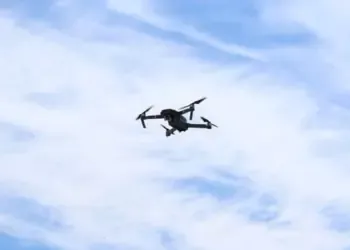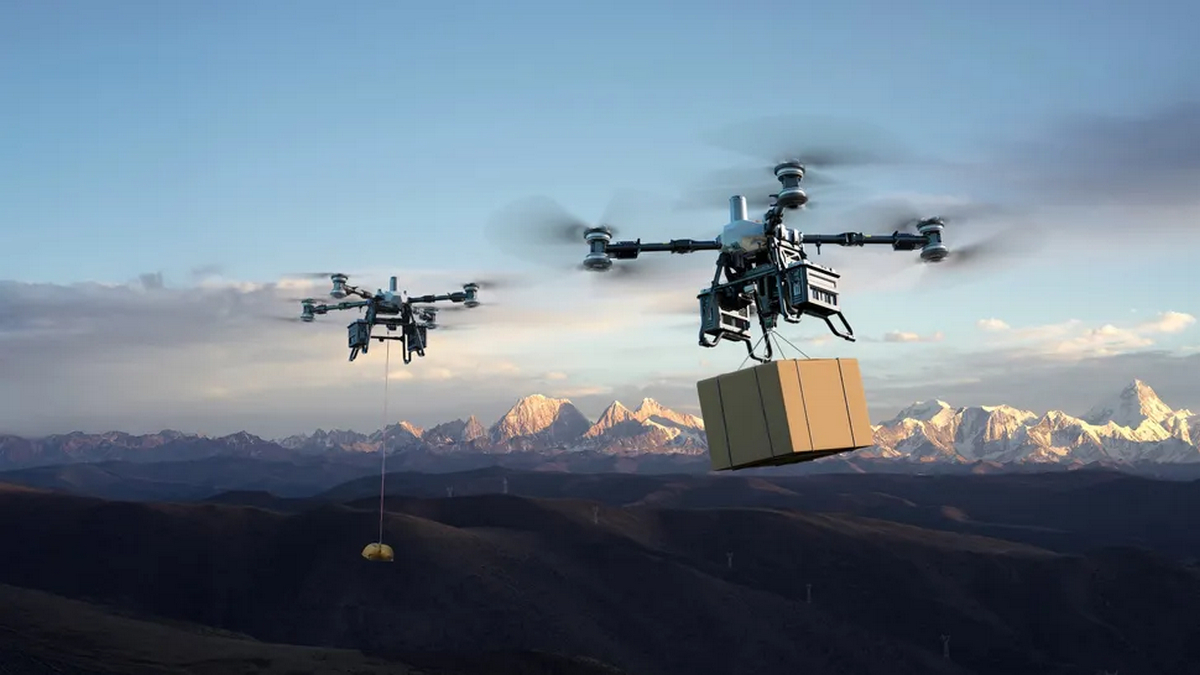
The new heavy-lift drone from DJI, the FlyCart 100, is now the most capable model in the company’s lineup. It is designed not for everyday consumer use but for transporting substantial loads in challenging environments where standard drones are insufficient.
According to DJI’s press release, the FlyCart 100 can literally deliver a package – though primarily in scenarios where the destination is not a city street but a mountaintop or other hard-to-reach location. The drone is purpose-built for carrying heavy cargo.

The new platform supports a maximum payload of up to 100 kg. Its flight capabilities vary depending on the load: it can transport approximately 65 kg over a distance of about 12 km, or 80 kg over up to 6 km. For cargo handling, the drone is equipped with a winch featuring a 30-meter cable capable of retracting at 1.2 m/s. The winch can operate in either manual or automatic mode.
To sustain these loads, the FlyCart 100 uses high-capacity batteries with hot-swap support and redundancy – if one module fails, the drone can continue operating. Fast charging is supported, and the battery modules can be heated to maintain stability in low temperatures.
According to DJI, the drone operates within a temperature range of –20 °C to +40 °C, can ascend to altitudes of up to 6,000 meters, and withstand wind gusts of up to 12 m/s. The airframe is rated at IP55 for environmental protection. It is equipped with a LiDAR-based obstacle avoidance system and a parachute for emergency descent, reducing fall speed to approximately 7 m/s.
Externally, the FlyCart 100 is far from a “lifestyle product.” Its large frame, eight rotors, and exposed technical modules give it a distinctly industrial appearance. The overall design suggests a machine built for a utilitarian, near–cyberpunk setting rather than something intended for casual use.
&pp=ygUPREpJIEZseUNhcnQgMTAw
DJI has not announced an official price. According to third-party sources, the drone is expected to cost around $12,500. A system of this type could be valuable in various field operations, including situations where conventional vehicles cannot reach or where transport must be carried out under difficult conditions. Tasks such as delivering supplies, moving medical materials, relocating equipment, or supporting logistics in remote or unstable locations illustrate scenarios in which a drone with a 100-kg payload capacity and reliable performance in low temperatures or strong winds could serve as an essential transport tool.
Read also:
- Northrop Grumman Unveils New Talon Combat Drone
- Pentagon Launches $1 Billion Program to Procure Thousands of Kamikaze Strike Drones
Source: Techradar