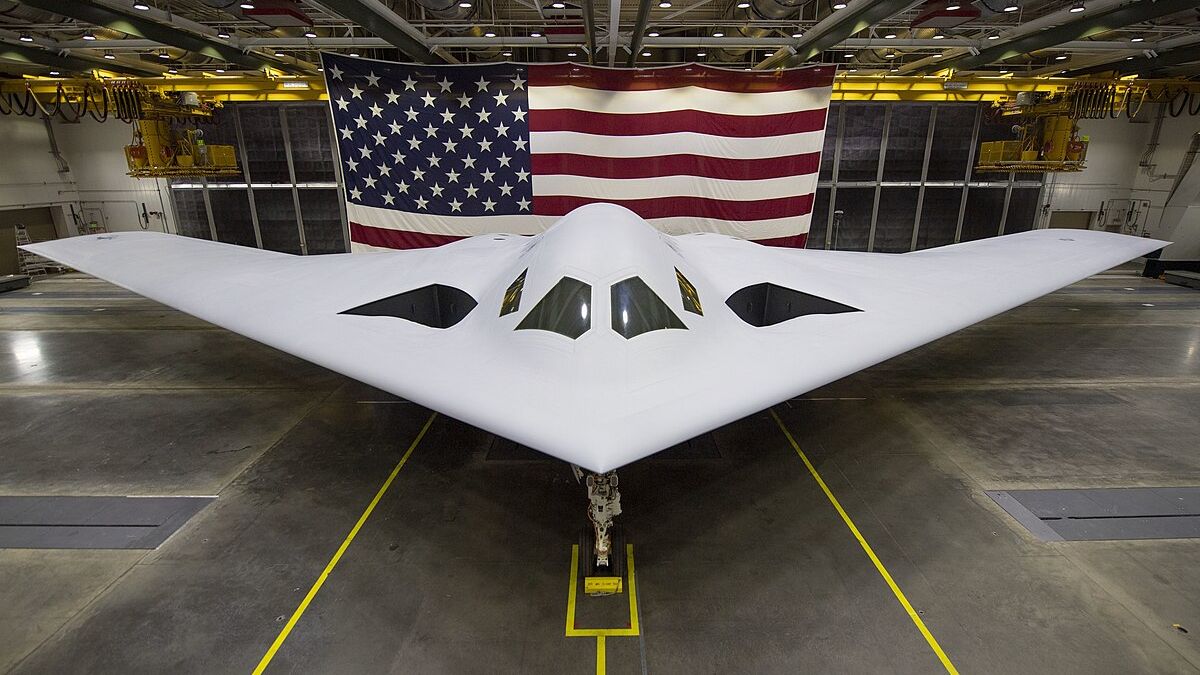
Chinese researchers report that they have developed an advanced aerospace modeling tool that could influence approaches to the design of modern combat aircraft. According to their preliminary findings, the tool identifies potential limitations in the aerodynamics and stability of configurations similar to the latest U.S. stealth bomber, the B-21 Raider.
The authors describe the PADJ-X software as a “universal” design platform that integrates multiple engineering disciplines into a single optimization workflow. This approach, they claim, significantly reduces the computational resources and time typically required to refine next-generation aircraft designs.

According to the publication, PADJ-X is based on adjoint optimization technology – an algorithmic method that allows thousands of design parameters to be adjusted simultaneously. This stands in sharp contrast to traditional approaches, which rely on repeated trial-and-error simulations, are computationally expensive, and often yield only incremental improvements.
To demonstrate the system’s capabilities, a research team led by Huang Jiangtao from the China Aerodynamics Research and Development Center applied PADJ-X to conceptual configurations resembling the U.S. Air Force’s B-21 stealth bomber, which is currently undergoing flight testing. The B-21 itself is being developed by Northrop Grumman and is intended to form the backbone of the United States’ long-range aircraft fleet for both nuclear and conventional strike missions.
Using 288 parameters in their models, the researchers report that aerodynamic optimization improved the lift-to-drag ratio by approximately 15% and significantly reduced shockwave effects. They also note that the pitching moment, which reflects longitudinal stability, was reduced from 0.07 to nearly zero. In theory, this would allow for smoother and more stable flight with less need for continuous control corrections.
A near-zero pitching moment means the aircraft can more naturally maintain level flight, which, according to the authors, could improve fuel efficiency and extend operational range. Combined with increased lift and reduced wave drag, the optimized configuration is presented as having substantial potential for long-endurance missions.
At the same time, the researchers emphasize that their conclusions are based solely on theoretical models and publicly available shape data, not on classified information about the aircraft’s actual design. The real performance characteristics of the B-21 remain highly classified and are protected by the U.S. military.
PADJ-X integrates five key disciplines – aerodynamics, propulsion, electromagnetics, infrared signature, and sonic boom – into a single computational framework. According to Huang Jiangtao, this allows engineers to balance competing requirements, such as reducing radar observability while maintaining aerodynamic efficiency and structural integrity.
Such trade-offs are fundamental to stealth aircraft design. Flat and highly integrated shapes reduce radar reflections but can increase drag, while thinner wings improve efficiency at the cost of structural stiffness. Traditional optimization methods typically address these factors in isolation, whereas PADJ-X uses a sensitivity-based approach to identify optimal solutions across all disciplines simultaneously.
In addition to analyzing B-21–like configurations, the researchers applied PADJ-X to a model resembling the U.S. Navy’s stealth drone, the X-47B – a classified program that was closed in 2015. In this simulation, the software reduced aerodynamic drag by roughly 10% and decreased frontal radar cross-section nearly tenfold, from 13.55 m² to 1.33 m².
The study also describes simulations related to hypersonic vehicle atmospheric entry, reduction of engine nozzle infrared signatures, optimization of stealth coatings for weight reduction, and shaping low-sonic-boom profiles for supersonic aircraft.
Adjoint optimization tools are not fundamentally new. NASA began developing similar systems in the 1990s, including the FUN3D platform, which was used in projects such as the X-59 low-sonic-boom demonstrator. Comparable tools have also been developed in Germany and France. However, Chinese researchers claim that most existing systems cover fewer disciplines and often require manual tuning when scaled up.
If the effectiveness of PADJ-X is confirmed, the platform could significantly accelerate aircraft development, reduce reliance on wind tunnel testing, lower prototyping costs, and help future manned and unmanned aircraft achieve greater range and improved flight performance. At the same time, whether the modeling results will translate into actual operational advantages remains uncertain, particularly when applied to highly classified foreign systems.
Read also:
- Stealth Strike Without Shot: PLA J-20 Approached Taiwan Without Being Detected by Radar
- Lockheed Martin Unveils Vectis Stealth Drone for Collaborative Combat Aircraft Program
Source: Interestingengineering