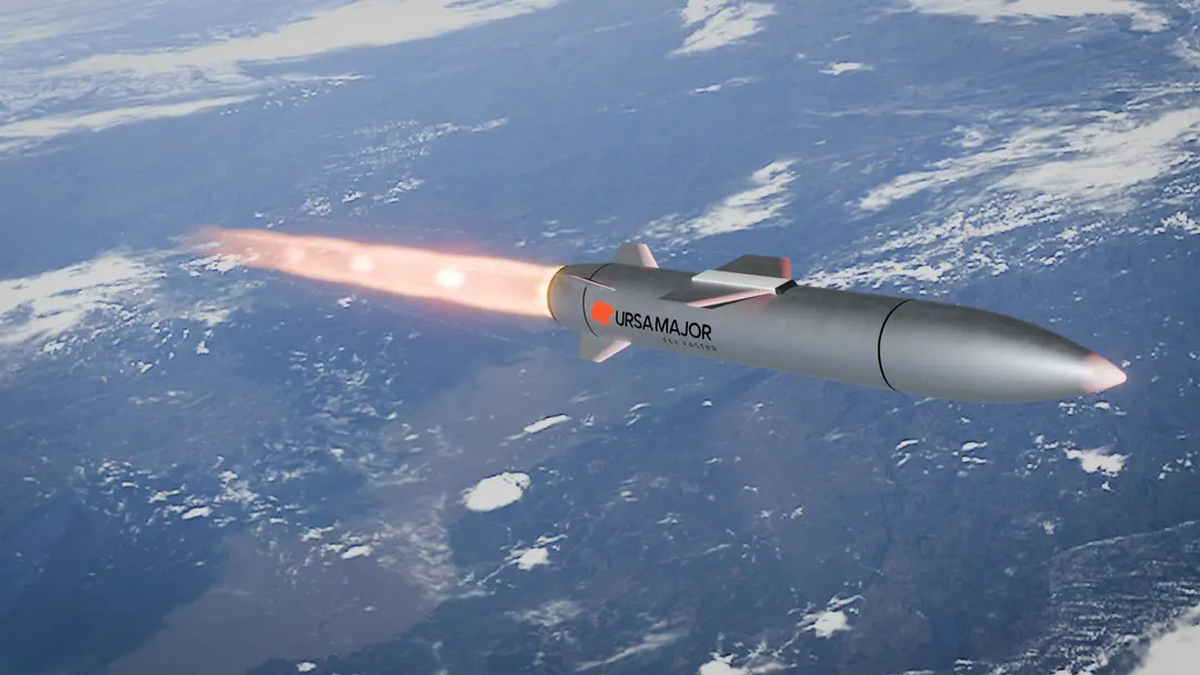
U.S.-based company Ursa Major, which specializes in hypersonic propulsion systems, introduced a new hypersonic missile system on February 24 designed with scalable production in mind. The development reflects an effort to accelerate delivery timelines and reduce the cost of high-speed weapons. The presentation took place during the Air Warfare Symposium organized by the Air and Space Forces Association, where military leaders discussed next-generation aviation technologies.
The new system is designated HAVOC. It is intended not only for operational use but also as a hypersonic target for testing and training purposes. According to the company, this dual-role concept is aimed at addressing immediate operational requirements while simultaneously strengthening the U.S. defense industrial base.

The HAVOC system is built around Ursa Major’s internally developed Draper liquid rocket engine. It operates on storable propellants and is designed for safe handling and use in operational environments. According to the manufacturer, its cost represents only a fraction of that associated with air-breathing hypersonic propulsion systems.
To reduce production costs and accelerate output, the company makes extensive use of additive manufacturing and modern industrial processes. The system was designed from the outset for rapid, large-scale production rather than limited runs of high-cost technology demonstrators. CEO Chris Spagnoletti stated that maintaining technological parity with potential adversaries requires more than producing advanced prototypes; delivery speed, affordability, and scalability are critical factors.
He described the Ursa Major HAVOC missile system as a high-performance hypersonic capability developed specifically for operational deployment at scale, providing the military with a flexible and sustainable tool. The company also noted that HAVOC was conceived to address urgent defense requirements by combining high-speed performance with serial production capability.
One of HAVOC’s distinguishing features is throttle control and in-flight restart capability across all flight phases, including boost, cruise, and terminal segments. This functionality enables more complex maneuver profiles and engagement options compared with traditional boost-glide hypersonic systems or cruise-type configurations.
The engine’s controlled operating profile has allowed designers to reduce reliance on costly thermal protection systems typically required to withstand extreme heat loads during hypersonic flight. This approach lowers overall system cost and simplifies supply chain and logistics requirements.
The missile is designed to operate both within dense atmospheric layers and beyond them. This dual endoatmospheric and exoatmospheric capability expands mission flexibility and enables engagement of targets at extended ranges that may reach hundreds of miles, depending on the selected booster configuration. HAVOC features a modular architecture that allows integration with various solid-fuel boosters, ensuring compatibility with a wide range of launch platforms.
The missile can be deployed from fighter aircraft and bombers. It is also configured for launch from ship-based vertical launch systems as well as ground-based launch complexes. Depending on the booster selected, extended-range variants can be implemented.
The company noted that the program builds on more than a decade of experience in hypersonic technologies and flight testing. Its Hadley liquid rocket engines have already operated under hypersonic flight conditions, validating their performance in real-world scenarios. Ursa Major has also partnered with the Air Force Research Laboratory under the Affordable Rapid Missile Demonstrator program, which aims to confirm the feasibility of rapidly designing and manufacturing fully operational missile systems.
Read also:
- ISS Cameras Capture Large-Scale Russian Missile Attack on Kyiv
- Successful Strikes: Ukrainian Drones Destroy Russian Buk and Uragan Systems
Source: interestingengineering