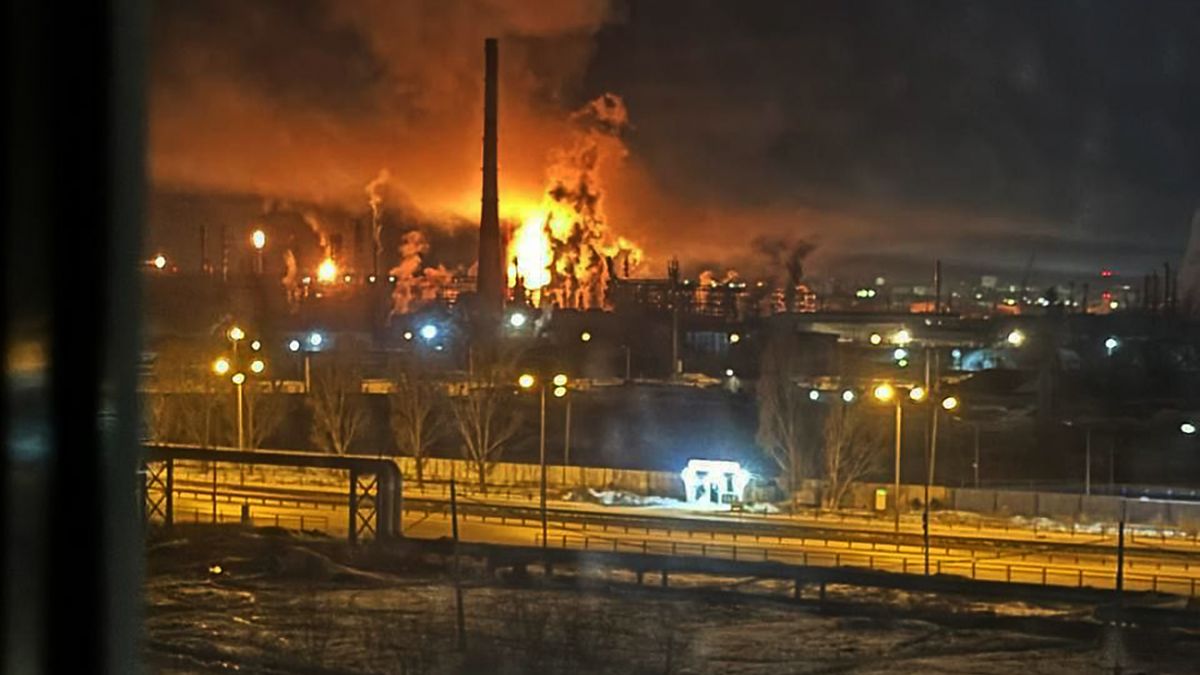
While Russia continues to strike civilian homes in Ukraine with ballistic missiles, on the night of Thursday, August 28, Russian oil refineries came under a new wave of drone attacks carried out by Ukraine’s Unmanned Systems Forces. Facilities in the Samara region and in Krasnodar Krai were hit. Samara’s governor Fedorishchev confirmed the attack, adding that temporary restrictions on departures and landings had been introduced at Samara airport.

In the region itself, mobile network outages were reported, along with the introduction of additional flight restrictions. According to several Ukrainian and Russian sources, the main target of the drones was the Novokuibyshevsk oil refinery, owned by Rosneft. This facility has already been hit multiple times: previous strikes took place on July 22 and August 2. The plant has the capacity to process up to 8.8 million tons of oil annually, but after the early August attack, it completely halted production of petroleum products.
Another attack took place the same night in Russia’s Krasnodar region, this time targeting the Afipsky oil refinery. Debris from a drone strike caused a fire on the facility’s grounds, igniting one of its processing units. The blaze covered roughly 20 square meters and was contained with the help of 21 firefighters and eight pieces of specialized equipment, according to the regional emergency response center.
This marks the second attack on the plant since the beginning of August, the first having occurred on the 7th. The Afipsky refinery has an annual processing capacity of up to 6.25 million tons of crude oil, making it one of the key refining facilities in southern Russia.
Since the beginning of August, at least ten oil refineries in Russia have come under aerial attack. Some facilities were forced to halt fuel production entirely, while others scaled back operations. According to Reuters estimates, these incidents have taken roughly 17% of Russia’s refining capacity offline – equivalent to about 1.1 million barrels of oil per day. The impact is already visible: fuel shortages have been reported in Crimea, the Kuril Islands, Primorsky Krai, and Zabaykalsky Krai. On commodity exchanges, gasoline prices have surged by 40–50% since the start of the year, reaching record levels in August – 72,600 rubles per ton for Regular-92 and 82,200 rubles per ton for Premium-95.
Andriy Kovalenko, head of Ukraine’s Center for Countering Disinformation under the National Security and Defense Council, confirmed the fires at the Afipsky and Novokuibyshevsk refineries. He emphasized that these facilities play a critical role in sustaining Russia’s wartime economy. According to him, while Russia continues to launch missiles and drones against civilian targets such as residential buildings and kindergartens, strategic infrastructure inside Russia – including key oil refineries – is being hit by fire.
Source: USF