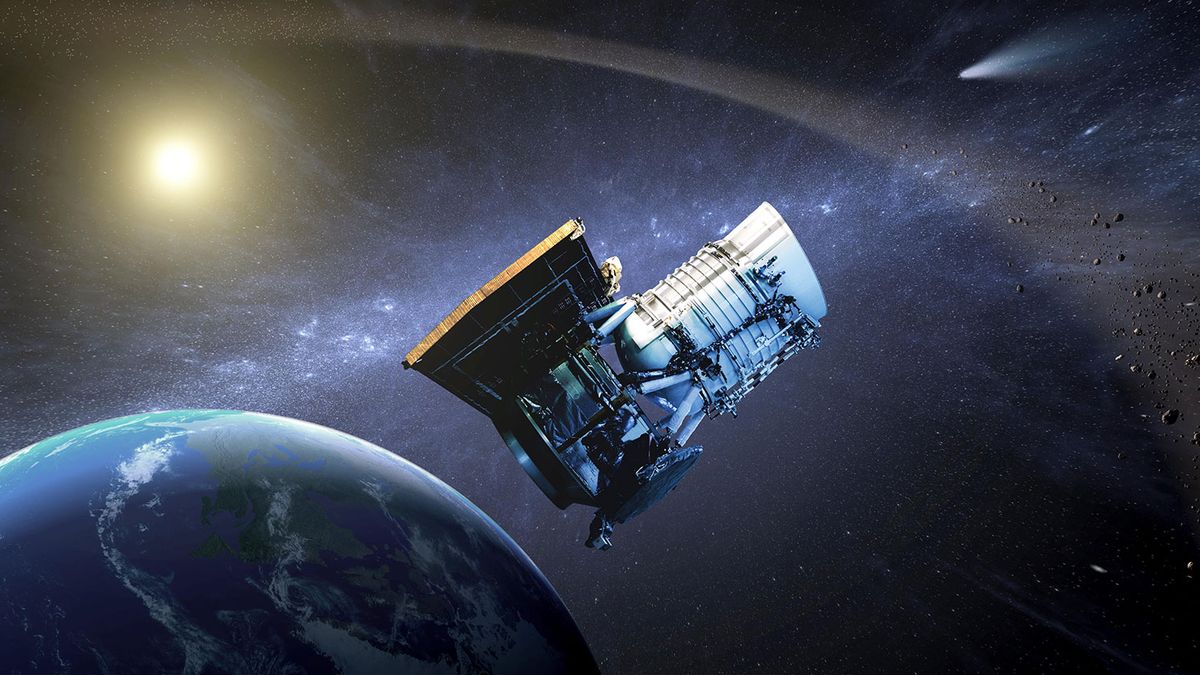
The NASA NEOWISE (Near-Earth Object Wide-field Infrared Survey Explorer) infrared space telescope has transmitted its final data to Earth. Following this, the project engineers sent a final command to shut down its transmitter, marking the end of the more than 10-year mission dedicated to detecting asteroids and comets, including those that could potentially threaten Earth.
The final command was sent from the Orbital Mission Control Center at NASA‘s Jet Propulsion Laboratory. NASA’s satellite tracking and data transmission system sent the signal to NEOWISE, which allowed the spacecraft to be decommissioned.

As previously reported by the agency, the scientific research phase of the telescope concluded on July 31. All remaining scientific data was gradually transmitted from the spacecraft via its communication channel.
“NEOWISE has been an extraordinary success story, as it has helped us better understand our place in the universe by tracking asteroids and comets that could potentially be hazardous to us here on Earth,” said Nicola Fox, Assistant Administrator of NASA’s Science Mission Directorate. “While we are sad to see this mission come to an end, we are excited about the future scientific discoveries it has enabled, laying the groundwork for the next-generation planetary defense telescope.”
NASA has concluded the mission because NEOWISE is expected to descend too low on its orbit soon, making it unable to provide useful scientific data. Increasing solar activity is heating the upper layers of the atmosphere, causing it to expand and create drag on the spacecraft. NEOWISE, now decommissioned, is anticipated to re-enter the atmosphere and burn up by the end of 2024..
During its operational lifetime, the infrared survey telescope achieved the scientific objectives of not just one, but two missions. Initially, it was part of the WISE (Wide-field Infrared Survey Explorer) mission, which launched in December 2009 and scanned the sky in infrared over seven months. After a few months, the spacecraft’s coolant, which maintained the heat produced by the spacecraft, was depleted. NASA extended the mission under the name NEOWISE until February 2011 to complete the survey of main-belt asteroids, after which the spacecraft entered hibernation mode.
The lack of coolant meant that the space telescope could no longer observe the faintest infrared objects in the universe. However, it could still study asteroids and comets, which emit a strong infrared signal due to solar heating as they pass near Earth. Therefore, NASA reactivated the telescope in 2013 and continued asteroid and comet research under the NEOWISE program, focusing on planetary defense.
“NEOWISE played a crucial role in our efforts to map the sky and understand the near-Earth environment. The vast number of discoveries has expanded our knowledge of asteroids and comets and contributed to strengthening our planetary defense,” said Lori Leshin, Director of NASA’s Jet Propulsion Laboratory. “As we say goodbye to NEOWISE, we also recognize the team behind its creation for their remarkable achievements.”
While observing the sky from low Earth orbit, NEOWISE mapped the entire sky, capturing 1.45 million infrared measurements of over 44,000 Solar System objects. Of more than 3,000 near-Earth objects discovered, NEOWISE was the first to spot 215. The mission also identified 25 new comets, including the famous comet C/2020 F3 NEOWISE, which graced the sky in the summer of 2020.
In addition to leaving behind a treasure trove of scientific data, the spacecraft also contributed to the development of NASA‘s first infrared space telescope designed specifically for detecting near-Earth objects: the NEO Surveyor.
“The NEOWISE mission provided a unique, long-term set of infrared sky data that will be used by scientists for decades to come,” says the project team. “But its additional legacy lies in helping lay the groundwork for NASA’s next infrared space telescope dedicated to planetary defense.”
NEO Surveyor will search for some of the most challenging near-Earth objects, such as dark asteroids and comets that do not reflect much visible light, as well as objects approaching Earth from the direction of the Sun. It will enhance the capabilities of the international planetary defense community, and construction of the telescope has already begun. It is expected to launch no earlier than 2027.
Source: phys