• • CONTACTS
  • • PRIVACY POLICY
  • • GADGETS & TECHNOLOGIES
AERONAUT.media
  • NEWS:
  • • Aviation
  • • UAVs & drones
  • • Flying weapon
  • • Space
  • ARTICLES
  • Language:
  • EN
  • UA
No Result
View All Result
  • NEWS:
  • • Aviation
  • • UAVs & drones
  • • Flying weapon
  • • Space
  • ARTICLES
  • Language:
  • EN
  • UA
No Result
View All Result
AERONAUT.media
No Result
View All Result
Home News Space news

NASA Cassini Delivers New Data on Saturn’s Moon Titan’s Seas

Julia Alexandrova by Julia Alexandrova
23/07/2024
in Space news
0
NASA Cassini
1
SHARES
17
VIEWS

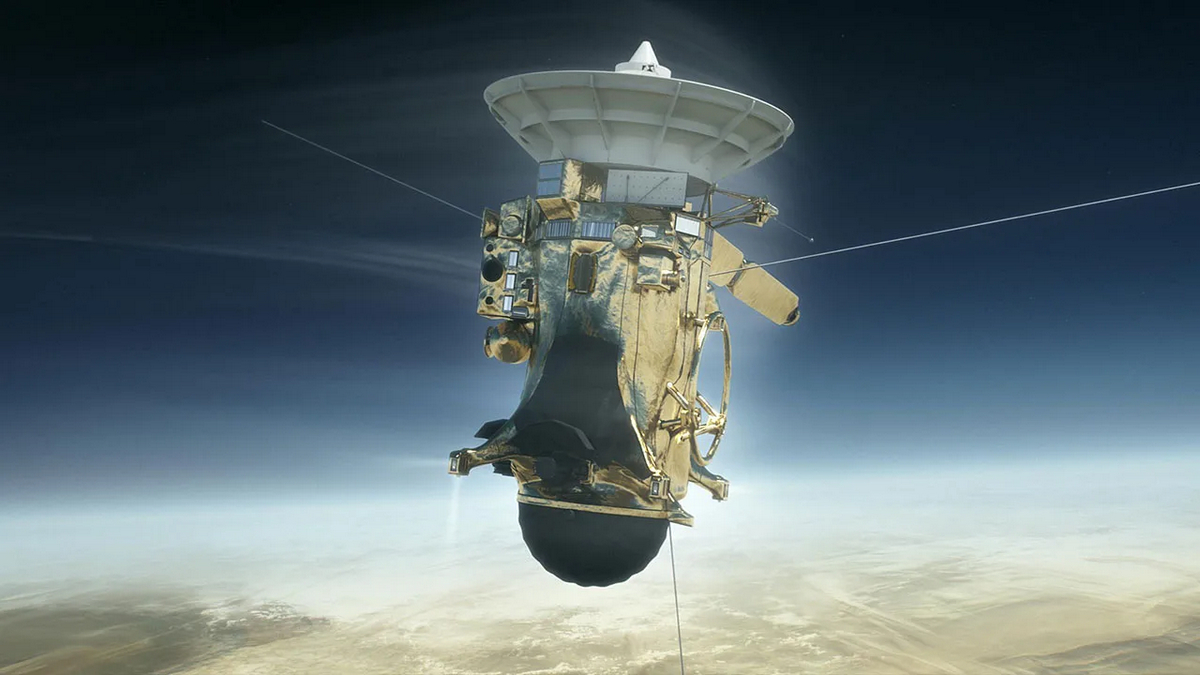
NASA’s Cassini spacecraft dramatically concluded its 20-year mission exploring the Saturn system seven years ago when it plunged into the gas giant, but it continues to provide valuable scientific insights.

Using radar data from Cassini, astronomers at Cornell University have gathered new information about Titan, Saturn’s largest moon, which hosts a liquid ocean composed of hydrocarbons – a class of organic chemicals made up of carbon and hydrogen. This includes substances such as methane and ethane.

NASA Cassini

The team was able to analyze the composition and “roughness” of Titan’s northern polar sea. Researchers discovered calm methane seas with gentle tidal currents. This finding not only reveals what previous Titan sea studies failed to uncover but also lays the groundwork for future investigations into oceanic moons within our solar system. The Cassini data used for these new discoveries were collected using “ballistic radar,” where the spacecraft directed a radio beam towards Titan, which then reflected back to Earth.

NASA Cassini
NASA’s Cassini spacecraft exploring Titan, with its mother planet Saturn in the background.

As a result, the polarization of the reflection from Titan’s surface allowed the team to view it from two different perspectives. The standard radar, which detected the signal reflected back to Cassini, provided only a single viewpoint.

“The main difference is that bistatic information provides a more complete data set and is sensitive to both the composition of the reflecting surface and its roughness,” said Valerio Poggioli, a team member and researcher at Cornell’s Center for Astrophysics and Planetary Science (CCAPS).

Cassini was launched on October 15, 1997, and spent seven years traveling to the Saturn system. In 2017, NASA deliberately crashed Cassini into Saturn to prevent the spacecraft from eventually colliding with one of the 146 known moons of the gas giant.

NASA Cassini
Diagram showing the internal structure of Saturn’s moon, including its deep ocean.

The ballistic radar data used by Poggiagli and his colleagues were collected by Cassini during four flybys of Saturn on May 17, June 18, and October 24, 2014, and again on November 14, 2016. For each of these radar datasets, surface reflections were observed as Cassini approached Titan and again as it moved away from the moon.

The researchers examined observations of three of Titan’s polar seas: Kraken, Ligeia, and Punga. They found that the composition of the surface layers of the hydrocarbon seas varies with location and latitude. Specifically, the material on the surface of the southernmost part of Kraken Sea reflected radar signals most effectively.

All three of Titan’s seas appeared calm when Cassini observed them: the spacecraft detected waves about 3.3 mm high. Where the hydrocarbon seas met the shorelines, wave heights increased to 5.2 mm, indicating the presence of weak tidal currents.

“We also see signs that the rivers feeding the seas are pure methane until they enter the open liquid seas, which are richer in ethane,” added Podgiali. “It’s similar to how freshwater rivers on Earth flow into the salty waters of the oceans and mix with them.”

NASA Cassini
Titan, the largest moon of Saturn, as seen by NASA’s Cassini spacecraft.

The team stated that this finding aligns with Saturn’s moon Titan’s meteorological models, which predicted that rainfall on Titan is predominantly methane, with small amounts of ethane and other hydrocarbons.

Podgiagli added that the team continues to work with data collected by Cassini over 13 years of studying Titan. “There is a vast amount of data still awaiting full analysis, which is expected to lead to new discoveries,” he concluded. “This is just the first step.”

Source: Space
Tags: NASANews
ShareTweetShareShareShareSharePin
Previous Post

NASA’s X-ray Telescope “Weighs” the Nearest Dead Star to Earth

Next Post

MBDA Plans AI Integration for SPEAR Cruise Missiles

Julia Alexandrova

Julia Alexandrova

Coffee lover. Photographer. I am writing about science and space. I think it's too early for us to meet aliens. I follow the development of robotics, just in case ...

RelatedPosts

NASA Skyfall
Space news

Project Skyfall: NASA’s New Martian Drones Surpass Mach 1

12/05/2026
178
Sweden military spy satellite
Space news

Falcon 9 placed Sweden’s first reconnaissance satellite into orbit ahead of schedule

04/05/2026
212
Space Reactor-1 (SR-1) Freedom
Space news

60 Years of Setbacks and $20 Billion: NASA Is Developing a Nuclear Propulsion System for a Mission to Mars

24/04/2026
270
Voyager 1
Space news

NASA Shuts Down Scientific Instruments on Voyager 1 to Preserve the Mission: What Will Happen to the Spacecraft?

21/04/2026
373
Blue Origin
Space news

New Glenn demonstrated reusability but did not accomplish its primary objective

21/04/2026
101
SpaceX Starship V3
Space news

SpaceX Prepares Its Most Powerful Starship: New Version Passes Key Test

16/04/2026
706
Next Post
MBDA SPEAR

MBDA Plans AI Integration for SPEAR Cruise Missiles

Leave a Reply Cancel reply

Your email address will not be published. Required fields are marked *

Subscribe

  • Bluesky
  • Facebook
  • Mastodon
  • RSS
  • Twitter

Recent Comments

  • Haley Knudsen on Month of Silence and Uncertainty: European Space Agency Reestablishes Contact with Proba-3 Spacecraft
  • JoeRonamo on Tomahawk Cruise Missiles – What You Need to Know
  • Richard on Light Fighters: Useful Option or an Unnecessary Substitute?
  • asansör perdesi on Everything About the Bell AH-1Z Viper and UH-1Y Venom Helicopters: History, Specifications, and Prospects in Ukraine
  • Vladyslav Surkov on A-10 Thunderbolt II Attack Aircraft Escort Nuclear Submarine Wyoming During Drills

Recent Posts

  • Ukrainian FPV drone operators demonstrated their skills during NATO training exercises in Sweden
  • Weapons of Ukraine’s Victory: The Hornet UAV, Also Known as “Martian-2”
  • UK tests of the SkyLance drone designed to counter GPS jamming systems
  • Project Skyfall: NASA’s New Martian Drones Surpass Mach 1
  • New Group of Ukrainian Students Completes Flight Training Program in United Kingdom

Help this site

SWITCH LANGUAGE:

  • EN
  • UA
  • • CONTACTS
  • • PRIVACY POLICY
  • • GADGETS & TECHNOLOGIES

© 2024-2025 AERONAUT.media

No Result
View All Result
  • NEWS:
  • • Aviation
  • • UAVs & drones
  • • Flying weapon
  • • Space
  • ARTICLES
  • Language:
  • EN
  • UA

© 2024-2025 AERONAUT.media