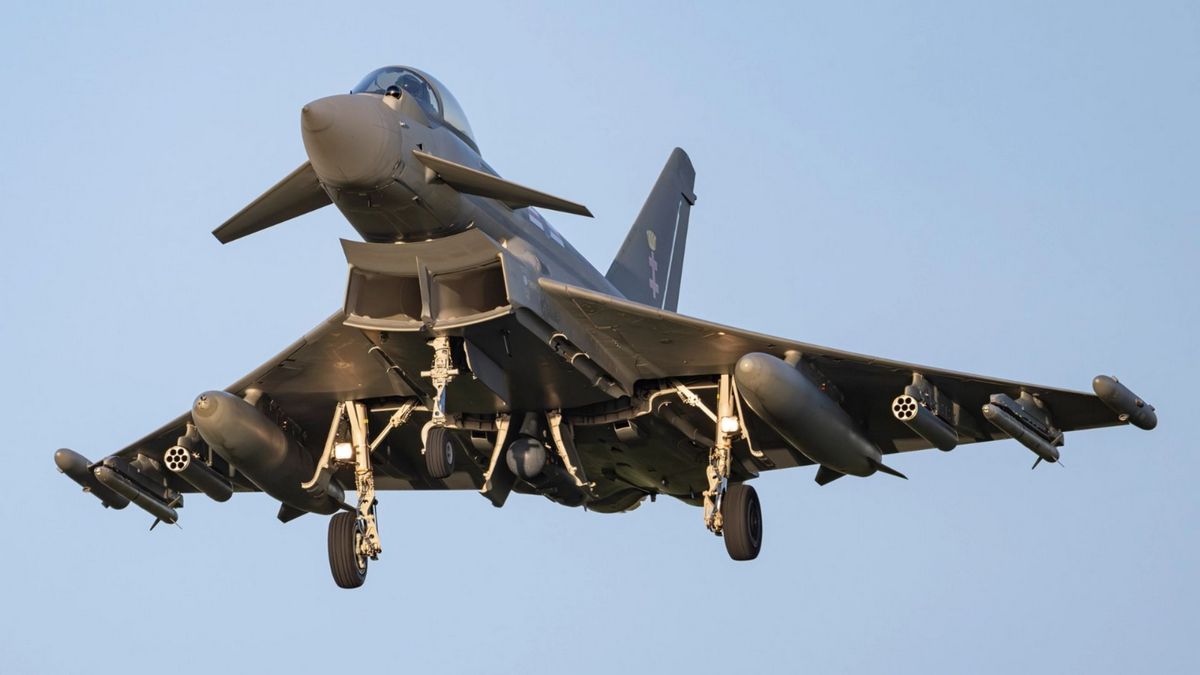
On April 8, BAE Systems reported successful testing of a low-cost precision-guided munition deployed from a Eurofighter Typhoon fighter aircraft. The trial took place in the United Kingdom with the participation of the Royal Air Force and reflects a growing focus on cost-effective countermeasures against unmanned aerial systems.

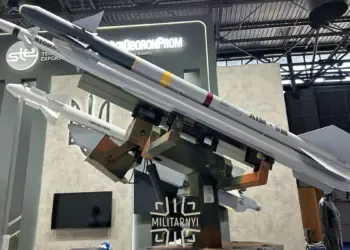
The trial was conducted at BAE Systems’ flight test facility in Warton, Lancashire. A Typhoon aircraft configured for test and evaluation launched the munition and successfully engaged a ground target at a UK military range. The system used in the trial was the Advanced Precision Kill Weapon System (APKWS). Rather than being a standalone missile, APKWS is an upgrade kit that converts unguided Hydra 70 rockets into precision-guided munitions.
Richard Hamilton, Head of Aviation Operations at BAE Systems, stated that testing the APKWS laser guidance system on the Typhoon demonstrates a new operational capability while also offering a cost-efficient solution that complements the aircraft’s existing weapons suite. The company noted that these tests are part of a broader program aimed at expanding the Typhoon’s combat functions while maintaining control over operational costs.
The APKWS system functions by inserting a guidance module between the motor and warhead of a standard 2.75-inch (70 mm) Hydra rocket. The module includes small aerodynamic surfaces and laser sensors. Once launched, the system acquires a laser-designated target and adjusts the rocket’s flight path accordingly. This effectively converts an unguided rocket into a precision munition capable of engaging both ground and aerial targets.
The APKWS system has been in service since 2012 and is currently deployed on F-16 and A-10 aircraft, as well as on various helicopter platforms. Its operational effectiveness has been demonstrated in combat conditions, establishing it as a versatile tool for a range of mission profiles. A notable characteristic of APKWS is its cost. Each unit is priced at under $40,000, which is significantly lower than traditional air-to-air missiles, whose costs can reach hundreds of thousands or even millions of dollars.
This cost profile makes the system particularly suitable for engaging unmanned aerial vehicles, including low-cost platforms such as the Iranian Shahed series. The use of expensive missiles against inexpensive drones has become a logistical and financial concern in recent conflicts, driving the adoption of more economical solutions. Recent operational examples support this trend. Reports indicate that F-16 aircraft have employed APKWS to intercept drones in the Red Sea region, and last year the Pentagon awarded contracts totaling $322 million for the procurement of thousands of these guided rockets.
The new Typhoon trials build on previous tests conducted in the United States with the F-15E Strike Eagle and further demonstrate the system’s adaptability for integration across different aerial platforms. BAE Systems indicated that the data collected during testing will inform the continued integration of cost-effective precision munitions on the Typhoon, particularly for missions involving unmanned aerial vehicle countermeasures, where cost efficiency is a key consideration. The trials also create the potential for subsequent testing against aerial targets, which could further extend the aircraft’s capabilities in air-to-air engagements.
Concurrently, the United Kingdom is evaluating additional counter-drone solutions. Royal Navy Wildcat helicopters are equipped with Lightweight Multirole Missiles, known as Martlet, and are deployed at RAF Akrotiri in Cyprus to address unmanned aerial threats.
Read also:
- Secret U.S. Stealth Drone Spotted Over Greece: What Is Known About the Mission
- Everything About Ukrainian Interceptor Drone JEDI Shahed Hunter
Source: interestingengineering