The China Manned Space Engineering Office (CMSEO) has announced a delay in the planned return of the Shenzhou-20 crewed spacecraft due to a possible collision with space debris.
“The Shenzhou-20 spacecraft with crew may have been struck by a small piece of space debris. An impact analysis and risk assessment are currently underway,” the CMSEO statement said. “To ensure the safety and well-being of the astronauts, as well as the overall success of the mission, a decision has been made to postpone the return of Shenzhou-20, which was originally scheduled for November 5.”

The agency did not specify which part of the spacecraft may have been struck, what damage might have occurred, or what data indicate a possible collision. A new return date for the crew has not yet been determined.
The Shenzhou-20 crewed spacecraft was launched on April 24, carrying three astronauts – mission commander Chen Dong, along with Chen Zhongrui and Wang Jie – to China’s Tiangong orbital station. The spacecraft docked with the radial port of the station’s core module, Tianhe. After six months in orbit, the crew completed their mission and officially handed over control of the station to the incoming Shenzhou-21 team on November 4.
Collisions with space debris are an increasingly serious concern for objects in low Earth orbit. Both the International Space Station (ISS) and China’s Tiangong station have repeatedly had to perform avoidance maneuvers to prevent potential impacts. Some debris fragments are too small to be tracked from Earth, yet at orbital speeds of around 8 km/s, even a microscopic particle can cause significant damage – including compromising thermal protection or systems essential for a safe atmospheric reentry.
The inspection of the Shenzhou-20 spacecraft is likely to involve telemetry analysis, pressure integrity tests, verification of navigation and propulsion systems, and evaluation of accelerometer and acoustic sensor data to identify possible damage. The main concern centers on potential harm to the thermal shielding or the structures responsible for parachute deployment, both of which are critical for a safe return to Earth.
The Tiangong station is equipped with a 10-meter robotic arm and a smaller, more precise manipulator. These tools can be used to inspect the spacecraft and capture images of the suspected impact site. If necessary, the crew may conduct a spacewalk to directly assess the situation. The astronauts have previously installed additional debris protection panels, and similar equipment and procedures could be used to inspect Shenzhou-20.
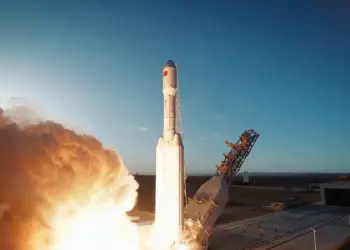
CMSEO has previously stated that in the event of serious damage, the Shenzhou-20 crew could return to Earth aboard the Shenzhou-21 capsule. China also maintains a standby spacecraft of the same series and a Long March 2F launch vehicle, which can be prepared for launch in under nine days. The Jiuquan launch site has two preparation zones – the eastern area for the primary rocket and spacecraft assembly, and the western area for the backup unit – allowing a rapid integration of an emergency mission into the launch schedule if needed.
The delay of the Shenzhou-20 return marks the first instance in the history of China’s crewed space program linked to a potential collision with space debris. The previous mission was postponed by only one day, and that delay was caused by unfavorable weather conditions at the landing site.
Read also:
- Micro-Spy Technologies: China Tests Insect-Sized Drones
- China Unveils the World’s First Electronic Warfare System Capable of Jamming F-35 Radar
Source: spacenews